 Guide On Map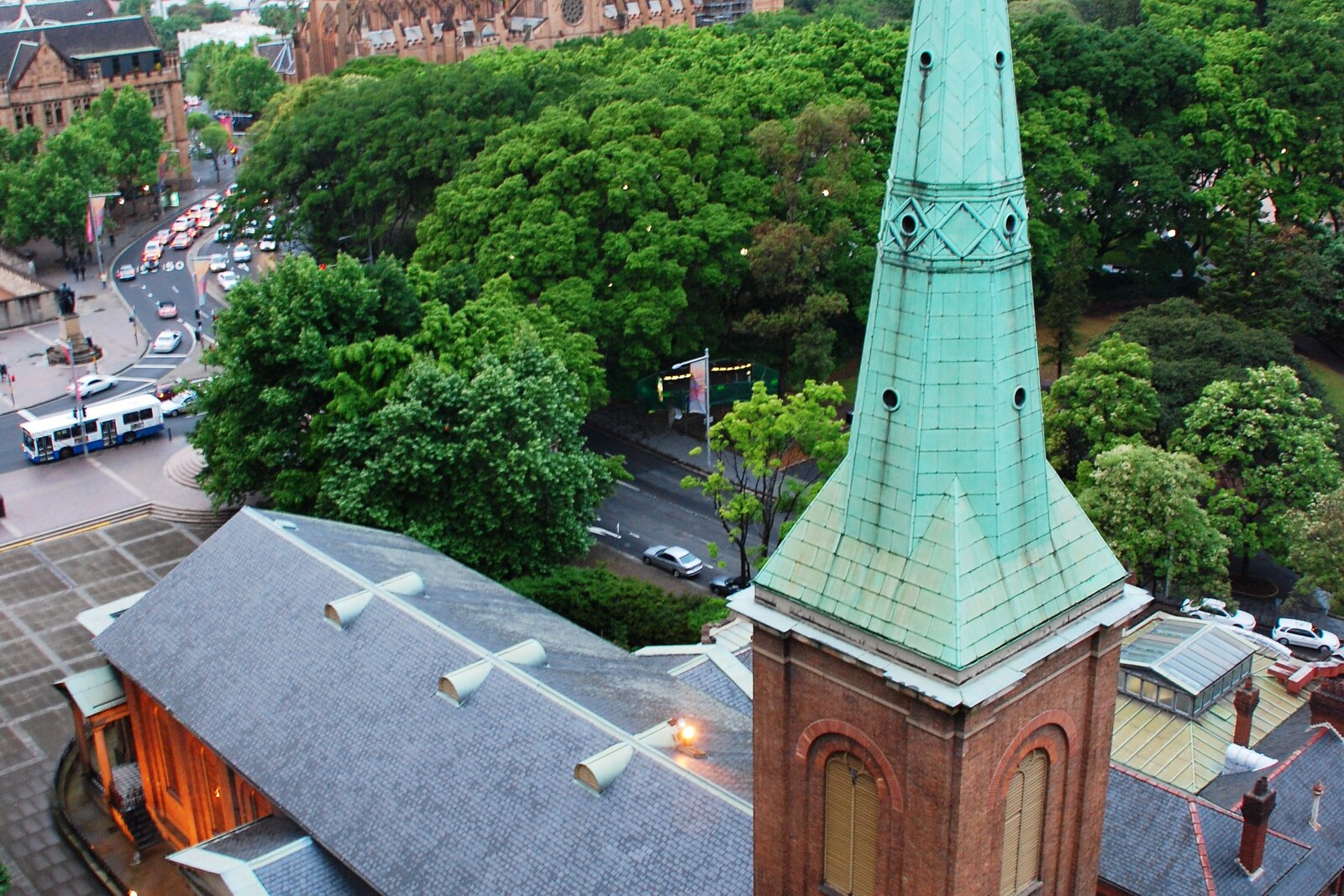
Look around first
What to notice
- Eastern pediment
- Stone plaque with Macquarie's name
- Mosaic floor
- Stained-glass windows
The story of the place
St James' Church is an active Anglican church here, a city parish with a choir and organ concerts. The eastern pediment is marked by a stone commemorative plaque, and the same pilgrimage signs appear in the mosaic, the stained-glass windows, and on the ends of the pews. Later tradition associated James, son of Zebedee with a shell, a staff, and a travel bag; the church is named after the apostle. Anglican services have been held here since eighteen twenty-four.
On October seventh, eighteen nineteen, Governor Lachlan Macquarie laid the foundation stone here for a large courthouse. Beside him stood the royal commissioner John Bigge, sent from London to examine the governor's spending and restore to the colony the harsh order of a place of punishment. That day, Bigge approved the design. Francis Greenway, the government architect, was already preparing a rectangular brick building for the court, while gangs of convicts began construction.
At the same time, Macquarie was building the large St Andrew's Cathedral on George Street. The commissioner thought it would require too much money and five years of work. By February eighteen twenty, Bigge had changed his mind: the cathedral should be abandoned, and the court already under construction turned into a more modest church. For Macquarie, this was an instruction from a man whose report would determine his official reputation and promised pension. The governor agreed.
Greenway had to redesign his own project. His post brought him three shillings a day, housing for his family, a horse, and feed for it; a dispute with the commissioner could have deprived the architect of all this. A month later, Macquarie laid the foundation stone for another building nearby—the Georgian School for children left without care. Bigge intervened again and demanded that the courthouse be placed there instead. Greenway objected, in a contemporary's words, as firmly as caution allowed. As a result, the two projects exchanged their purposes: the courthouse became a church, and the school became a courthouse.
This rearrangement outlived all three men. Macquarie left Sydney at the end of eighteen twenty-one, and later defended his name in Britain against accusations in Bigge's reports. After Macquarie's departure, Greenway lost his patron. The new governor dismissed the architect in November eighteen twenty-two after a dispute over fees; Greenway never regained his former position. Construction of the neighboring courthouse dragged on until eighteen twenty-eight.
People gathered in the unfinished church much earlier. In January eighteen twenty-two, the clergyman William Cowper sheltered here from bad weather parishioners who had come from the Hyde Park Barracks. The chief chaplain Samuel Marsden forbade the service to be repeated until the legal formalities had been completed. In February eighteen twenty-four, Marsden consecrated the building, and Anglican services have been held here ever since. Today, the church is served by a city parish, a choir sings here, and organ concerts are held.
The name refers to the apostle James, son of Zebedee: the English name James corresponds to the Russian biblical name Iakov. The Galilean fisherman left his trade and became one of the twelve disciples of Jesus in order to preach his teaching. Herod Agrippa, the king of Jerusalem who persecuted the first Christians, ordered James to be executed by the sword. Later pilgrimage tradition gave the saint a shell, a staff, and a travel bag—these signs are repeated inside Sydney's church on the mosaic floor, in the stained-glass windows, and on the ends of the pews.
On the eastern pediment, a stone plaque survives with words saying that St James' Church was erected by Governor Macquarie in eighteen twenty. John Bigge is not named on it. A few steps from the plaque stands the old wing of the Supreme Court—the very school project that the commissioner ordered to be handed over to the judges.
Useful on site
This is an active church. If the doors are open, enter quietly; during a service or ceremony, limit yourself to viewing it from outside.