 Guide On Map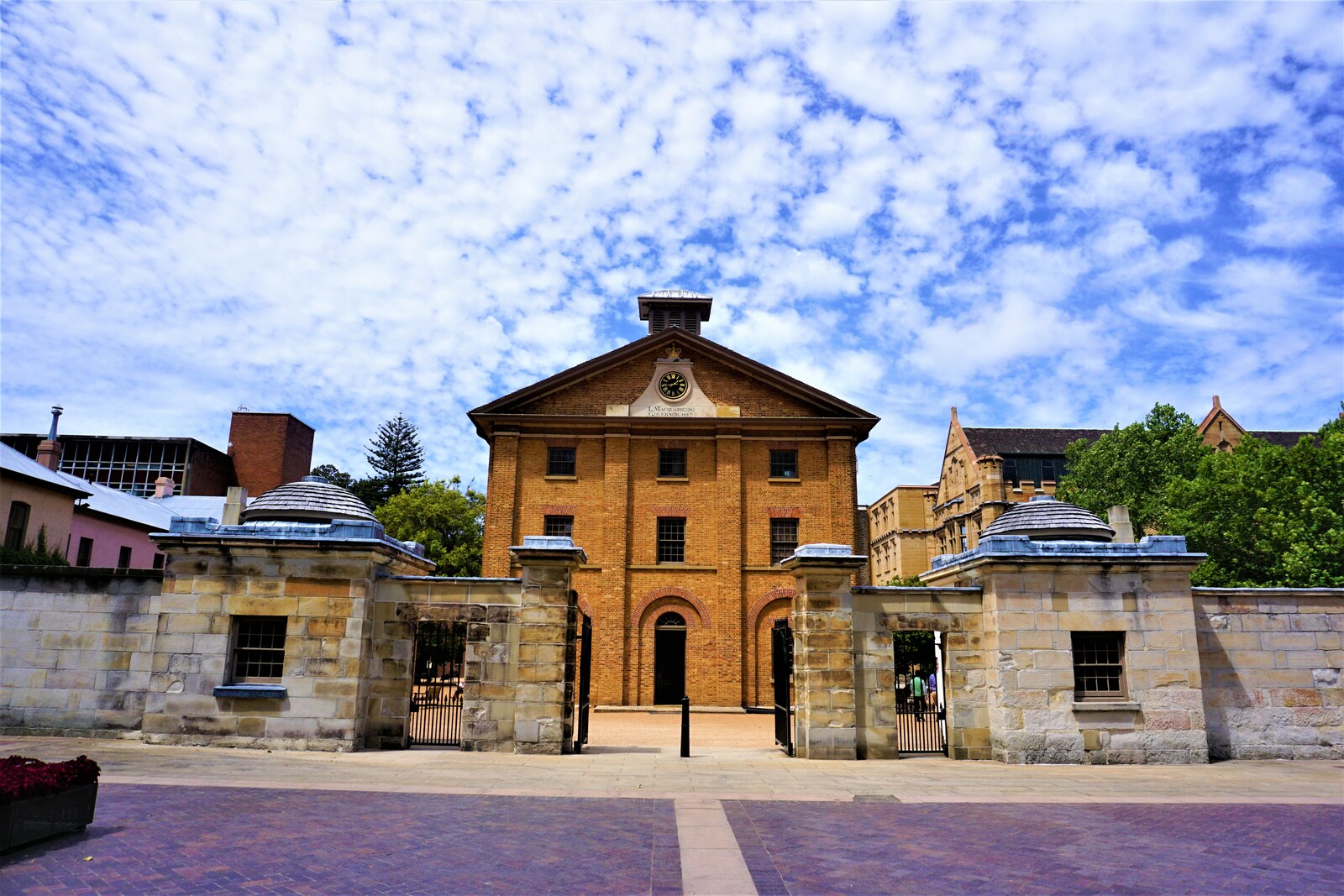
Look around first
What to notice
- Main brick building
- Rows of hammocks
- Facade clock
- Inscription with Macquarie's name and date
The story of the place
The three-story brick building in the middle of the yard was built for men whom the colony sent to public works. Here they were given a shared dormitory with about six hundred places, surrounded by walls, with guards at the gates and cells in corner pavilions. In the mornings, work teams gathered in the yard, and by evening the residents were counted, searched, and locked up for the night in hammocks. Now, all that remains of this enclosed world is the museum building with its facade clock; the name of the neighboring park recalls the London model.
The man who drew up these barracks for exiles arrived in Sydney under sentence himself. Francis Greenway was an architect from Bristol. In eighteen twelve, he was found guilty of forging a document and sentenced to death; the execution was commuted to fourteen years of exile. In Sydney, Greenway immediately opened an architectural office. Supporting his family and his own freedom now depended on his profession.
Lachlan Macquarie, the governor of New South Wales, needed someone capable of designing public buildings. In eighteen sixteen, he appointed Greenway civil architect. The salary was three shillings a day; it came with housing for his family, a horse, and feed for it. For a well-executed lighthouse, Greenway received conditional release: he could work and manage his own life within the colony, but could not yet leave it.
Macquarie needed the barracks because of the way convict labor was organized in Sydney. Men assigned to public works had previously found their own lodging and paid for it with money earned after their compulsory shift. In the evenings, they dispersed throughout the city. The governor linked this freedom to nighttime thefts and decided to gather the workers in a single guarded complex.
Greenway placed a three-story dormitory for about six hundred people at the center. High walls ran around it; guardrooms stood by the gates, and pavilions with cells stood at the corners. A clock mechanism installed on the facade struck the time. Convict work crews built all of it.
On June fourth, eighteen nineteen, five hundred eighty-nine men were seated in the new dining halls. For the opening, they were served beef, plum pudding, and punch. Then the usual routine began. In the morning, a bell gathered the work teams in the yard. In the evening, the men were searched at the gates, counted, and locked up; they slept in rows of hammocks. Permission to spend the night outside the barracks became a reward for good behavior. Later, Macquarie reported that the number of nighttime robberies had decreased noticeably.
That same day, the governor personally gave Greenway a full pardon. Hundreds of men lay here under lock and key for the first time after their celebratory dinner, while the architect walked out with a document allowing him to leave the colony.
Today, the main brick building, converted into a museum, remains in the center of the yard; rows of hammocks are once again strung inside. The high walls and corner guard pavilions of the former complex have disappeared. Above Australia's oldest surviving public clock, Macquarie's name and the year eighteen seventeen—the year construction began—are still inscribed. Hyde Park in the name is the neighboring park, which the same governor named after the London model.
Useful on site
The story works best at the facade and gates. The interior spaces and museum displays require a separate visit; inside, do not disturb tours.