 Guide On Map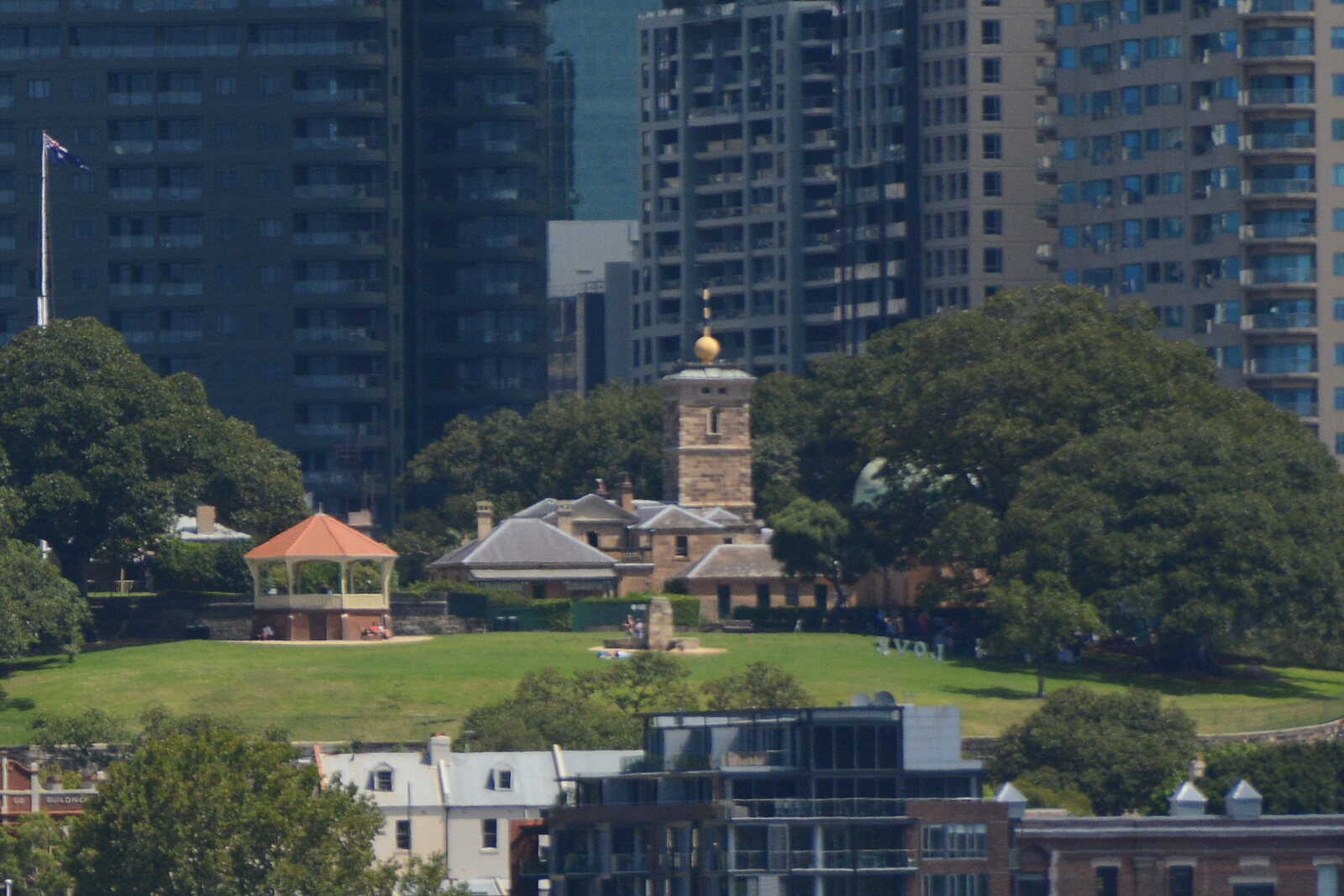
Look around first
What to notice
- Yellow-and-black time ball
- Observatory tower
- Harbor panorama
The story of the place
The high hill above Sydney Harbour first served for flag communication with ships: from here, colonists sent messages to the harbor, and the name Flagstaff Hill outlasted that service. Later, Sydney Observatory rose on the summit, with a tower, observing rooms, and telescopes; from this height, the harbor is visible—the harbor for which astronomers' work was needed here. Sailors setting out on long voyages had to check their chronometers against exact local time: where a ship would be on the map depended on the clock.
A yellow-and-black cast-iron ball hangs at the top of the tower. Sydney Observatory was built here for its sake.
By the middle of the nineteenth century, more ships in the harbor were setting out on long voyages. Before departure, captains checked their marine chronometers: from the difference between the exact time at the prime meridian and local noon, the navigator determined longitude. An error in the clock became an error in the ship's position on the map.
At first, colonial officials planned to install only a tower with a ball. At the appointed second, it was to fall, and sailors were to watch it from the harbor. Then a simple fact became clear: exact time could not be signaled until an astronomer had determined it from the Sun and stars. So the tower needed observing rooms, telescopes, and a person responsible for the entire service.
That person was William Scott, the first Government Astronomer of New South Wales. In Cambridge, the mathematician and Anglican clergyman supported his family through private lessons. In eighteen fifty-six, he left an established practice and moved with his family to Sydney for a salaried post. Here Scott oversaw the observatory's construction and put the colony's neglected astronomical observations in order.
June fifth, eighteen fifty-eight, was set as the first day of service. The ball was dropped exactly at noon. But this time proved inconvenient for Scott for a very physical reason. At noon, he was at the transit telescope, watching for the moment when the Sun crossed the local meridian—an imaginary north-to-south line. This observation was what made it possible to check the clock. He could not climb the tower and release the ball at the same time.
A few months later, Scott moved the signal to one o'clock in the afternoon. Now, after the noon observation, he had time to check the clock and climb to the mechanism. Ships could see the ball fall, and a cannon shot from Dawes Point carried the same moment to those whose view of the tower was blocked by buildings or rigging.
The height was chosen because of the harbor. Colonists had once called it Flagstaff Hill: signals had already been sent from here to ships by flags. After the observatory was built, the present name took hold. Scott himself worked here only briefly: in eighteen sixty-two, he left for health reasons and returned to teaching.
The cast-iron ball remained on the tower. It is now raised by an electric motor, and exactly at one o'clock, an atomic-clock signal releases the latch. The ball falls on the schedule Scott chose because at noon he had to be at the telescope one floor below.
Useful on site
The viewing point on the hill is for outdoor public viewing; observatory tours are listed from Wednesday through Sunday, times vary, tickets are charged, and accessibility is limited by stairs.
Checked: date not specified. Check the official source before visiting.For this stop, an exterior visit and the panorama are enough; plan a tour or a visit to the rooms separately.