 Guide On Map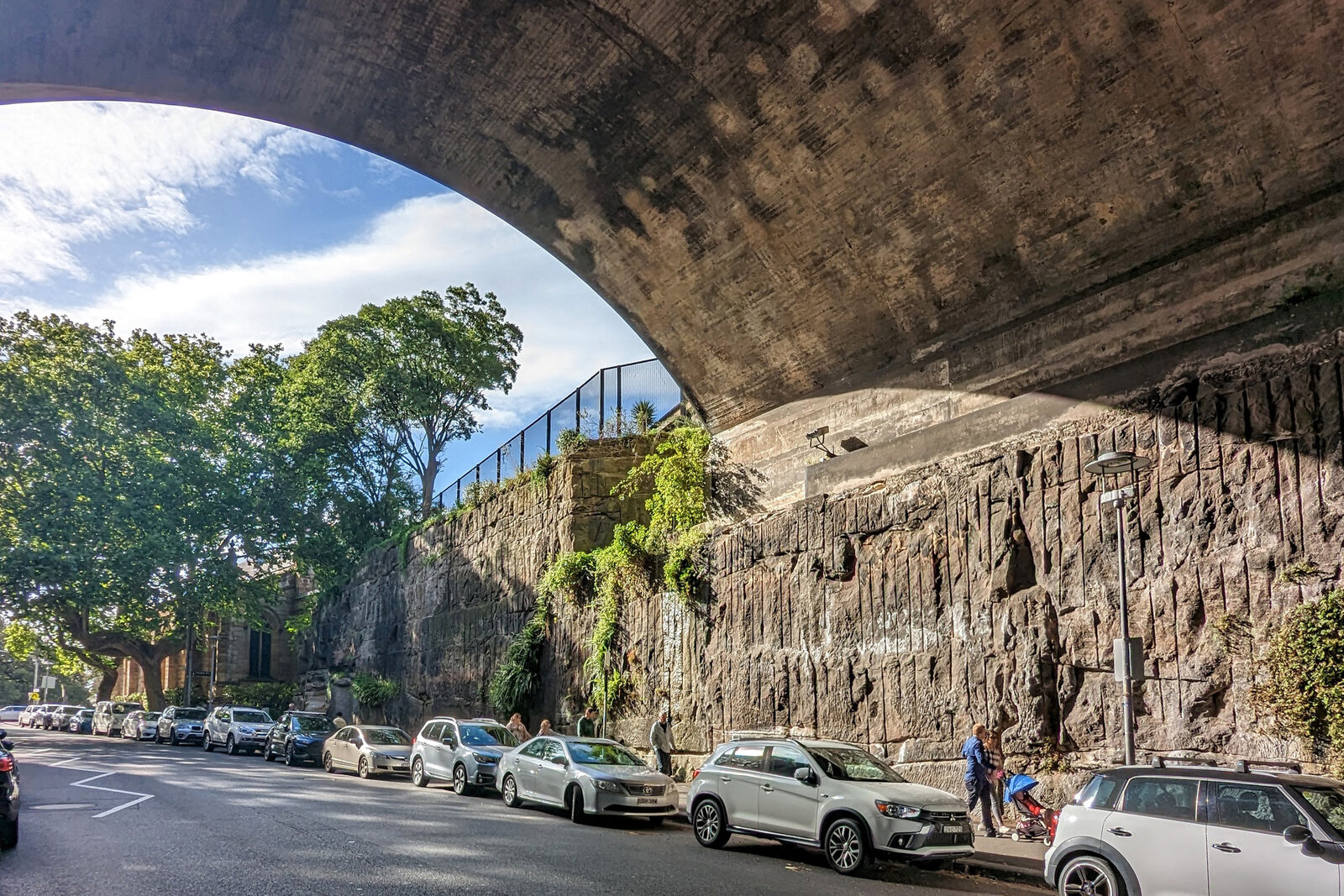
Look around first
What to notice
- High sandstone walls
- Roadway
- Sidewalks
The story of the place
Between high sandstone walls runs a roadway with sidewalks, and the rock around it consists of three sections made in different ways. At the edges, two manually cut sections remain, where forced laborers from a chain gang worked; the middle was later opened by City Council workers with blasts. The removed stone went to fill in the mouth of the Tank Stream and reinforce the shore of Circular Quay. The cut inherited its name from Argyle Street, named in memory of the Scottish county from which Governor Lachlan Macquarie came.
Until the middle of the nineteenth century, Argyle Street ended at a sandstone ridge. Its eastern and western sections lay at different levels. Pedestrians clambered up rock-cut steps that were already considered unreliable at the time. Carriages travelling between Sydney Cove and the wharves of Darling Harbour had to go all the way around Dawes Point. The present sidewalks and roadway appeared because people decided to take the street through the ridge.
Alexander Berry was the first to press for such a plan—a wealthy landowner, importer, and exporter whose office stood on the lower part of George Street. His goods passed through the port, so a short road to the western wharves had a direct monetary value for him. Berry gathered shareholders: they intended to pay for the passage, then charge a toll on every person, animal, and load until the investment was repaid with a profit. Governor Richard Bourke and members of the Legislative Council of New South Wales refused to grant them that right. The work was to be carried out at public expense; no private tollgate appeared on Argyle Street.
In eighteen forty-three, convicts from a chain gang began cutting the sandstone. They were forced laborers with picks and shovels. Overseer Tim Lane enforced obedience with a whip. He is credited with the threat that, with God's help and a flogger's strong arm, the prisoners would receive fifty lashes before breakfast.
Threats did not replace tools. The gang cut into the rock from both sides, but the middle of the ridge proved too difficult for manual cutting. Officials stopped the work and took the prisoners away, leaving the passage unfinished. Only in eighteen fifty-nine did paid City Council workers blast the remaining middle and join the two ends. The removed sandstone was used to fill in the mouth of the Tank Stream and reinforce the shore of Circular Quay.
The name is older than the passage itself. Governor Lachlan Macquarie named Argyle Street after his native Scottish county of Argyll, and the cutting made for the street inherited its name. In today's Argyle Cut, two unfinished sections cut by convicts meet the middle opened by City Council workers with blasts. Berry's company never installed a barrier gate between them.
Useful on site
An active street and exterior viewing; access depends on roadworks, events, and security measures.
Checked: date not specified. Check the official source before visiting.View the walls from the sidewalk and allow for traffic noise: for the story, it is better to choose a spot away from the roadway.