 Guide On Map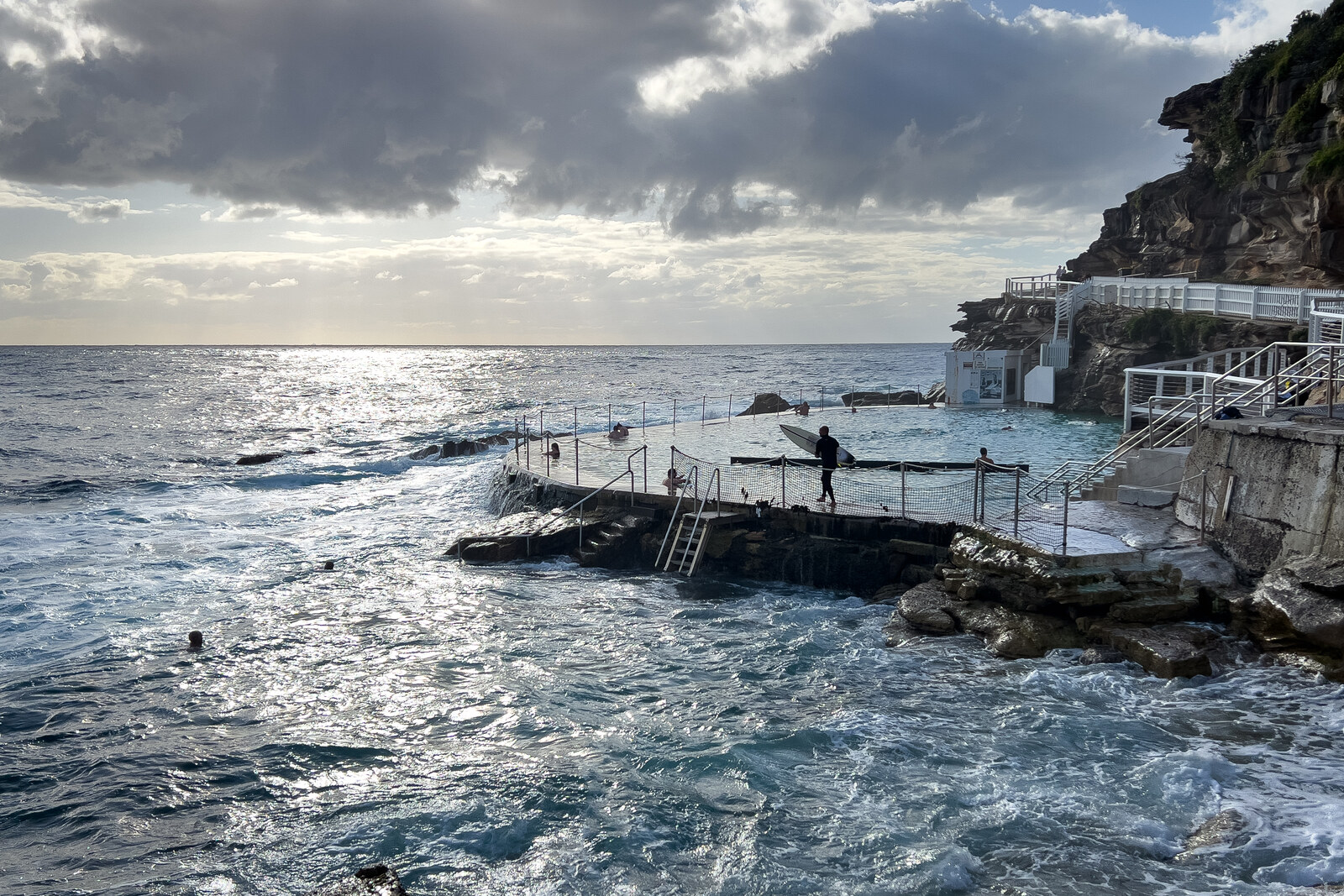
Look around first
What to notice
- The pool's stone basin
- The wall on the surf side
- The rocky southern edge of the beach
The story of the place
Beside the rocks at the southern end of the beach, there was once a natural hollow for swimming; Waverley authorities enlarged it and erected a stone barrier on the surf side. Seawater remains behind this wall, and the uneven basin, about thirty meters long, allows people to swim without going directly into the ocean current. Competitions were held here: to mark distances in a pool without straight sides, they even devised a movable lane marker.
At the turn of the nineteenth and twentieth centuries, a teenage boy from the Solomon Islands, Alick Wickham, regularly swam at Bronte Beach. In Sydney, he lived with his older brother, studied, and worked as a domestic servant. Back home, in Roviana Lagoon, Wickham had learned a swimming method known there as tapatapala: the arms moved forward alternately, while the legs moved rapidly up and down. In open water, this made it easier to cope with the current.
By then, the pool was already serving as a venue for competitions. Waverley municipal councillors ordered the natural swimming hollow at the southern edge of the beach to be enlarged, and in eighteen eighty-seven they enclosed it with a wall against the surf. The water remained seawater, but inside it was possible to mark out distances and compare swimmers. A turning board marking a race lane was even installed in the irregularly shaped rocky basin.
Wickham's best-documented race here took place in nineteen oh one. He entered the sixty-six-yard event to win the Eastern Suburbs Swimming Carnival. At the time, freestyle meant the freedom to choose any movement: competitors combined breaststroke, side swimming, and strokes with the arms recovering over the water.
Wickham covered the whole distance using tapatapala. A rival later recalled his short, rapid stroke, bent elbows, and head held high. A newspaper reported that the teenager won by about twelve yards. Sports historians regard this race as the first documented instance in which the crawl recognizable today was used from start to finish, rather than saved for a final sprint.
According to a later account, coach George Farmer, looking for fast swimmers for the East Sydney Swimming Club, saw Wickham and shouted, “Look, that boy is crawling!” The English word “to crawl” gave the style its name, “the crawl.” Farmer accepted Wickham into the club and began coaching him. The teenager won the Australian fifty-yard championship and set several records. Other swimmers adopted his movements; the champion Dick Cavill developed his own version of the crawl and demonstrated it in Britain. Within a few years, this swimming method spread around the world under the name “Australian crawl,” although Wickham had brought it from the Pacific.
The current stone basin at Bronte Beach is about thirty meters long. Swimming is still taught here, and races are held on weekends. The name tapatapala has nearly disappeared, while the movement with which Alick Wickham covered the whole distance here is now repeated as the crawl in every lane.
Useful on site
Look over the basin and the surf from above before going down. Wet steps require attention, and make any decision about swimming only on the basis of actual conditions and local instructions.