 Guide On Map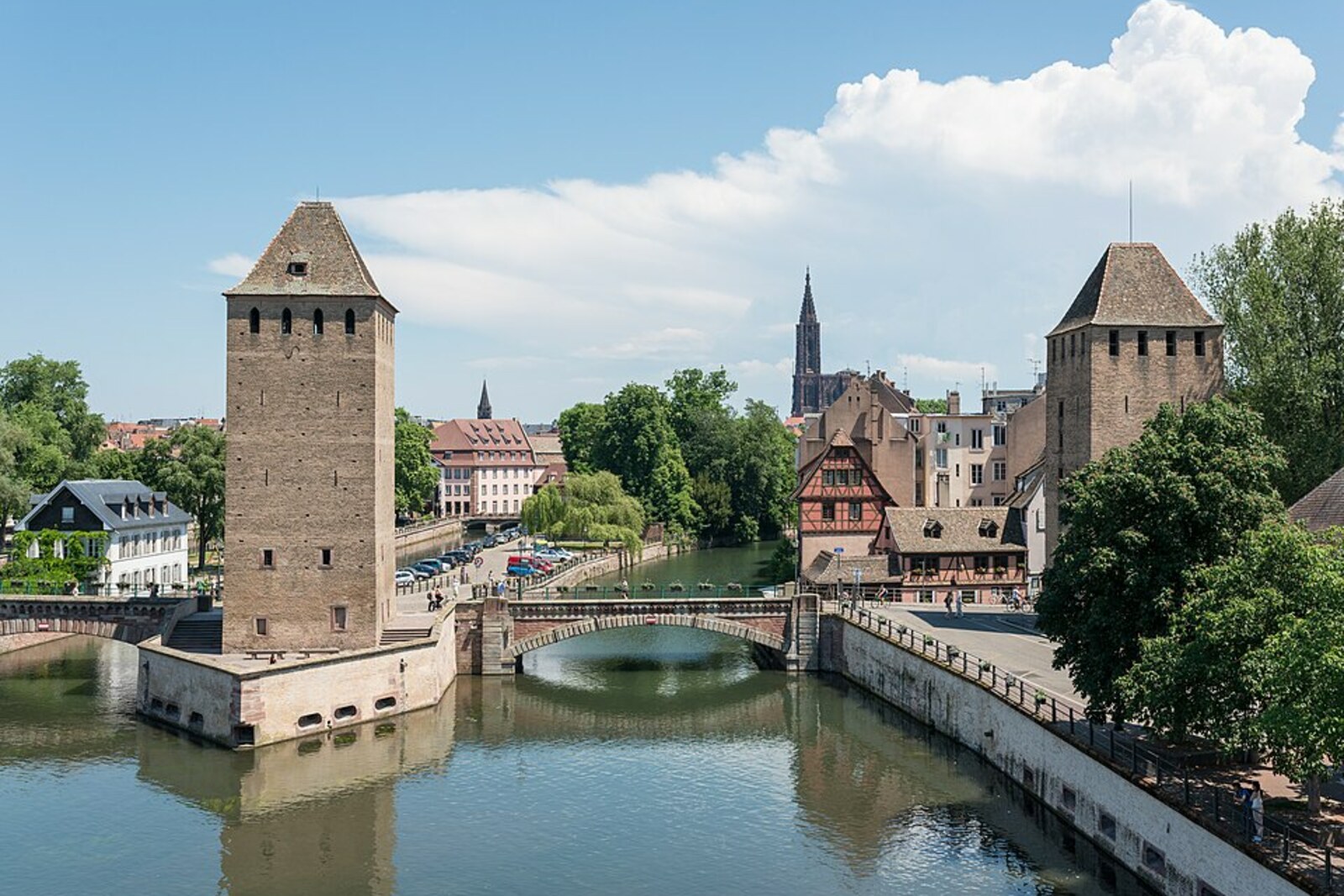
Look around first
What to notice
- Three brick towers
- Thirteen arches of the dam
- Stone spans of the bridges
- Panoramic terrace
The story of the place
The roofs that gave the Covered Bridges their name were dismantled long ago: wooden galleries once connected four brick towers, and only three have survived to our day. The towers belonged to the old line of the city's defenses, and civilian and military prisons were later housed in them. Beyond the stone spans stands a dam of sandstone and brick, built for the new line of fortifications when the old towers could no longer cope with cannon. A terrace is now open above it, while below, thirteen arches are visible through which the Ill passes on ordinary days.
In August eighteen seventy, the soldiers defending Strasbourg sealed thirteen arches of the dam across the Ill with iron shields. The river rose and flooded the ground in front of the southern fortifications. The water inundated the northern part of Neudorf, then a suburb with houses, vegetable gardens, and fields. The residents had to be evacuated, and several buildings were destroyed. The flooding was deliberate: the besiegers lost the dry ground on which they could place cannon and bring them up to the walls.
The defense was commanded by Jean-Jacques Uhrich, a sixty-eight-year-old general who had already been placed on the retired list. On July nineteenth, he was recalled to service specifically to defend Strasbourg. France had started a war with Prussia, but after its first defeats, the field army retreated, while Prussian troops and units from allied German states approached the city. Uhrich had to hold the fortress until help arrived. Meanwhile, the fortifications had not been prepared in time, and there were not enough soldiers even for the entire line of walls. Closing the dam made it possible to defend the southern sector with water instead of men.
The calculation worked. The flooded approaches became unusable for artillery, and the besiegers moved their main trenches and batteries to the northwest. But the dam offered no protection from bombardment on other sides. At the end of September, artillerymen opened two breaches near the Stone Gate, and Uhrich decided that the next assault would turn into street fighting. On September twenty-seventh, he ordered white flags raised and signed the capitulation that night. The line troops and the Mobile Guard laid down their arms and became prisoners of war; the National Guardsmen were disarmed and released. The southern front remained impregnable until the end of the siege, but the city was taken from another side.
Two centuries before these events, the French king Louis XIV sought control of Strasbourg—until then an independent city of the Holy Roman Empire and an important crossing over the Rhine. In September sixteen eighty-one, the city magistrates capitulated. Three days later, Sébastien Le Prestre de Vauban, the king's chief military engineer, presented a plan for new fortifications. The medieval bridges and towers no longer defended the city well against cannon, so Vauban proposed blocking the entire river upstream from the point where it divided into channels.
The structure bears Vauban's name precisely because of this project. He himself soon left, and construction was directed by his assistant Jacques Tarade. The result was a bridge-sluice: in ordinary times, water passed beneath the arches, but during a siege the military closed the passages and turned Neudorf into a flooded outer approach. The purpose was not to wash away enemy soldiers, but to prevent them from bringing heavy guns up to the walls.
The Covered Bridges beyond the dam belong to the earlier line of defense. Around thirteen hundred, the townspeople connected four brick towers with wooden galleries under roofs. The roofs were dismantled in seventeen eighty-four, and the present stone spans were built from eighteen sixty-three to eighteen sixty-five. The name outlived the covered galleries themselves. One of the four towers was demolished on the eve of the siege; the other three were preserved mainly because civilian and military prisons were set up in them.
By eighteen seventy, the dam too had been remodeled: the military added a vaulted story of sandstone and brick and covered it with earth against artillery shells. After the nineteen ninety-six reconstruction, a panoramic terrace was opened on top. Beneath it, thirteen arches still run through the structure—the very passages Uhrich's soldiers sealed, sending water onto the houses and fields of Neudorf.
Useful on site
The bridges and their exterior are accessible as urban public space. The dam's terrace has seasonal hours, but it was announced as closed for repairs in the first half of 2026; check its status before visiting.
Checked: June 24, 2026. Check the official source before visiting.Even without going up to the terrace, the structure can be clearly seen from the water and neighboring bridges. Do not make the panoramic platform a required part of this stop.