 Guide On Map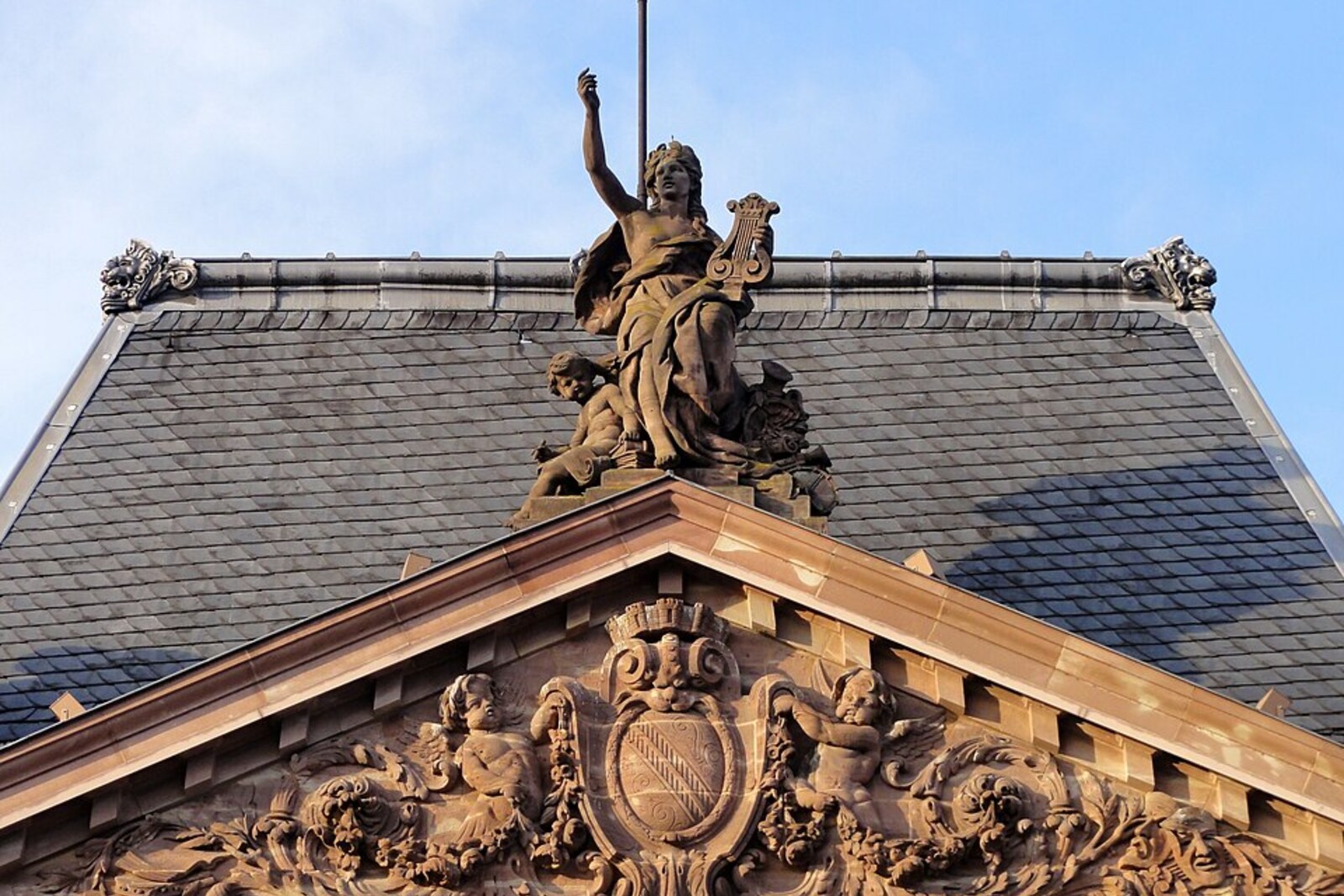
Look around first
What to notice
- The façade of the Aubette's right wing
- The bronze figure of Kléber
- The relief on the pedestal
- The pink stone of the former guardhouse
The story of the place
The right wing of the long pink building on Place Kléber was once occupied by the guardhouse of the royal garrison. It was built in the eighteenth century by what was then Place d'Armes, where soldiers changed guard at dawn. City tradition links this morning assembly to the name Aubette. The pink stone of the façade remains from the time when the square followed a military routine rather than urban entertainments.
In February nineteen twenty-eight, people came to the Aubette to have dinner, play billiards, watch films, and dance. But there was no ordinary backdrop for entertainment here. The walls, ceilings, floors, furniture, signs, and even the lettering on the doors formed a single geometric composition. Visitors found themselves inside an abstract painting.
This was the result envisioned by the brothers Paul and André Horn. Paul was an architect; André was a pharmacist, collector, and financial manager. In nineteen twenty-two, they leased the right wing of the Aubette for fifty years and decided to create a large entertainment complex. The rooms had to fill with visitors: an empty restaurant or dance floor would turn the long lease into a costly mistake.
For the decoration, the brothers invited the Strasbourg native Jean Arp and his wife, Sophie Taeuber-Arp. Jean Arp and Sophie Taeuber-Arp invited their friend Theo van Doesburg, a Dutch artist and architect who was looking for a chance to realize his ideas on this scale for the first time. Van Doesburg proposed designing everything, from the arrangement of the rooms to the typeface on the signs. Sophie Taeuber-Arp was responsible, among other things, for the tea room, bar, and billiard room; Arp decorated the basement dance rooms. In the cinema-dance hall, van Doesburg ran a diagonal grid of black, white, yellow, red, blue, and green shapes across the walls and ceiling. Film, dance, a table, and painting were meant to exist at the same time.
Visitors complained that the bright lines and colors kept them from feeling at ease. The managers depended on visitors returning, and after only a few months they began adding conventional decorations. After nineteen twenty-nine, the global economic crisis worsened the commercial situation. In nineteen thirty-eight, when the Horn brothers stopped managing the complex, the new owners covered over the murals and destroyed some of them. Van Doesburg's main large-scale work remained as intended for less than ten years.
During renovations in the early nineteen eighties, specialists found traces of old paint on the first floor. French and Dutch restorers compared these fragments with color sketches and photographs from nineteen twenty-eight. The cinema-dance hall was restored by nineteen ninety-four; the ballroom, staircase, and foyer bar by two thousand six. Exhibitions and cultural events are once again held there now. The other cafés, cabaret, tea room, billiard room, and basement halls have been lost in their original design.
The name Aubette itself appeared long before the Horn brothers. The long pink-stone building was constructed in the eighteenth century as the guardhouse of the royal garrison. Soldiers changed guard at dawn—"aube" in French—and city tradition links the word Aubette to this morning assembly. In front of the guardhouse lay Place d'Armes, today's Place Kléber.
The bronze man at its center is Jean-Baptiste Kléber, a native of Strasbourg and a general in the revolutionary army. After Bonaparte left Egypt, Kléber was given command of the French army that Bonaparte had left there. He tried to negotiate its return, and when the agreement fell through, he defeated the Ottoman troops at Heliopolis. The relief on the pedestal depicts this victory. A few months later, Kléber was killed in Cairo.
His body was removed from Egypt, but no ceremonial funeral was held in France. For eighteen years, his coffin remained at Château d'If near Marseille. Only King Louis XVIII authorized the remains to be transferred to the general's hometown. In eighteen eighteen, they were placed in Strasbourg Cathedral, and another twenty years later a city commission created a crypt in the middle of Place d'Armes. Above it, the sculptor Philippe Grass installed a bronze figure of Kléber. After the monument was unveiled in eighteen forty, the square received his name. Beneath the pedestal lies not a symbolic urn, but the coffin of the general himself.
Useful on site
The square is always open. The Aubette's 1928 halls are usually open Wednesday–Saturday 14:00–18:00, last entry 17:30; closures are possible on holidays.
Checked: June 24, 2026. Check the official source before visiting.The square and façade can be viewed independently. Do not regard entry to the restored Aubette halls as a guaranteed part of the route.