 Guide On Map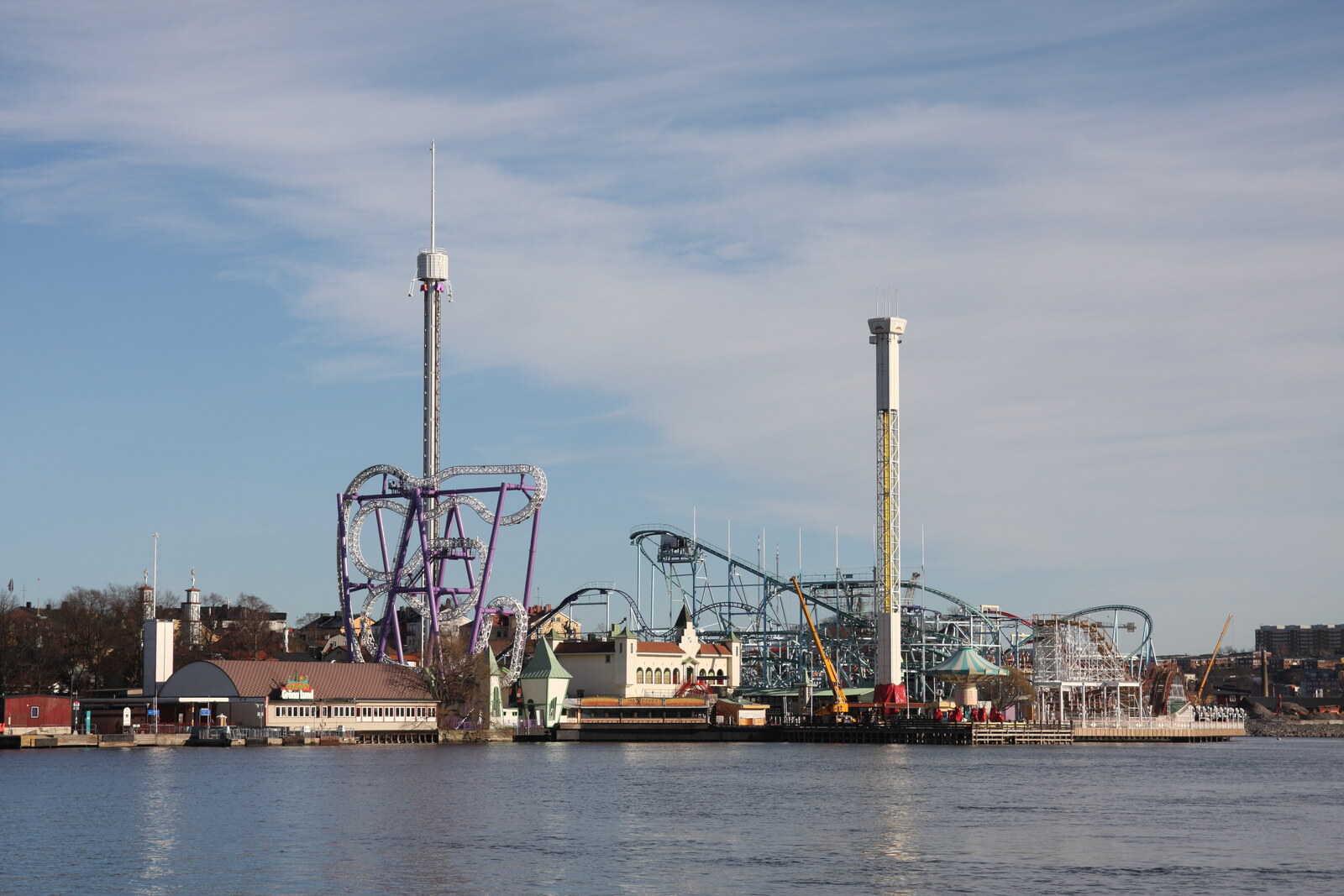
Look around first
What to notice
- The park gates
- Stora Scenen
- Allmänna gränd
- The parking lot opposite
The story of the place
Gröna Lund occupies a cramped courtyard on Djurgården, where rides, a concert venue, and service buildings stood for a long time on land leased for just one year at a time. Across Allmänna gränd, a second amusement garden once operated; the two shared visitors and plots for expansion. Stora Scenen still hosts concerts, while opposite it, a parking lot remains in place of the rides. One park drew a more prosperous crowd; the other depended on workers, sailors, and soldiers.
Beyond the gates is Sweden’s oldest amusement park still in operation. The name “Gröna Lund,” meaning “Green Grove,” appeared here before the rides: it was the name of the former garden, and an inn with that name is associated with one of the old buildings, although historians cannot determine its exact premises. When the German impresario Jacob Schultheis leased the courtyard in eighteen eighty-three, almost nothing remained of the garden. He installed a carousel turned by a horse walking in circles, opened a dance floor, and began inviting performers.
Forty-one years later, opposite, across Allmänna gränd, the owner of a traveling fair, Johan Lindgren, opened “Nöjesfältet”—“the Amusement Field.” The two parks shared one street, visitors, and plots for expansion. Gröna Lund drew a more prosperous crowd; Nöjesfältet drew workers, sailors, and soldiers. Lindgren also had an advantage: his own roller coaster.
Gustaf Nilsson, who owned Gröna Lund, once took over the lease of the building where his rival stored the roller coaster in winter, then ordered a wide ditch dug so that Lindgren could not take the structure out. Lindgren sued. The case reached the appellate court, but Nilsson won. For both men, this was a family livelihood: one had inherited the park from his father, while the other had previously worked at a sawmill and spent many years taking rides around the country before settling on this shore.
The rivals’ children grew up on opposite sides of the street. Ninni Nilsson was the daughter of the owner of Gröna Lund; John Lindgren was the eldest son of the owner of Nöjesfältet and the future head of his father’s business. Exactly how their romance began is not known for certain. According to their daughter, seventeen-year-old Ninni climbed over the fence at night to meet John. While their fathers were alive, the couple kept their relationship secret.
In nineteen forty, Gustaf Nilsson and Johan Lindgren died a few months apart. John took charge of Nöjesfältet, while Ninni’s mother continued to run Gröna Lund. The following year, the young couple announced their engagement, and on July third, nineteen forty-two, the day Ninni came of age, they married. Two orchestras played at the wedding: one represented Nöjesfältet, the other Gröna Lund.
Ninni’s family nevertheless would not allow them to merge the businesses. She then crossed Allmänna gränd to join her husband and began running Nöjesfältet with him—opposite her own mother’s park. After the war, visitor numbers declined, the land could be leased only one year at a time, and the old buildings required money. Ninni’s mother helped her daughter and son-in-law, but after the nineteen fifty-six season, they closed Nöjesfältet.
John then moved to Gröna Lund. In nineteen fifty-nine, after his mother-in-law’s death, he became director of the park, which was on the verge of bankruptcy. John reached an agreement with West German carousel owners: they brought equipment to Stockholm, and the revenue was split in half. Radio and television helped him bring contemporary performers to Stora Scenen. The Lindgren family ran Gröna Lund until two thousand one.
Stora Scenen still serves as a concert venue. On the other side of Allmänna gränd, where Ninni and John ran Nöjesfältet, there are no rides: the last buildings of their park were demolished in nineteen fifty-eight, and the site was turned into a parking lot.
Useful on site
Operates according to the season and event calendar; the official calendar on 2026-06-29 showed it closed on that day. Before entering, check the specific date, ticket, and available rides.
Checked: June 29, 2026. Check the official source before visiting.The park’s layout is clearly visible from outside. Treat admission to the rides and concerts as a separate plan: check the rules for the specific date, and do not use the paid area as a route to the next stop.