 Guide On Map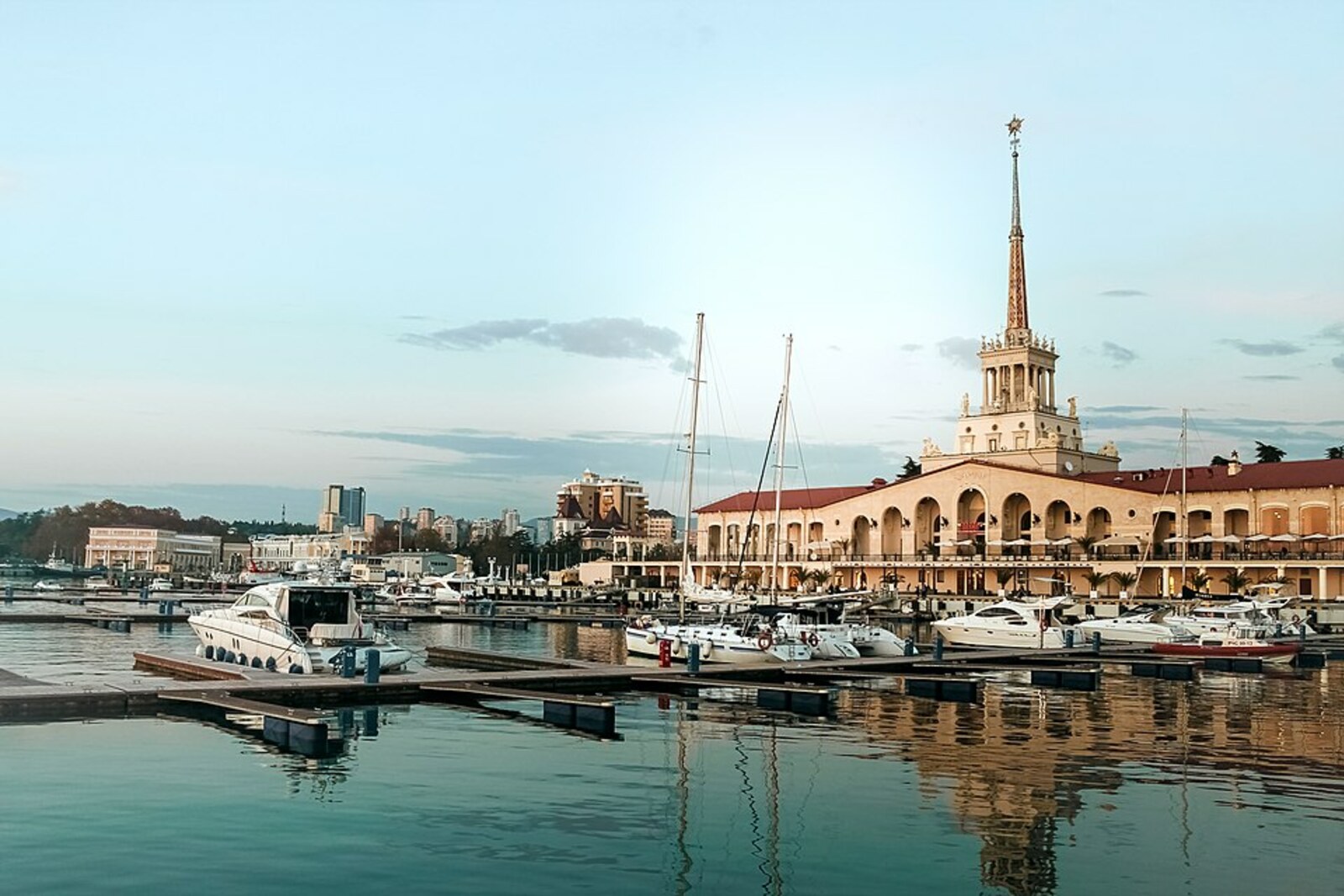
Look around first
What to notice
- Tower with a spire
- Open galleries along the water
- Sculptures on the tower's tiers
- Band of dolphins
The story of the place
A tower with a spire rises above the piers; figures are placed on its tiers, and a band of dolphins runs beneath the spire. Galleries open toward the water, and passengers used them to walk to the ships; on the city side, the entrance, ticket offices, and waiting room awaited them. In the nineteen thirties, the water area began to be enclosed with breakwaters, but before the war only workshops, a warehouse, and a wooden pavilion for passengers had been built here. After the war, the permanent terminal was meant to make the route from ship to city continuous.
Before a protected harbor appeared, a passenger steamship stopped about a kilometer from the Sochi shore. People and luggage were transferred into boats, then hoisted aboard by gangways and rope ladders. Storms broke the pile piers; in bad weather, the captain could pass Sochi by and take resort visitors to the next port. At times, they waited weeks for a chance to disembark.
In the nineteen thirties, when Sochi was being turned into the Soviet Union's main resort, builders began enclosing the water area with breakwaters. They managed to build workshops, a warehouse, and a temporary wooden pavilion for passengers, but the war stopped the work. Construction resumed in nineteen forty-seven.
Joseph Stalin, the leader of the Soviet Union, ordered the port to be completed. The brief called the future terminal the ceremonial entrance by sea to the country's largest resort. Karo Alabyan, an academician of architecture, and his co-author Leonid Karlik had to combine two tasks: take a passenger from a ship to the ticket offices and waiting room, while also greeting that passenger with a building worthy of the new Sochi.
Alabyan made the city side and the sea side different. On the pier side, the structure stretched out in open galleries along the water: passengers used them to walk to the ships. On the city side, a tower with a spire rose above the entrance. Alabyan invited the sculptor Vladimir Ingal during construction itself. Instead of finished sketches, the architect explained to Ingal how a person would see the terminal from the sea and what role the figures had to play. Together with his students, Ingal placed the seasons and the cardinal directions on the tower's tiers, and a band of dolphins beneath the spire. In the square, Navigation appeared, holding a small boat and a pilot book. Here, the maritime theme indicated the building's purpose even before an arriving passenger had time to read the sign.
By November nineteen fifty-five, the terminal had been completed. Then the already finished project came under threat. On November fourth, Nikita Khrushchev, the party's first secretary, and the Soviet government demanded that construction be made cheaper and shifted to standard buildings. The decree listed tower superstructures, decorative colonnades, and porticos among the condemned excesses—an almost exact description of the Sochi terminal. Projects for structures under construction were ordered to be reviewed within three months; architects lost their positions and awards.
The Sochi complex managed to slip through between the decision and the redesign. Forty-one days later, on December fifteenth, the port chief signed the order putting the terminal into operation. Passengers received ticket offices, a waiting room, and a direct route to the piers, while Alabyan received one of the last projects realized in his lifetime.
Today, the port receives passenger and cruise ships, excursion boats, and yachts. Above them remain the very tower, colonnades, porticos, and sculptures that were declared architectural excesses several weeks before the opening.
Useful on site
The facades and city square are accessible without a schedule; the piers and service areas operate according to the port's schedule.
Checked: June 24, 2026. Check the official source before visiting.View the tower from a distance: its sculptural tiers are difficult to make out right by the walls. At the piers, do not go beyond the service barriers.