 Guide On Map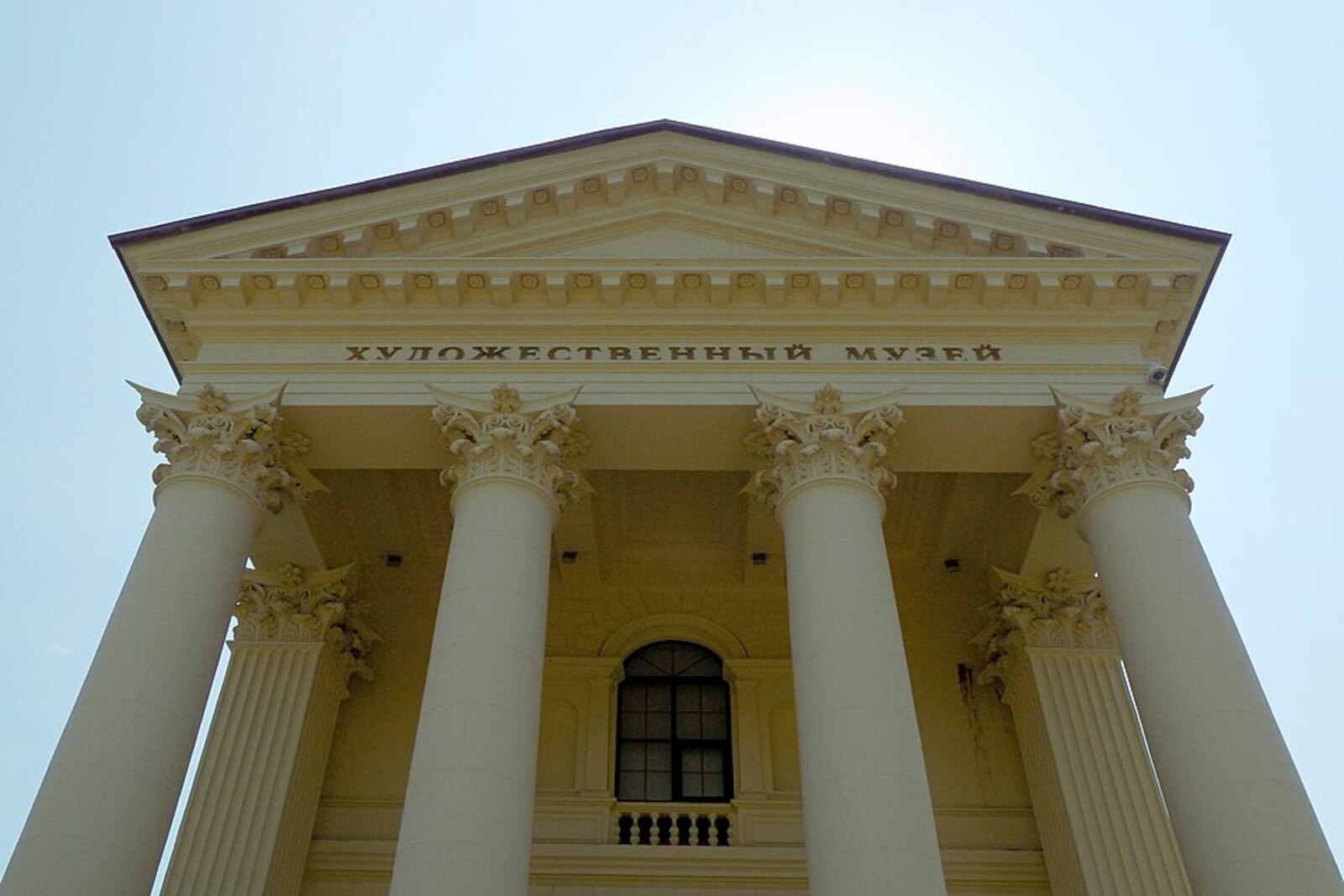
Look around first
What to notice
- Main portico
- Figure of the Mason
- Figure of the Carpenter
- Inscription with Dmitry Zhilinsky's name
The story of the place
Behind the main portico lie spacious offices and long corridors in a building conceived for major administrative work, not for hanging canvases. When the local party leadership moved out, the former service rooms were converted for exhibitions over five years. The first paintings were transferred here from Sochi sanatoriums, where they had previously hung for vacationers, so the collection grew out of resort interiors. Dmitry Zhilinsky's name on the façade recalls the artist, born nearby, who came to Sochi more than once to work.
In the museum's side porticos stand the Mason and the Carpenter. These figures appeared here before the paintings did. They recall the building's original purpose: this is the former headquarters for the reconstruction of Sochi.
In nineteen thirty-three, Alexander Metelev, the special plenipotentiary of the Central Executive Committee of the Soviet Union, was given the task of turning a small resort into a major all-Union health resort. Metelev had started as a factory fitter, but now he controlled money and land for sanatoriums, roads, waterworks, and clinics. In his very first order, he required that no plot in Sochi be allocated for construction without his permission, a master plan, and a project. Managing this construction required a building of its own.
Metelev invited the architect Ivan Zholtovsky, an expert on the Italian Renaissance. Zholtovsky designed the House of the Plenipotentiary with large offices, an assembly hall, wide corridors, and a main façade facing the park. The office took on the appearance of a country palace. The Mason and the Carpenter on either side showed what the officials gathered here for: construction of the new resort was directed from these offices. The House was completed in nineteen thirty-six.
Metelev used it only briefly. Just a year later, his administration was dissolved, and the city party committee occupied the building for three decades.
When the committee moved out in nineteen seventy-one, the staff of the future exhibition hall received the vacated offices. They spent five years converting them for exhibitions. The basis of the collection was created by order of the city executive committee: paintings were transferred here from Sochi sanatoriums. Thus, one collection brought together canvases that had previously hung in health resorts for vacationers. At first, the institution remained an exhibition hall while also building its own collection; it received the status of an art museum in nineteen eighty-eight.
Dmitry Zhilinsky's name appeared in the title in two thousand nineteen by decision of the city toponymic commission. Zhilinsky was a painter born in Volkovka near Sochi who returned here many times to work. Just a year after the exhibition hall opened, his solo exhibition was held here. The museum now holds four of his paintings, including “White Horse.”
The Mason and the Carpenter still stand in the side porticos. Behind them, the former offices of the House of the Plenipotentiary are occupied by paintings from sanatoriums and works by the artist whose name is now written on the façade.
Useful on site
Tuesday–Sunday 10:00–18:00; ticket office until 17:30; closed Monday.
Checked: June 24, 2026. Check the official source before visiting.The façade can be read regardless of whether the museum is open. For the interior and collection, check the current visiting hours and allow separate time.