 Guide On Map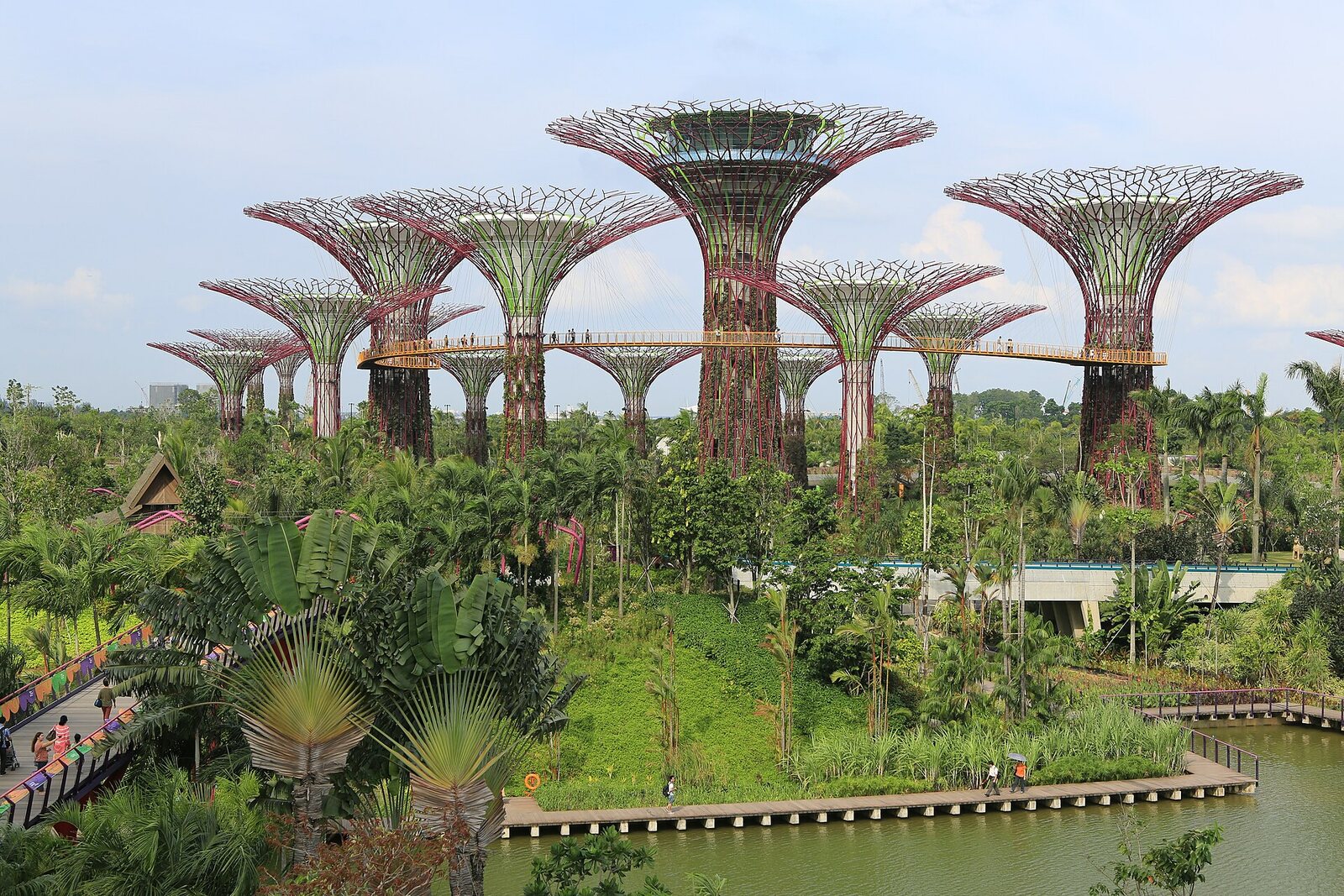
Look around first
What to notice
- Steel branches of the Supertrees
- Planting panels with plants
- Tall crowns
- Rain trees in depressions
The story of the place
The land reclaimed from the sea beneath the grove was first the parking lot of Marina City Park; samaneas still grow there, and the gardeners left depressions for their large roots. Above them stand eighteen Supertrees with hidden reinforced-concrete cores and steel branches carrying planting panels made of bark and coconut fiber. Orchids, ferns, bromeliads, and vines grow on them; in nature, they settle high on the trunks and branches of other trees. Seven crowns carry solar panels for evening light, while others take in air from the conservatories or collect rainwater.
In two thousand five, Ong Chui Leng, assistant director of development for the future Gardens by the Bay, did not know whether city residents would want to spend their free time among plants. Her team was planning to create a large public garden on expensive land beside the new business center, but they considered shopping malls, cinemas, and the television at home to be competitors. The staff even discussed with the zoo whether orangutans should be housed here: plants alone seemed insufficient to them.
The site of today’s grove was then the parking lot of Marina City Park. It had been built on land reclaimed from the sea, and the ground had had time to settle. The gardeners preserved the rain trees—samaneas—growing by the parking lot: some were raised together with their roots, while depressions were made around the largest ones, which could not be moved.
The team needed a tall grove immediately, on opening day. Real trees would have needed decades. Large specimens can be transported only in containers that limit the size of their roots and crowns. Ong recalled how the task came down to one question: how could a tree fifty meters tall be brought here?
Landscape architect Andrew Grant and his team answered with a structure of reinforced concrete and steel. Twelve of the eighteen Supertrees were assembled here. Steel branches and planting panels made of bark and coconut fiber were fixed around concrete cores. More than one hundred sixty-two thousand nine hundred plants of over two hundred species were planted on them: orchids, ferns, bromeliads, and vines. Many of them are epiphytes, which in nature settle high on the trunks and branches of other trees. The metal height allowed the gardeners to raise such vegetation immediately to where it would reach in an ordinary forest only together with an old crown.
The engineers gave different Supertrees different duties. Seven crowns carry solar panels; the energy produced is used for evening lighting. Other structures take in exhaust air from the cooled conservatories. Rainwater collection was provided in the broad crowns. The artificial trunks were needed not to replace a living forest: they gave the young garden height, shade, and technical systems while the trees planted nearby grew at their own pace.
After the opening, Ong returned to her original concern: how to interest people who do not usually choose a garden. Evening lighting was already being prepared for the Supertrees, but she felt that light alone was not enough. The team added music and staged the first show here in July two thousand twelve. When the crowns lit up, the spectators applauded. Some lay directly on the paving to see the full height of the structures. For Ong, this became proof that the former parking lot had truly been turned into a shared urban place.
Today’s Garden Rhapsody is sounded through sixty-eight individual speakers distributed across the grove. And beneath the steel crowns still stand the rain trees of the former parking lot; the largest of them remain in the depressions that the gardeners built around the old roots.
Useful on site
The outdoor gardens are usually open daily 05:00—02:00. The OCBC Skyway is open 09:00—21:00, with last entry at 20:30; access may be suspended because of weather, and the nearest maintenance is indicated for 15 July 2026. Until 16 July 2026, diversions are in effect around the Meadow, parts of the Colonnade, and the lawn of Supertree Grove.
Checked: July 1, 2026. Check the official source before visiting.The grove can be explored from the ground without going up. The OCBC Skyway and other enclosed facilities are visited separately and may be unavailable because of weather; the evening lighting is best viewed from an open area.