 Guide On Map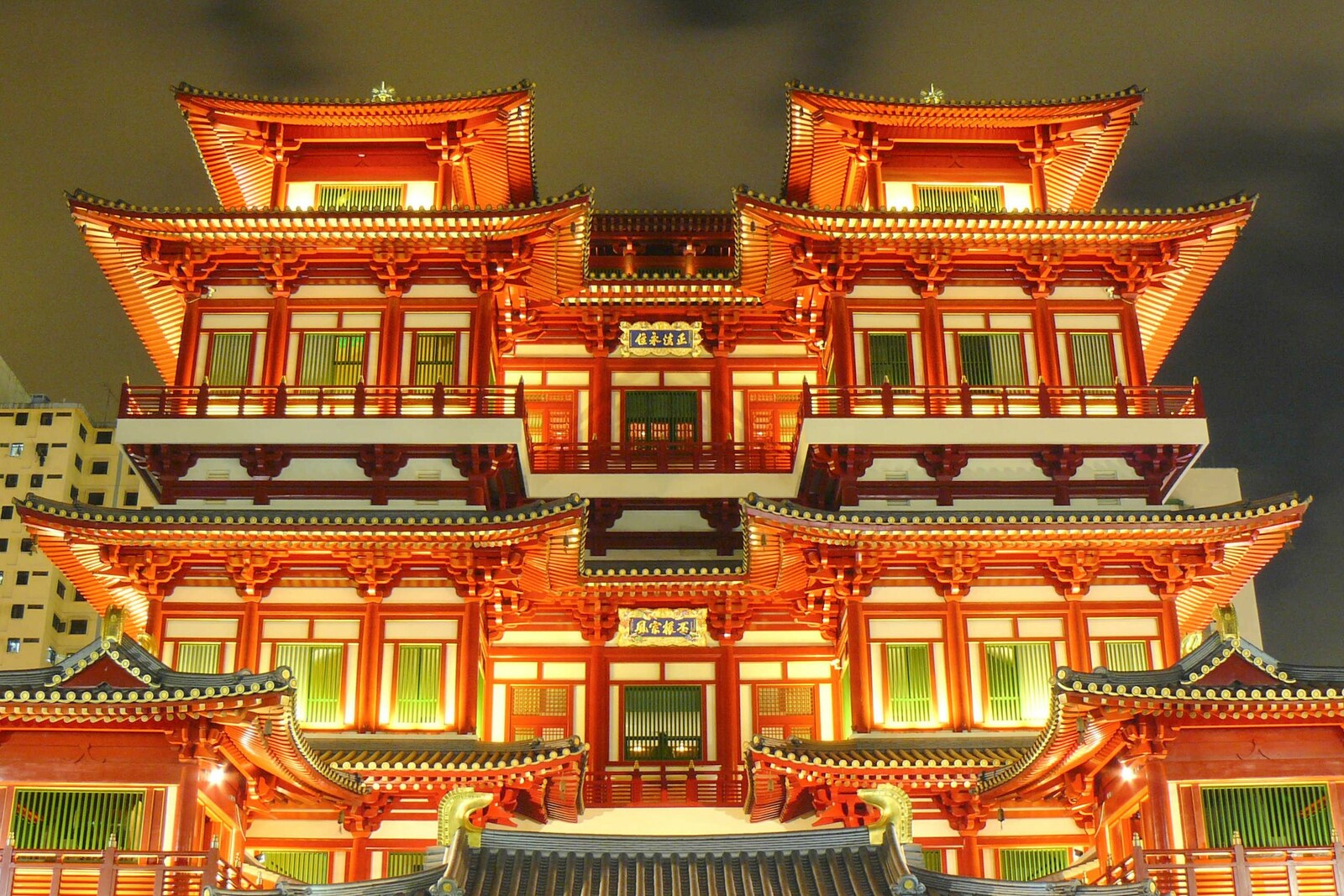
Look around first
What to notice
- The red façade of the complex
- The golden stupa behind glass
- Museum halls
The story of the place
The red façade conceals four floors arranged as a Buddhist mandala in the form of a Chinese temple from the Tang era. Services take place below, charitable programs and museum halls operate there, and above, a golden stupa stands behind glass. Its bronze frame is supported by a steel structure covered in gold that donors brought for the temple.
The red complex on South Bridge Road opened in two thousand seven. The Buddhist monk Shi Fa Zhao, abbot of the small Golden Pagoda Buddhist Temple in the Tampines district, had been seeking this site even before he became the keeper of a famous relic.
In nineteen ninety-seven, the Singapore Tourism Board asked him to devise a temple for a vacant lot near Sago Lane. Shi Fa Zhao prepared a design in four days, but the officials did not pursue it. A year later, they asked for a traditional Chinese complex with an opera stage, intended both for worshippers and for visitors to Chinatown. The monk brought new drawings—and once again was left without the site.
On August fourth, two thousand two, the situation changed because of Chakkapala, abbot of the Burmese Bandula Monastery and keeper of an object revered as a Buddha tooth. According to the account accepted at the temple, Chakkapala found it in nineteen eighty, while dismantling a collapsed stupa in Mrauk-U. The relic has no verified chain of ownership linking the find to the cremation of Shakyamuni Buddha.
Chakkapala gave the tooth to Shi Fa Zhao and asked him to build a permanent monastery for it, where Buddhists from different countries could come. After a crowded exhibition, it became clear that the Golden Pagoda Buddhist Temple was too small for this. Shi Fa Zhao spent a year in seclusion, chose the future temple's name, and combined the arrangement of a Buddhist mandala with forms from China's Tang era in the design. He then returned to the vacant lot that he had previously failed to obtain twice. In January two thousand five, the trustees signed a lease, and construction began.
Tens of thousands of donors gave money and gold. People brought rings, chains, ingots, and other jewelry. Jewelers melted them down, and craftspeople made a stupa about three and a half meters high for the fourth floor. Beneath its gold cladding are a bronze frame and a steel structure; three hundred twenty kilograms of gold in all went into it. The other floors were occupied by halls for worship, charitable programs, and museum collections. In this way, Shi Fa Zhao fulfilled both conditions: he created a place to worship the relic and opened the history of Buddhist traditions from different countries to visitors.
A few weeks after the ceremonial opening, a dispute arose around the tooth itself. It is about seven and a half centimeters long. Dentists who studied photographs stated that its shape did not match a human tooth and more closely resembled the molar of a cow or buffalo. Singaporean Buddhist art collector Woon Wee Teng said that monks in Myanmar had given him similar relics. He showed them to veterinarians and forensic dentists; they identified them as teeth from herbivorous animals, and Woon declined to display them in his museum. He now demanded the same examination from the new temple. Some donors joined him: they wanted to know what they had given their money and jewelry for.
Shi Fa Zhao and the temple management refused an analysis. They explained that the examination would damage the sacred object, and that there was no reliable specimen for comparison anyway. For the monks and worshippers, the relic's origin remained a matter of faith; scientific confirmation of its connection to the Buddha never appeared.
On the fourth floor, the golden stupa stands behind glass. During Chinese New Year and Buddha's Birthday celebrations, monks remove the relic and place it closer to visitors for worship. In the museum halls, the object is called the sacred Buddha Tooth; there is no separate laboratory label beside it stating an identified animal species.
Useful on site
Daily around 07:00–17:00 according to the temple's current official pages. Individual halls and ceremonies may have their own hours; a late visit should be checked again on the temple's website.
Checked: June 28, 2026. Check the official source before visiting.This is an active religious site: keep quiet, observe the clothing requirements, and do not expect to see the relic up close.