 Guide On Map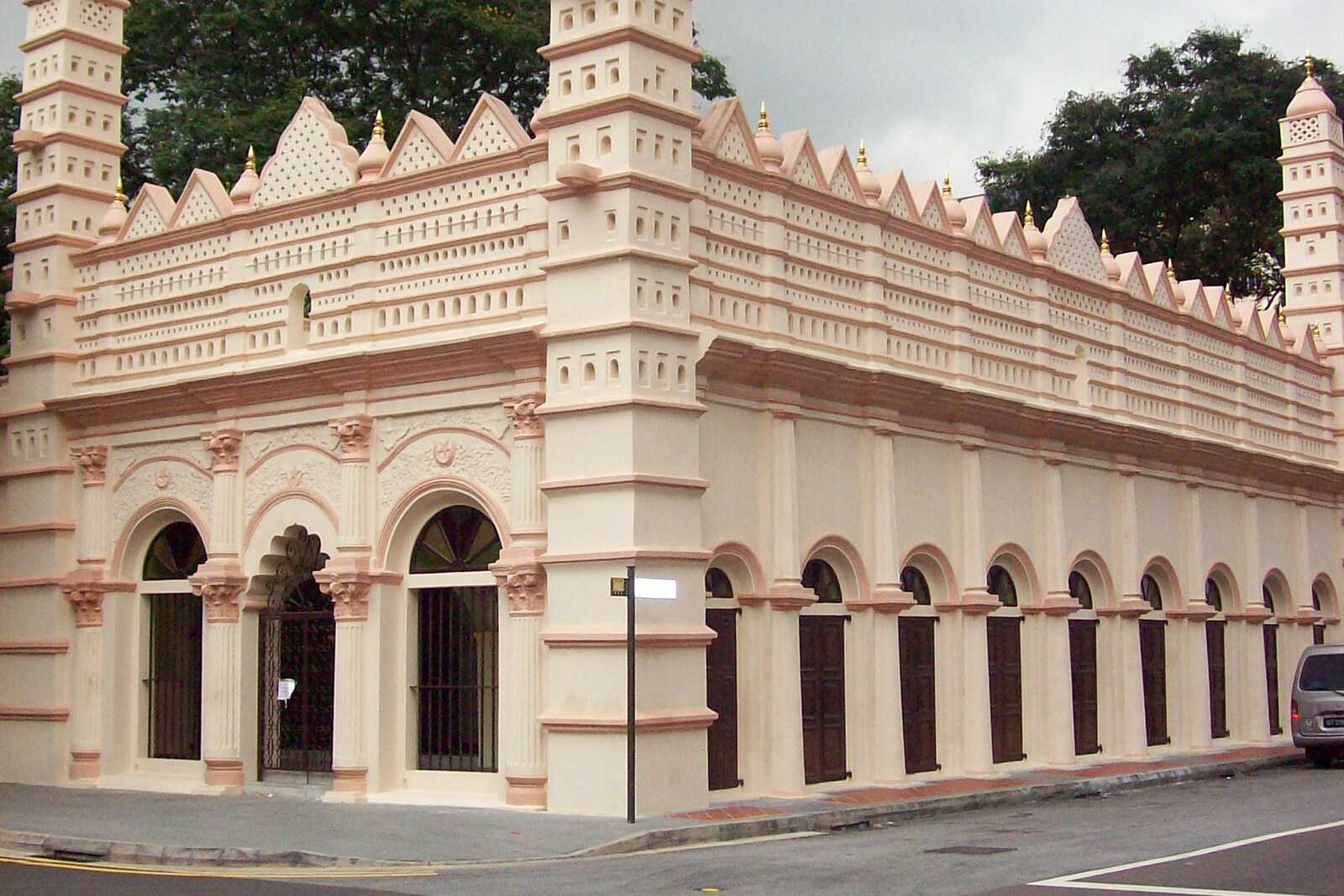
Look around first
What to notice
- The two towers of the upper tier
- Facade niches for oil lamps
- The birth certificate with the building's address
- A childhood photograph on the roof
The story of the place
Nagore Dargah has undergone a change of purpose and now serves as a center for the history of Indian Muslims. The two towers of the upper tier and the niches on the facade remain from the commemorative shrine, where flags were raised and oil lamps lit during the annual commemoration. It was built by a community of people from the Coromandel Coast on what was then the edge of Telok Ayer; at the authorities' demand, noncombustible materials had to be chosen instead of a palm-leaf roof and wooden walls. The shrine also had a tiny caretaker's room: his family lived right inside the building.
Chulia Tamil Muslims earned their living through trade and money changing between the ports of the Indian Ocean. Before sailing to Singapore, many visited the shrine of Shahul Hamid in the South Indian city of Nagore. Shahul Hamid was a sixteenth-century Sufi preacher; sailors believed that he helped them make a safe sea journey. For a merchant, such a journey meant risk both to the goods on which he depended for his livelihood and to his own life.
Having reached Singapore, people from the Coromandel Coast decided to give thanks to the saint here. Two brothers, Mohamed and Haja Mohideen, undertook to build a Singapore counterpart to the Nagore shrine. In eighteen twenty-seven, Kader Pillai was granted a plot by the then shoreline of Telok Ayer Street, but the British administration set a condition: no palm-leaf roof and no wooden walls, as they were too dangerous in a fire. The brothers had to construct the building from noncombustible materials. The work took place from eighteen twenty-eight to eighteen thirty.
A dargah is a shrine at the tomb of a revered Muslim saint. Shahul Hamid's tomb remained in India; the Singapore building never contained either his body or relics. The word “Nagore” in the name points to the city where he is buried. The Chulia built a commemorative copy for people who lived across the sea and could not return to the real tomb every time.
Thanksgiving prayers and an annual fourteen-day commemoration of Shahul Hamid were held here. Festive flags were raised on the upper tier, and oil lamps were placed in the facade niches. A caretaker looked after the building, and his family lived in a small room inside.
Shaik Kadir, the caretaker's son, was born in this room in nineteen forty-six. When the boy was seven years old, his father died in the main hall; after his death, his mother took the children away from Nagore Dargah. As an adult, Kadir returned here and saw blackened walls. He was certain that the dilapidated building would be demolished.
When the community and the Islamic Religious Council of Singapore decided to open a center for the history of Indian Muslims here, Kadir brought two items: his childhood photograph on the roof and a birth certificate with the address—one hundred forty Telok Ayer Street. Since two thousand eleven, the former shrine has operated as a heritage center. The saint's tomb is in Nagore, while Singapore's Nagore Dargah keeps the document of a child who was actually born inside.
Useful on site
Mon–Fri 10:00–17:30, Sat 09:00–13:00, Sun closed. If the center is closed, the facade remains accessible from the street.
Checked: June 28, 2026. Check the official source before visiting.Do not mistake the building for an ordinary mosque; when the entrance is closed, its main features can still be clearly seen from the street.