 Guide On Map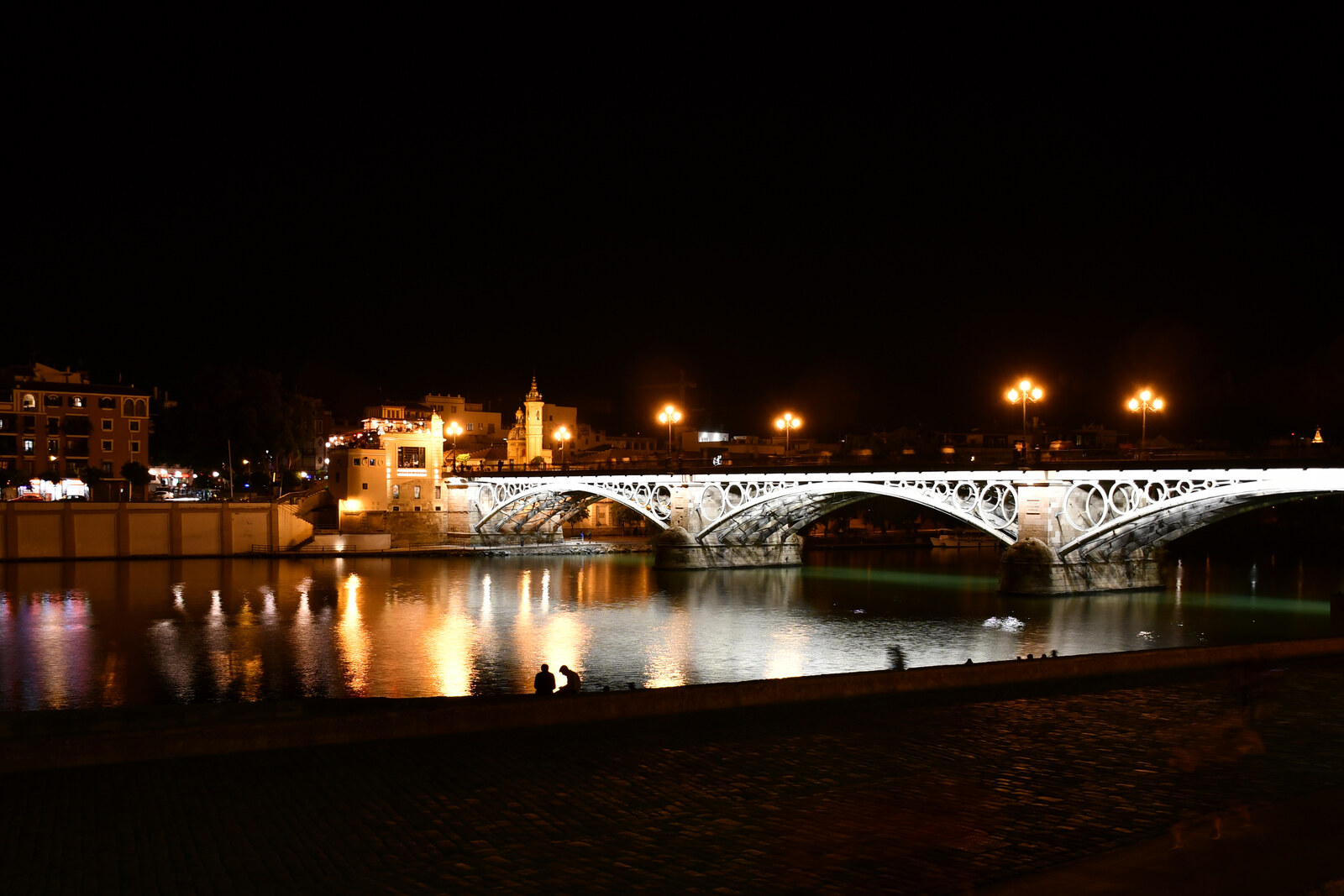
Look around first
What to notice
- Cast-iron arches and rings
- Stone piers
- Round chapel
- Octagonal bell tower
The story of the place
Where the Guadalquivir River divides Seville and Triana, a permanent bridge replaced an old crossing made of linked boats. The side cast-iron arches and rings have been preserved above the stone piers from a structure that served the crossing for more than one hundred twenty years. A round chapel with a narrow octagonal bell tower occupies the narrow site between the approach ramp and the market. It was built in place of the former chapel, dismantled when the crossing was widened, and inside it is kept a painting of the Virgin Carmen and Child, the patroness of sailors.
At dawn on Good Friday in nineteen seventy-four, the Esperanza de Triana Brotherhood was bringing a processional platform bearing the image of the Virgin of Hope back to its chapel. Because of rain, the procession had taken shelter in the Church of La Magdalena the day before and was now returning across the river. When the platform reached the middle of the bridge, the structure vibrated violently. The bearers, members of the brotherhood, and people gathered around feared a collapse.
That fear did not arise without reason. Back in nineteen fifty-seven, the engineer Carlos Fernández Casado, who had been assigned to assess the bridge's strength, warned that the old cast-iron arches could not be reinforced enough to withstand the growing flow of traffic, and that a collapse could occur without warning signs. Buses and trucks were soon banned here. Fernández Casado himself prepared a replacement plan: the old bridge was to be dismantled, and a three-span bridge of prestressed concrete built on its piers.
By then, the cast-iron structure had served for more than one hundred twenty years. It had been built in place of a floating bridge made of linked boats, which had stood at this same crossing between Seville and Triana. In eighteen forty-four, Queen Isabella II of Spain approved construction of a permanent iron bridge; because the work was completed during her reign, the structure was officially named after her. In everyday use, another name remained: Triana Bridge.
After the fright during the procession, road engineers again demanded that the demolition plan be carried out. The city council initially did not object. But when reports of the planned dismantling reached the newspapers at the end of July, the people of Seville spoke out against it. The College of Architects demanded that the work be stopped, and the provincial heritage commission urgently began the procedure to declare the bridge a national monument.
The decision was entrusted to another engineer, Juan Batanero, director of the Madrid School of Civil Engineers. His conclusion would determine whether the arches familiar to the city could be preserved while daily traffic could still pass safely. Batanero proposed separating one from the other: removing the old deck, installing a lightweight independent metal structure, and transferring its weight directly to the stone piers. The cast-iron arches remained in place, but no longer had to support anything.
The city council adopted this option. The bridge was declared a national monument, rebuilt to Batanero's design, and reopened in nineteen seventy-seven. The arches and rings visible from the side belong to the bridge from the time of Queen Isabella II of Spain; cars and pedestrians travel on a deck that no longer rests on them.
Engineers had altered this entrance to Triana before. In nineteen eighteen, they widened the deck and the approach ramp, and builders dismantled the chapel that had stood by the bridge. Its principal sacred object, a painting of the Virgin Carmen and Child, was temporarily moved to the Church of Santa Ana. Carmen here refers to the Virgin Mary in Carmelite devotion, the patroness of sailors. The anonymous eighteenth-century painting is believed to have been at the old bridge of boats, where people leaving across the river could pray before it.
The residents of Triana pressed for the image to be returned to the bridge, and the municipality commissioned a new chapel from Aníbal González. For the narrow site between the ramp and the market, the architect combined a small round shrine with a narrow octagonal bell tower. Construction was completed in nineteen twenty-eight. Through the grille, the painting of the Virgin with the Child and silver semicrowns is still visible; González retained the weathervane from the former chapel.
Useful on site
The bridge is open as a public crossing; the chapel is usually viewed from outside or through its glazed grille.
Checked: June 26, 2026. Check the official source before visiting.First, look at the chapel from the riverbank, then cross the bridge; choose a place away from the dense pedestrian flow to listen.