 Guide On Map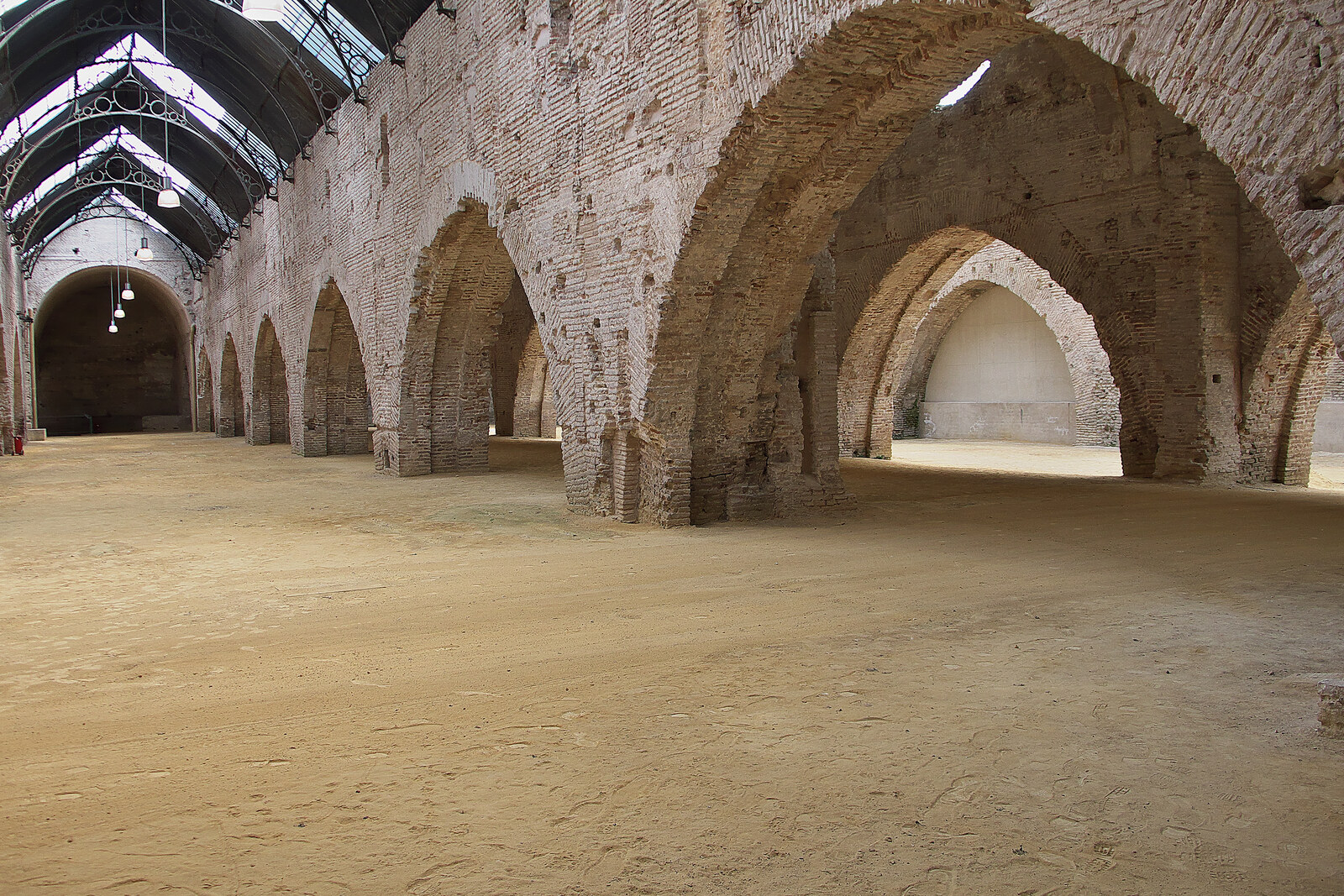
Look around first
What to notice
- Wide brick arches
- Seven surviving halls
- High vaults
The story of the place
These high brick vaults remain from the royal shipyard where long oared warships were built and repaired. There were originally seventeen rooms: their end walls faced the Guadalquivir River, while the city wall stood behind them. On the empty sandy strip between the river and the shipyard, workers used ropes, pulleys, and winches to drag the heavy hulls under the roof. Each room held two galleys, and the old floor is now about five meters below here.
In the autumn of fifteen eighteen, officials of the Casa de Contratación de Indias—a royal agency that prepared ocean expeditions—began bringing hemp, planks, ropes, anchors, weapons, sails, beans, chickpeas, cheese, and wine here. The hemp was teased apart here into oakum for sealing the gaps between planks; barrels were assembled from the staves that had been brought in, and candles were made from tallow. Everything was intended for Ferdinand Magellan's five ships.
Magellan was a Portuguese sailor who sought money from the Spanish king for a westward route to the Moluccas, the main market for cloves. He received no support in his homeland and entered the service of the young Charles I. The king wanted to reach the spices through the part of the ocean that he considered Spanish. Magellan was risking his life for a very earthly reward: he had been promised the post of governor of the lands discovered and a twentieth share of the profits. Portuguese representatives tried to halt the preparations, so royal officials hurried to get the fleet to sea.
For this they were given a huge medieval arsenal. Alfonso X of Castile, who needed a permanent military fleet, ordered it completed in twelve fifty-two. The word “atarazana” came from Arabic and meant a house of production. They were called the Royal Shipyards because the ships and everything needed for them belonged to the Crown.
Seventeen long brick halls were set across the shore, with their ends facing the Guadalquivir River. The city wall ran behind them, and the undeveloped sandy El Arenal lay before them. There, craftsmen built and repaired galleys—long oared warships. Then teams of workers used ropes, pulleys, and winches to drag the heavy hulls across the sand under the roof. Each hall held two galleys. That is why the arches were so wide, and why no houses could be built between the building and the water.
By the start of Magellan's expedition, galleys had already given way to tall sailing vessels designed for the ocean. The officials decided to save time: they bought five second-hand ships in Cádiz and used the old Royal Shipyards of Seville as a sheltered warehouse and workshops. That is why the ships of the first circumnavigation were not built here. Under these roofs, they assembled what the ships could not have left without: from ship bolts and spare planks to wine, oil, and beans. The cargoes were then carried down to the waterfront in batches.
In August fifteen nineteen, five vessels left Seville. Magellan found the strait from the Atlantic to the Pacific Ocean, but he was killed on Mactan Island and did not live to receive his promised share of the spices. The return voyage was taken over by the Basque sailor Juan Sebastián Elcano, captain of the Victoria. In September fifteen twenty-two, it alone of the five returned to Seville. On board were Elcano and seventeen other men who had completed the first voyage around the Earth, while the hold contained the cloves for which it had all begun.
The Victoria itself is not here, and no individual storehouse for its supplies can be identified among the surviving spaces. Seven of the seventeen medieval halls survive. Their original floor now lies about five meters below the present one—the height that once made it possible to haul entire galleys in here remains underground.
Useful on site
VisitSevilla indicates a temporary closure; exterior viewing is possible from the street.
Checked: June 26, 2026. Check the official source before visiting.Do not build this stop around a required entry: access inside may be limited, and the story is easy to listen to from the street.