 Guide On Map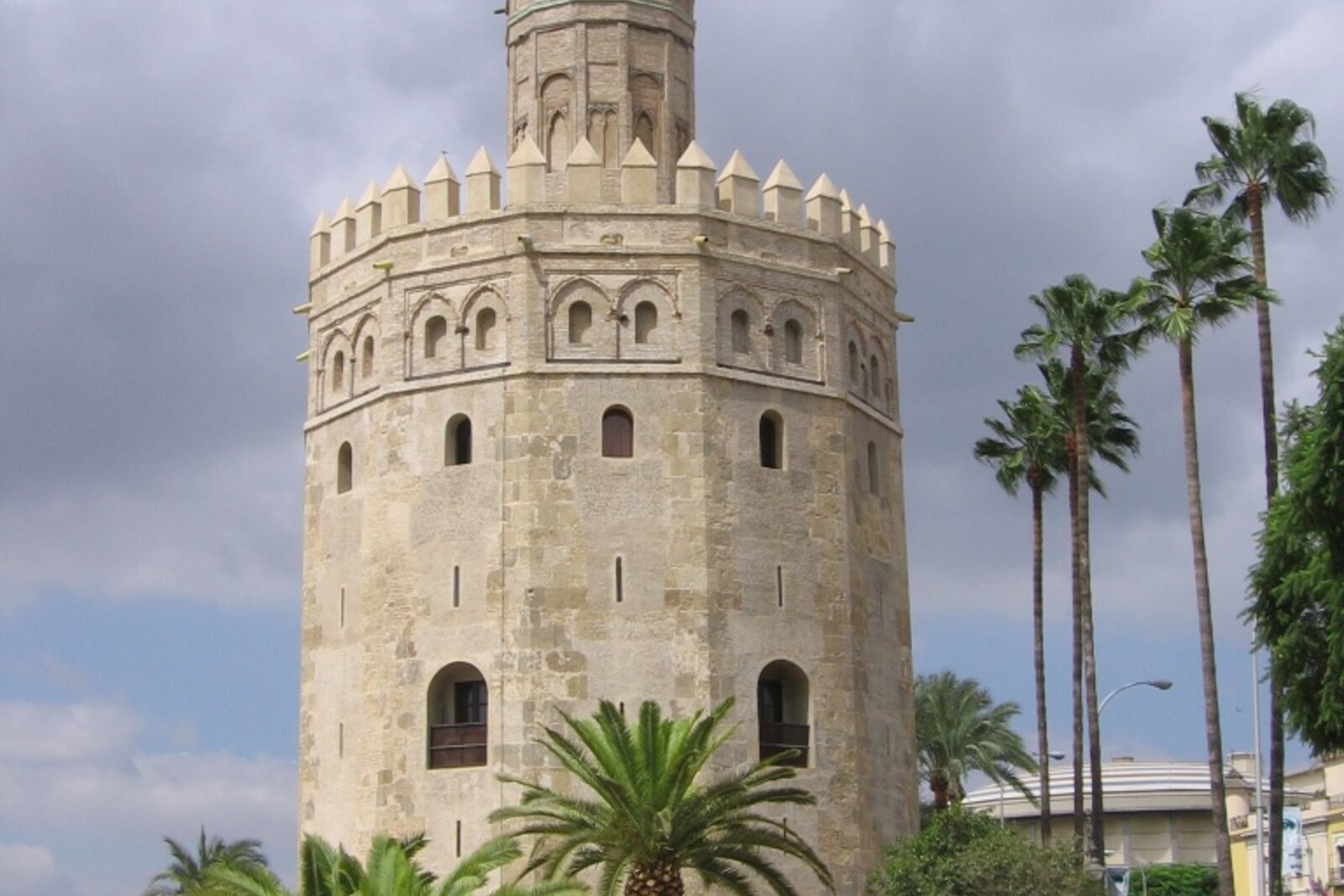
Look around first
What to notice
- Round upper turret
- Golden dome
- Raised entrance
The story of the place
In seventeen fifty-eight, Pedro Samaniego, Marquis of Monte Real, proposed demolishing Torre del Oro. Samaniego was the assistant of Seville—a royal official acting as the head of the city. He was responsible for urban improvements and wanted to widen the passage for carriages, while also straightening the road from San Telmo Palace to the old pontoon bridge to Triana. The tower stood directly in the way.
Three years earlier, the earthquake in Lisbon had damaged its vaults and upper sections. The foundation had already been weakened by floods of the Guadalquivir River, and the building had to be propped up. During an inspection, one of the invited architects recommended dismantling the tower; two others maintained that the walls could still be bound with iron bands and saved. For Samaniego, the damaged fortification, long stripped of its former military importance, was an obstacle in the part of the city he governed.
Educated residents of Seville with access to the court opposed the demolition. They secured the king's intervention, and Samaniego did not get the direct passage he wanted. On March seventeenth, seventeen sixty, repairs began instead of dismantling, under the direction of Ignacio Moreno, master of the Royal Alcázar of Seville. The builders filled the lower level with rubble and mortar, bound the weakened sections with iron, and added a round turret with a dome at the top. The entrance had to be moved higher, into an opening through which the wall had previously run.
What they saved was part of a defensive system created more than five hundred years earlier. In twelve twenty-one, Abu l-Ula, governor of the Almohads—a North African dynasty that then ruled Seville—ordered the city wall to be extended from the Royal Alcázar of Seville to the river. Torre del Oro was placed at its end. From here, warriors guarded the port, the pontoon bridge, and the river approach to the city; during a siege, they could block movement along the Guadalquivir River. The wall disappeared, which is why the tower now seems solitary.
American gold has nothing to do with its name. The medieval “History of Spain” already calls it “Golden” in its account of events in twelve forty-eight—more than two centuries before Columbus's first voyage. The exact explanation of the name remains disputed. Old chroniclers wrote of golden ceramic plaques, and after the restoration in two thousand five, the sheen was linked to a mixture of lime mortar and pressed straw that covered the walls. The golden tiles of the current dome appeared only during the repairs of seventeen sixty, when the name had long already existed.
The Spanish Navy has used the tower since eighteen seventy, initially housing the port administration here. In nineteen forty-four, the Seville Naval Museum opened inside, with maps, ship models, and navigational instruments. Its lower hall occupies the space above the level that Ignacio Moreno's builders permanently walled up to save the tower.
Useful on site
Accessible outside as urban space; the hours of the Seville Naval Museum change, so check them before entering.
Checked: June 26, 2026. Check the official source before visiting.The narration works from the riverside promenade; plan a museum visit inside separately and only after checking access.