 Guide On Map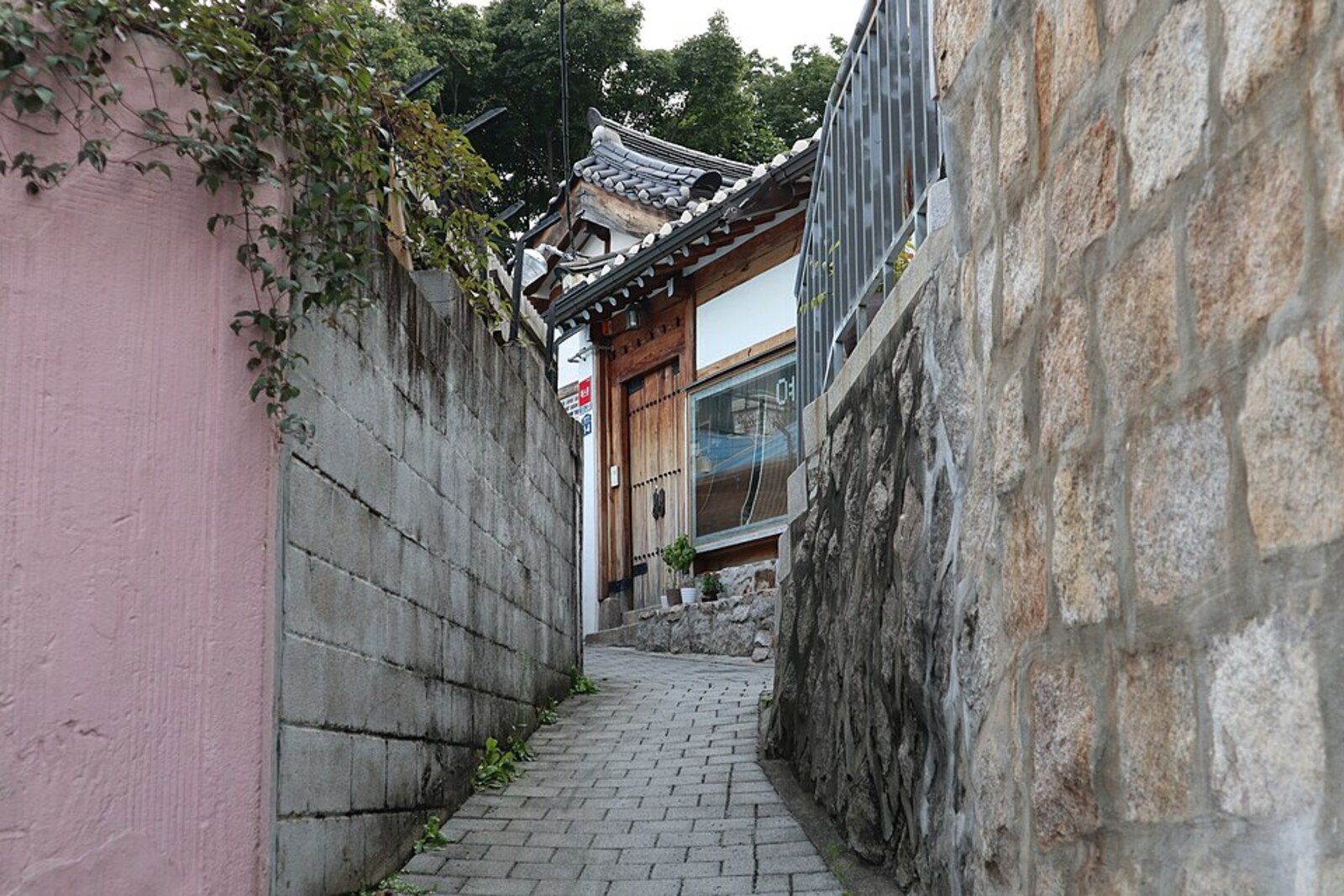
Look around first
What to notice
- One-story house No. 7
- Old wooden beams
- Brickwork
- Inner courtyard
The story of the place
In Bukchon, a tiled roof alone guarantees nothing: sometimes it conceals a house with a steel or concrete frame. This private hanok is arranged around a small courtyard; its wooden beams and brickwork have survived. The owners admitted people for small exhibitions and performances, so that the house could be seen from inside, rather than only from the alley.
In a side branch of this alley stands a one-story house, number seven. Under its old address, it was lot Gahoe-dong thirty-one to seventy-nine. Carpenters employed by Jeong Se-gwon built an urban hanok here in nineteen twenty-nine—one of the small houses whose origins the previous stop has already explained.
In nineteen eighty-eight, the house was bought by the British journalist David Kilburn and his wife, the Korean entrepreneur Choi Geum-ok. They wanted to live in an old hanok specifically, rather than replace it with a more convenient building. Kilburn earned his living as a journalist then; later, the couple opened a tea-trading company. Architectural preservation was not his profession.
He had to take it up after construction began beyond the neighboring wall. In two thousand one, the city began giving owners money to repair hanoks. The idea was to reinforce old houses and adapt them to modern life. In practice, some owners dismantled the wooden frame, replaced it with steel and concrete, added a floor, and then covered the new building with a tiled roof. The Kilburns’ neighbor did exactly that. According to David, the work damaged their house, and the enlarged structure encroached onto their lot.
Kilburn tried to use the same program to register and repair his hanok without demolishing it. In July two thousand four, the district administration rejected the application. In a surviving letter, he stated that officials had advised him not to apply again: they had no intention of registering the house on lot thirty-one to seventy-nine.
Kilburn then began photographing every demolition in Gahoe-dong, comparing new buildings with old lot plans, and putting the documents into an open online archive. He went to City Hall and the district office, sent letters, and brought journalists and researchers into his courtyard. In nineteen ninety, he was still writing about hanoks for an airline’s in-flight magazine; now the disappearance of houses around his own courtyard was becoming his subject.
Sometimes he stood in front of construction crews. After a confrontation with a foreman in two thousand six, Kilburn ended up in the hospital. He was unable to stop the rebuilding: between nineteen eighty-five and two thousand seven, the number of hanoks in Bukchon fell from more than fifteen hundred to about nine hundred. Many of the flat roofs in the famous alley appeared only after the city preservation program began.
The couple did not dismantle their own house. They began admitting visitors for small exhibitions and performances, so that people could see the old beams, brickwork, and layout of the courtyard. By two thousand ten, Kilburn called it almost the only original hanok left in this part of Gahoe-dong.
David Kilburn died in Seoul in two thousand nineteen. Lot thirty-one to seventy-nine is still occupied by a one-story private house. Its current address is Bukchon-ro 11ra-gil, number seven.
Useful on site
For Bukchon-ro 11-gil, the tourist hours are 10:00-17:00; the red zone has restrictions from 17:00-10:00.
Checked: June 28, 2026. Check the official source before visiting.Do not try to look inside private homes. Visit Baek In-je House and other accessible estates only within areas open to visitors; you can listen to the entire account from the street.