 Guide On Map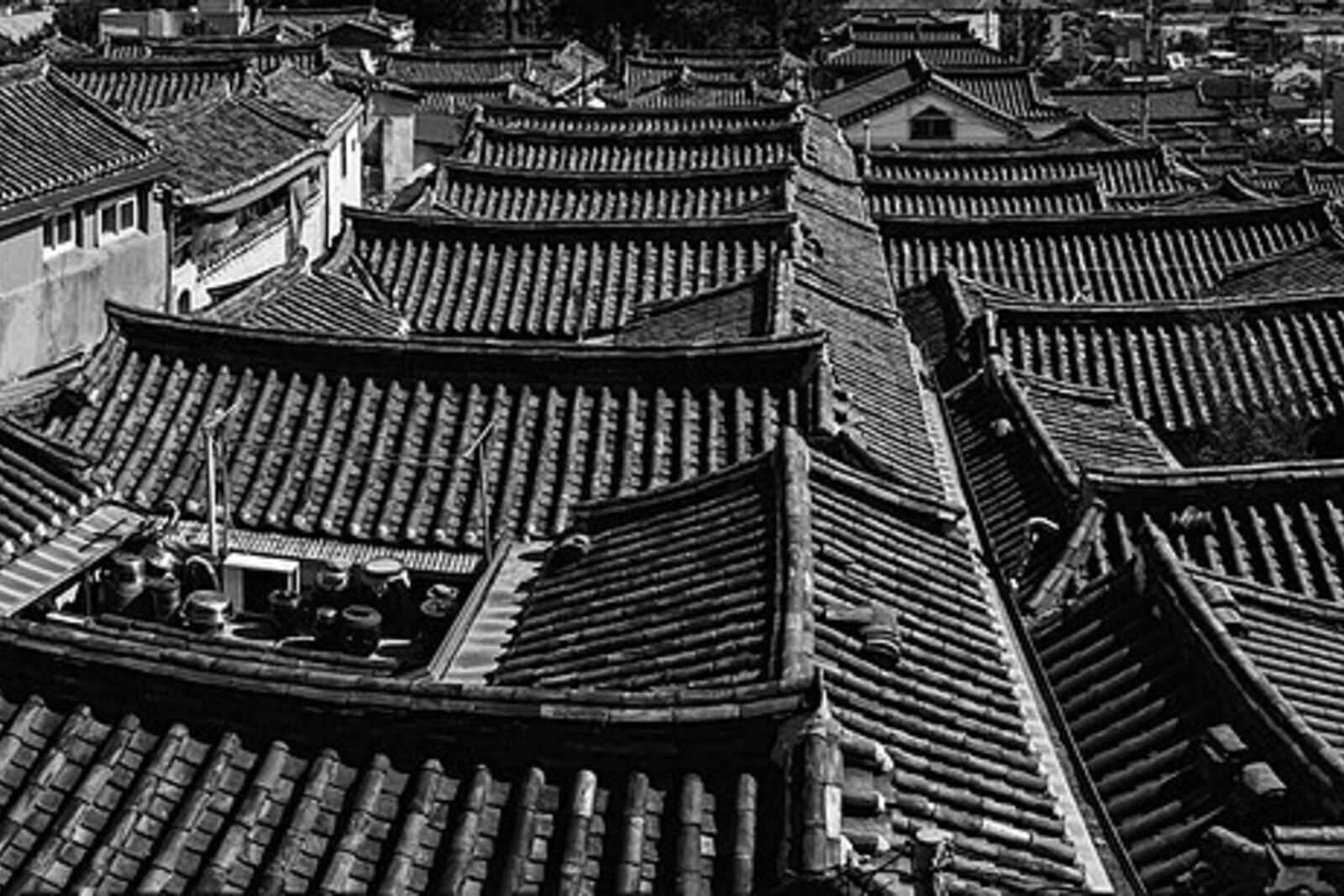
Look around first
What to notice
- Tiers of tiled roofs
- Small plots
- Narrow alleys
- Compact hanoks
The story of the place
Bukchon means “northern village”: this was the name for the neighborhoods north of Jongno, on the southern slope between Gyeongbokgung Palace and Changdeokgung Palace. The northern edge here is higher, and the streets descend along old gullies, so the tiled roofs can be seen in tiers.
The close rows of hanoks took shape mainly in the nineteen twenties and nineteen thirties. Before that, the slope was occupied by spacious estates belonging to officials and noble families. One compound occupied land that would later hold an entire block.
After Japan's annexation of Korea, Seoul's population grew quickly, housing was scarce, and neighborhoods of Japanese houses were advancing north of Jongno. Jeong Se-gwon, a Korean developer, wanted to preserve a place here for Korean families. He bought large estates, divided the land into small plots, laid out alleys, and built urban hanoks—compact Korean houses with tiled roofs and inner courtyards.
Se-gwon made money by selling these houses, but accepted payment in installments after residents had already moved in. This made home ownership accessible to families unable to pay for a purchase all at once, while the developer's investment was returned over months and years. The houses were fitted with water and electricity, the toilet was moved indoors, and the rooms were designed for a family of six. After completing each section, Se-gwon moved his family there for a time and tested the layout in his own daily life.
In less than a decade, he was nicknamed the “construction king of Gyeongseong,” the official name for Seoul during the colonial period. Se-gwon gave part of the profits from the hanoks to the Korean Language Society, which was compiling a dictionary and unified rules for the Korean language. He bought land nearby in Hwadong, built a two-story house for the society, and donated it to the dictionary compilers.
In nineteen forty-two, the police crushed the society. Se-gwon was arrested as one of its main donors and tortured. The following year, he was accused of an economic crime and stripped of a substantial part of his property. The construction business that had paid for the linguists' work was ruined.
The former estate boundaries on the slope disappeared. What remains of the system Se-gwon created are small plots, narrow alleys, and compact hanoks descending in steps toward Jongno.
Useful on site
For Bukchon-ro 11-gil, the tourist visiting window is 10:00-17:00; the red zone is subject to a 17:00-10:00 restriction.
Checked: June 28, 2026. Check the official source before visiting.This is a residential neighborhood: speak quietly, do not block entrances, and do not point your camera into windows or over fences. A general view from the street is enough to understand this stop.