 Guide On Map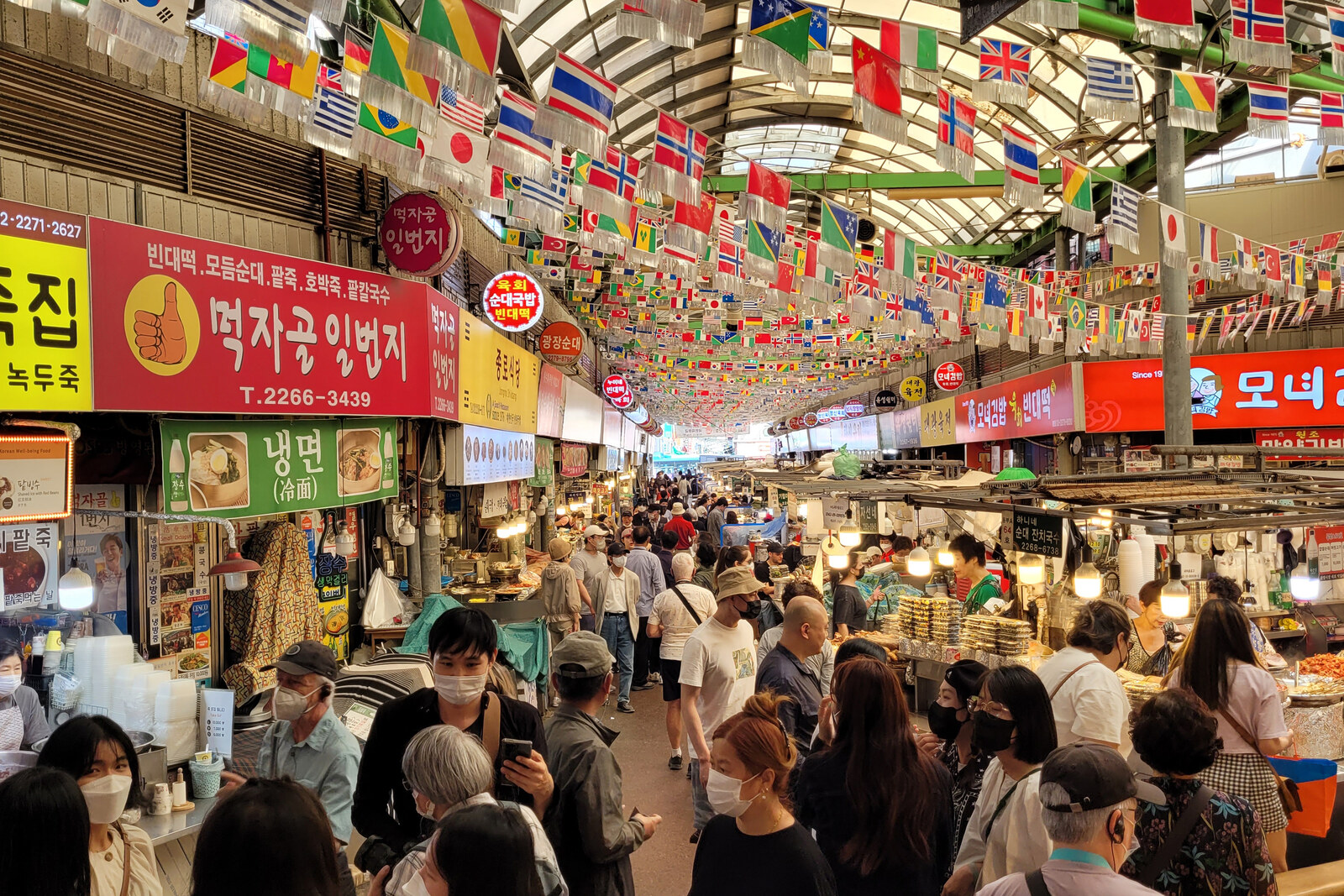
Look around first
What to notice
- Covered market aisles
- Food counters
- Second-floor fabric rows
- Market signs
The story of the place
In the Baeogae quarter, sellers from one of the large markets of old Seoul had gathered since long ago. They could trade only briefly, most often early in the morning, and then people dispersed. Later, the site was enclosed by an earthen fence with four gates; inside, covered shops for storing goods and tin awnings were installed, with places assigned to about two hundred sellers. What remains of the territory that was locked after sunset is its narrow covered aisles and the fabric rows one floor above.
In Gwangjang's central aisles, people eat at counters and buy meat, fish, and vegetables. On the second floor, they choose fabrics, order hanbok, and sort through vintage clothing. Food made the market famous among travelers, but the merchants created it for a more pressing purpose: they needed a place where they could work permanently and manage the shops themselves.
In the summer of nineteen oh five, a rumor spread around Seoul that the market near Namdaemun Station would be relocated. After the Russo-Japanese War, the Japanese military occupied city barracks and institutions, and the commercial land near the station was becoming increasingly valuable. For Korean merchants, this meant the risk of losing one of the few established urban markets.
Among those directly affected was Park Seung-jik. He made his living selling fabric and had opened a shop here, in Baeogae—an old commercial district near the eastern part of Jongno—as early as eighteen ninety-six. Park, together with other merchants and several high-ranking officials, invested in a company that was to create a new permanent market. Kim Jong-han, an official and entrepreneur who knew how to conduct business with both ministries and private investors, sought permission for it.
The market was initially planned farther west. The entrepreneurs decided to cover the section of Cheonggyecheon Stream between Gwanggyo Bridge and Janggyo Bridge and place market rows over the streambed. They formed the company's name from the names of the two bridges: they took the first syllable from Gwanggyo and the second from Janggyo. On July tenth, Kim Jong-han submitted a petition to the Ministry of Agriculture, Commerce and Industry, soon received permission, and workers began laying the materials.
Then heavy rain fell. The water carried away what had been prepared to cover the stream, and the investors had to abandon that site. They did not dissolve the company. Park Seung-jik and his partners moved the project to Baeogae, where trade already supported Park and many other shopkeepers. It was one of the three largest markets in old Seoul, but merchants gathered here only briefly, often early in the morning, and then dispersed.
The company bought land and established a permanently operating market. The first rows contained fifty tile-roofed warehouse shops, with merchants under tin awnings beside them. About two hundred sellers received assigned places. The grounds were enclosed by an earthen wall, fitted with four gates, and closed after sunset. By early March nineteen oh nine, the market had fully occupied its present site.
Officials were nominally at the head of the enterprise, but merchants handled its daily affairs. In nineteen twelve, the merchants and officials clashed over management of the market and the distribution of profits. At a meeting, the shareholders removed the former officials from management; Park Seung-jik and other merchants gained control of the company, and Park himself served as its representative for a time. A man who earned his living selling fabric in Baeogae ultimately ran a market built around shops like his own.
After the move, the pronunciation of the name was retained, but the second Chinese character was replaced: instead of the character meaning “long,” which recalled Janggyo Bridge, they chose a homophonous character meaning “storehouse.” That is why Gwangjang is not the name of a square. On the present sign, the name of the section between two other bridges remains; after the downpour, the merchants themselves opened the market here, in old Baeogae.
Useful on site
The general market operates 09:00‑18:00; charity shops — 10:00‑19:00; the food street — 09:00‑23:00. On Sundays, everything except the food street is closed.
Checked: June 28, 2026. Check the official source before visiting.Do not stop in the middle of an aisle, and keep in mind that sellers are cooking, taking orders, and serving regular customers at the same time. For food, choose an open seat at a particular stall; arrange in advance before photographing people.