 Guide On Map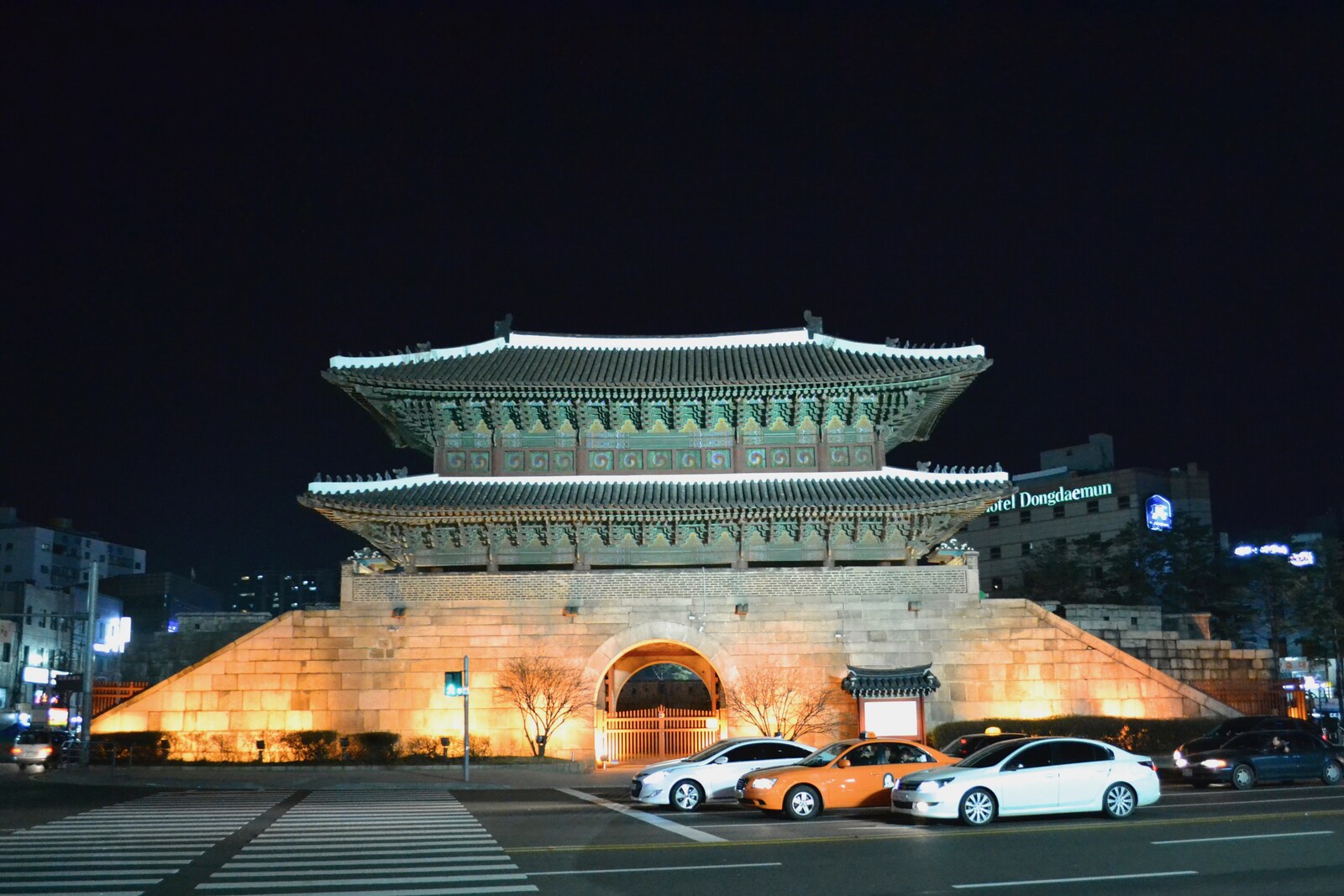
Look around first
What to notice
- Semicircular outer wall
- Arched passage
- Two-story gate tower
- Plaque with the official name
The story of the place
Dongdaemun is the colloquial name, meaning “Great East Gate.” The official name is written on the square plaque beneath the roof: Heunginjimun (Dongdaemun), “Gate of Rising Benevolence.” The builders of the Joseon capital assigned Confucian virtues to the main gates; the east received benevolence—“in.” Even under King Jeongjo, the extra character “ji” in the four-part name was explained as an attempt to strengthen the city’s weak eastern side: here, the low mountain of Naksan descended onto the plain, and water flowed out of the capital.
That is why a semicircular outer wall, an onseong, was built in front of the arch. The entrance was left only at the northern edge of the semicircle: attackers had to turn and proceed along the wall under fire from above. Of Seoul’s eight gates, only the eastern one received this fortification.
In the spring of fifteen ninety-two, Toyotomi Hideyoshi, who had unified Japan, sent an army through Korea toward Ming China. The first division was commanded by Konishi Yukinaga. He was born into the family of a medicine merchant from Sakai, entered Hideyoshi’s service, and rose to become a daimyo—a military landholder who lived on rice revenues from his province. A neighboring part of that same province was governed by Kato Kiyomasa, commander of the second division. Now they competed for the right to be the first to report to Hideyoshi that they had captured the Korean capital.
Near Chungju, the dispute over who would go ahead nearly led to a clash between their men. In the end, the commanders divided their routes: Konishi was to approach Hanyang—as Seoul was then called—from the east, and Kato from the south.
After the Korean army was defeated near Chungju, King Seonjo decided to preserve the court and reach the troops in the north. He left the capital and headed for Pyongyang. Soldiers and officials scattered after him. Some townspeople looted the state storehouses and set fire to the institutions where debt and slave records were kept.
Seeing the glow above the capital, Konishi ordered his men to march at night. At dawn, June twelfth in the modern calendar, his men reached the eastern gate.
Records give different accounts of how they got inside. Korean witnesses maintained that the gate had been left open and had no defenders. A later Japanese military chronicle attributes the decisive act to the warrior Kido Sakuemon: allegedly, he removed the wooden stock from a matchlock gun, used its barrel to pry open the iron door of a small water outlet beside the gate, crawled inside, and opened the gate leaves. This detail cannot be considered undisputed. One thing is certain: no battle took place at Dongdaemun. Kato reached the southern gate several hours later.
Konishi won the race, but he did not receive the king’s surrender: Seonjo was already moving farther north. The Japanese divisions had to continue the pursuit. Konishi occupied Pyongyang, was driven out seven months later by a combined Ming-Korean army, and retreated back to Seoul. The following spring, Japanese troops left the capital.
The gate tower standing here now was rebuilt in eighteen sixty-nine; Konishi never saw its timbers. But the former eastern gate stood at this same passage. The semicircle of the onseong, the outer defensive wall, still shows where attackers were meant to be turned sideways toward the defenders. That morning, no defenders remained on the wall.
Useful on site
The exterior can be viewed around the clock, with free entry; we cannot promise separate regular access to the tower.
Checked: June 28, 2026. Check the official source before visiting.It is best to view the structure from several exterior points: the curve of the barbican does not reveal itself all at once. Roads run around it, so change sides only at permitted crossings.