 Guide On Map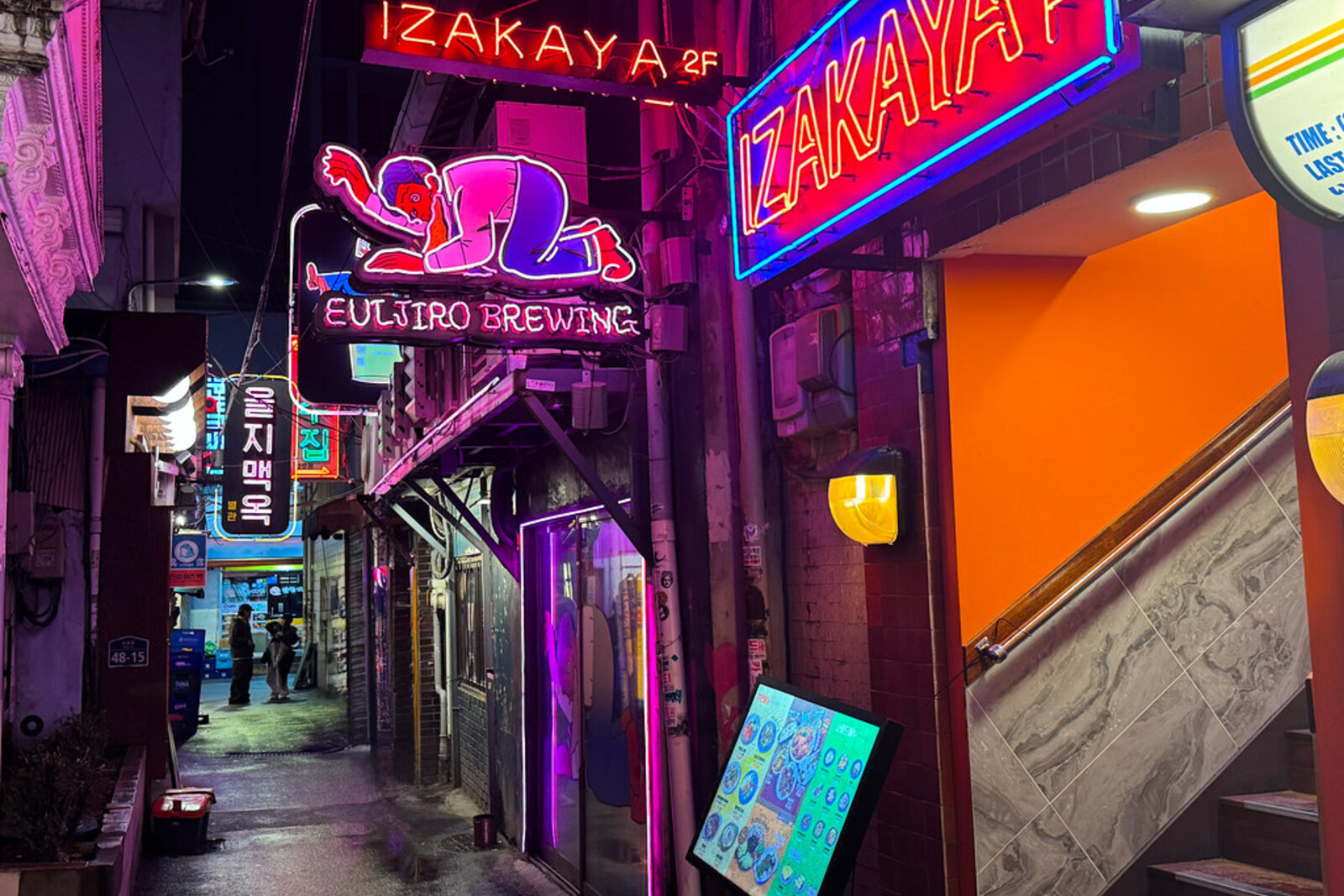
Look around first
What to notice
- Beer-bar tables
- Establishment signs
- Fish grills
The story of the place
By evening, this working alley becomes a long row of beer bars: tables stand along the facades, signs glow above them, and fish grills smoke at the entrances. There was once a small room of about twenty square meters here, where a family ran a beer bar and lived behind the same door. Printers, tool merchants, and metalworkers from nearby workshops came here, and at the tables they found both clients and work. That premises is gone after the lease dispute, but the alley is still occupied by dozens of other establishments.
Every morning, Kang Hyo-geun folded a small dried fish in half, beat it with a hammer, slit open its belly, and removed the bones. Then he put it over the coals and served it with pepper paste of his own making. His wife worked beside him, but he did not tell even her the exact recipe for the sauce.
Kang owned the first beer bar in this alley and tried to accustom the local printers, tool merchants, and metalworkers to draft beer. In December nineteen eighty, he opened Eulji OB Bear—the second Seoul outlet of a beer chain. The premises covered about twenty square meters. At the time, draft beer seemed an expensive and unfamiliar proposition to local customers: they more often chose soju or rice wine. For two years and five months, Kang lived right at the establishment. At half past six in the morning, he went out with a broom and swept the alley so that his neighbors would stop seeing him as an outsider. Gradually, people began exchanging orders at the beer bar and connecting craftspeople with those who needed work done.
At first, the brewery company itself delivered the snack: a packet for one hundred won contained peanuts, dried anchovies, and seaweed. But in nineteen eighty-one, the Korea Fair Trade Commission decided that a beer producer was not entitled to supply its establishments with food as well. Kang had to come up with his own cheap snack. He remembered how, in his native Hwanghae Province, pollock was put into kimchi seasoning. Dried young pollock was inexpensive, sold everywhere, and suited a small kitchen. In Korean, this fish is called nogari.
The combination of draft beer, nogari, and pepper sauce quickly filled the twenty-square-meter room. Kang made money on the beer, while he regarded the fish as almost a service for regular customers: later, its price was kept at one thousand won for a full twenty years, even when it no longer covered costs. Neighbors saw the queue and began opening their own beer bars with the same snack. By the end of the twentieth century, nogari was being served all along the alley. That is how the name of one cheap dish passed to the street.
In nineteen thirteen, the elderly Kang handed the establishment over to his daughter, Kang Ho-sin, and her husband, Choi Su-yeon. Two years later, the city recognized Nogari Alley as heritage of the future and officially named Eulji OB Bear its originator. Three years later still, the beer bar was included in the state program “Hundred-Year Store.” That same year, the building’s new owner refused to renew the lease. The family offered to double the rent, lost the court case, and in April two thousand twenty-two lost the premises. Early in the morning, enforcement officers carried out the dishes, broke the door and window, and removed the sign.
Kang’s daughter and her husband first reopened in another district, then in the spring of two thousand twenty-four brought Eulji OB Bear back to Euljiro—about fifty meters from exits nine and ten of Euljiro 3-ga Station. The original twenty-square-meter room of the family beer bar is gone. What remain here are dozens of tables belonging to other establishments and a name made up of the snack Kang Hyo-geun chose for one hundred won.
Useful on site
Hours depend on the particular establishment; plan for an evening visit and check your chosen bar separately.
Checked: June 28, 2026. Check the official source before visiting.During the day, the character of the place is less apparent, while in the evening the passage becomes crowded and noisy. The tables belong to specific establishments: choose a place, order from its staff, and do not block the passage just for a photograph.