 Guide On Map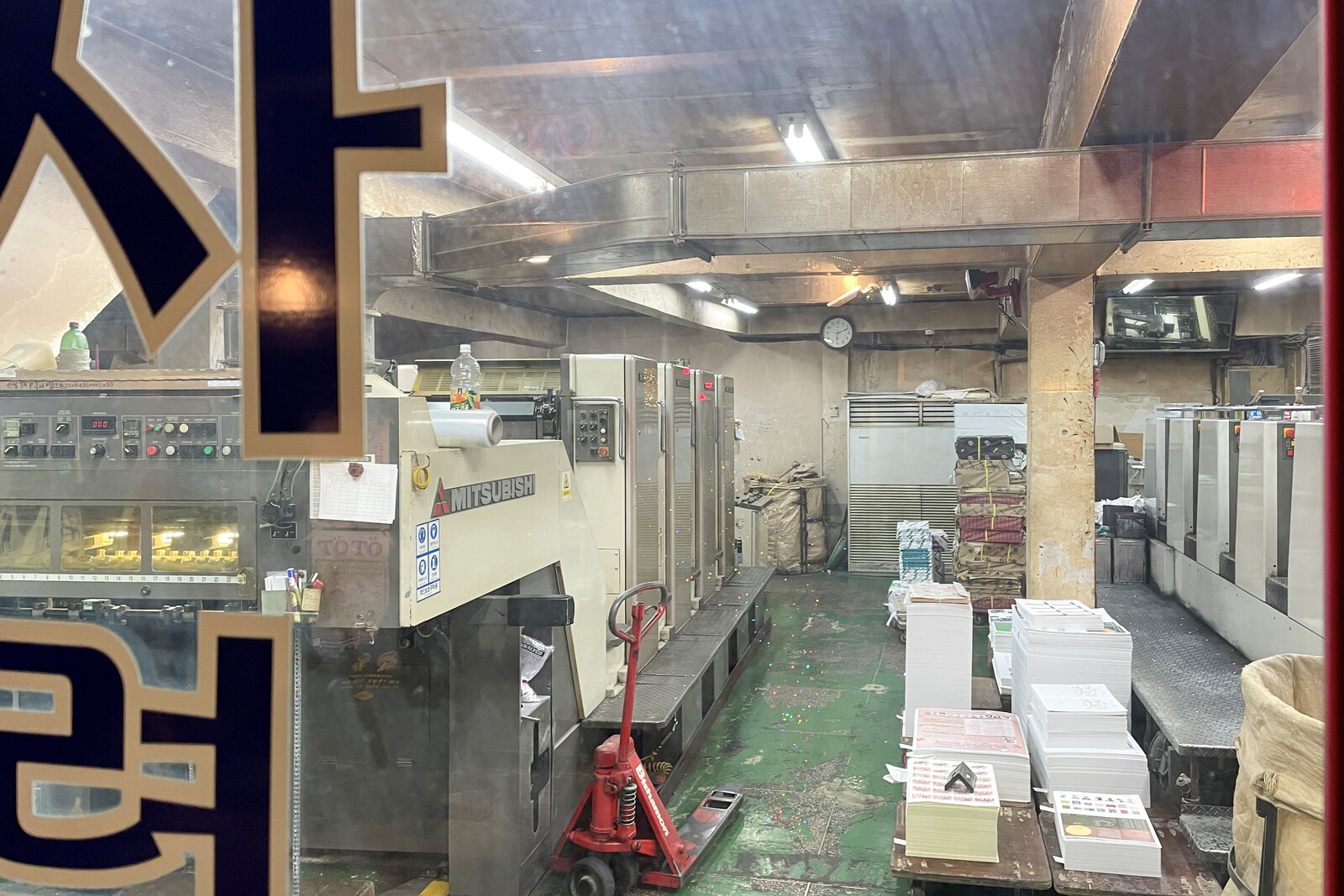
Look around first
What to notice
- Signs for printing operations
- Workshop doors
- Delivery motorcycles
- Bundles of paper
The story of the place
Small print shops occupied Inhyeon-dong between Euljiro and Chungmuro after redevelopment of the neighborhood began in Changgyo-dong. Before moving, they served institutions, trading companies, and movie theaters in neighboring Chungmuro: forms, reports, envelopes, invoices, posters, tickets, and screenplays came from here. By the mid-nineties, owners were leasing expensive foreign machines; after the Asian financial crisis, some workshops closed, while those that remained narrowed their work. Bundles of paper by the doors remain the simplest sign that this is still a working district.
The signs here list individual operations: typesetting, making printing plates, embossing, cutting, folding, and binding. Several workshops may make a single brochure or a box of business cards. A layout is passed to the printer, the printed sheets to the cutter, then to the binder. Orders are moved between neighboring doors by motorcycle: they are more convenient than a van in these narrow lanes.
Euljiro is named after Eulji Mundeok, a military commander of Goguryeo who defended it against an invasion by the Chinese Sui dynasty in six hundred twelve. The alleys’ printing trade appeared many centuries later and grew from a different calculation: print shops needed to remain close to their customers and to one another.
Until the beginning of the nineteen eighties, Seoul’s largest concentration of printers was farther west, in Changgyo-dong—a neighborhood by the first and second sections of Euljiro. They printed forms and reports for institutions, envelopes, invoices, and packaging documents for trading companies. Movie theaters in neighboring Chungmuro ordered posters, tickets, and screenplays. The owners of small workshops each made their living from a single operation: one ran a printing press, another a cutting machine, and a third handled binding. They could take on a large order only together.
In nineteen eighty-three, redevelopment of the neighborhood began in Changgyo-dong, and the print shops had to vacate their premises. Their owners tried not to lose their regular customers and their established chain of contractors. Many moved their equipment only a few blocks away—to Inhyeon-dong, between Euljiro and Chungmuro. That is how these alleys became the main printing district: individual businesses moved, and here they reestablished the entire sequence of production.
By the mid-nineties, there were so many orders that owners leased expensive foreign machines. After the Asian financial crisis of nineteen ninety-seven, companies cut their printing expenses, while the more expensive currency increased payments for imported equipment. Some print shops closed, while others had to seek narrower specializations. Later, digital technology combined several operations, but small firms still pass part of their work to their neighbors.
They have no shared workshop. Its boundaries are visible in the specialized signs, the workshop doors, and the route of a bundle of paper that passes through several neighboring premises before leaving the alley as a finished print run.
Useful on site
The alleys are accessible as city streets; individual print shops and workshops keep their own hours, most often during the day on weekdays, and some places are closed on weekends.
Checked: June 28, 2026. Check the official source before visiting.Look from the street and keep doors, loading areas, and passages between workshops clear. If a premises appears closed, do not try to enter: work may be going on behind an unassuming facade.