 Guide On Map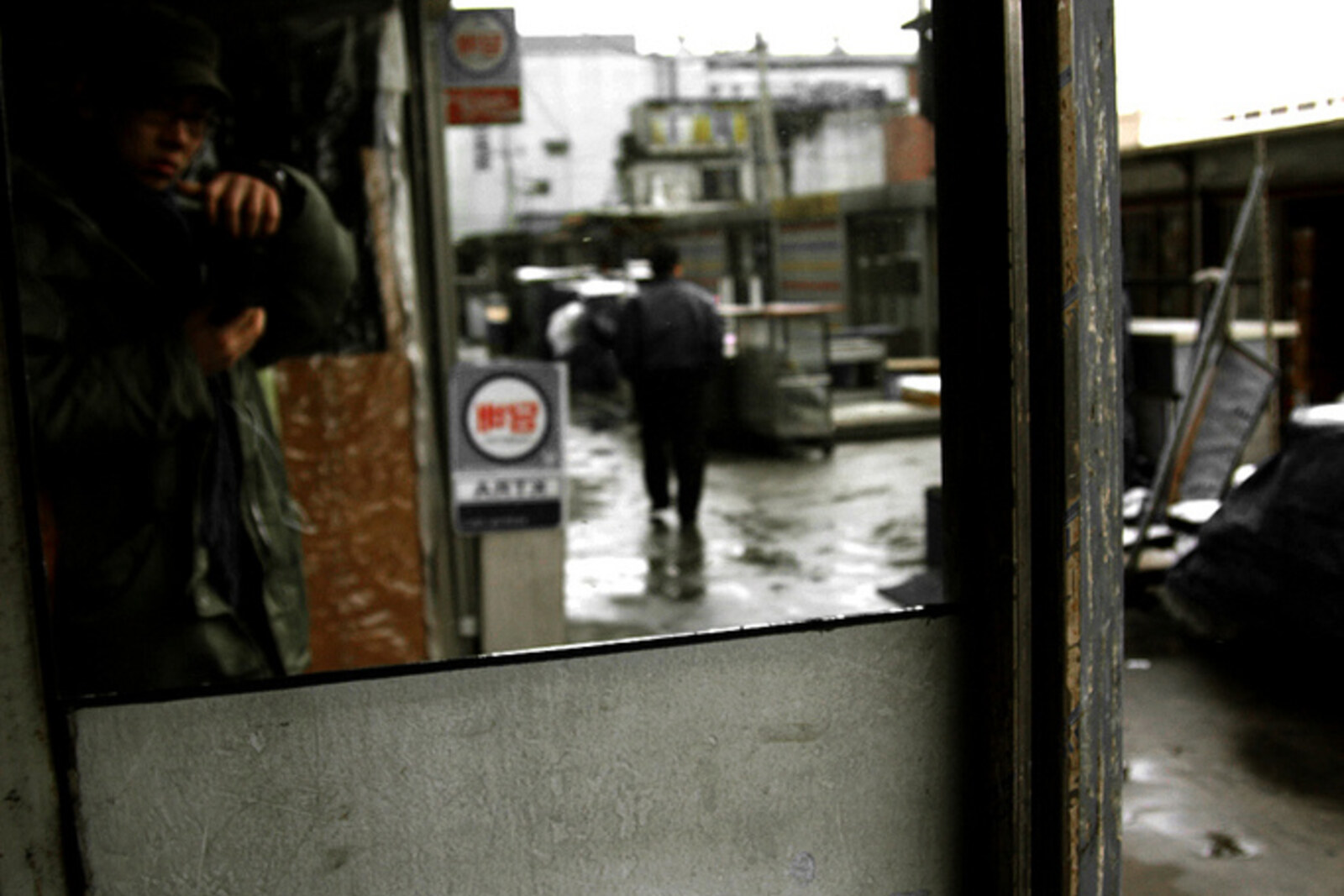
Look around first
What to notice
- Concrete commercial buildings
- Elevated pedestrian gallery
- Windows of the upper workshops
The story of the place
The eight concrete buildings of Sewoon Sangga stretch for almost a kilometer: commercial spaces are arranged below, former apartments remain above, and the pedestrian gallery is raised over the street. The complex occupies a strip cleared during the war as a firebreak; refugee shacks, junk dealers' shops, and repair workshops were later crowded here. The gardens, school, and continuous walkways from the original plan were not completed when the premises were adapted for sale. Workshops and offices can still be seen in the upper windows.
In nineteen sixty-one, there were no concrete buildings here yet. Eighteen-year-old Lee Jeong-seong came to Seoul to train as a television repairman and earn a living through repairs. He had no money for housing. He asked to stay with his older sister, agreeing to sleep even by the door if she would give him food and a roof over his head. After classes at a technical school in Euljiro, Lee found work in one of the workshops here.
Electronics repairers gathered by Cheonggyecheon Stream before Sewoon Sangga appeared. The reason was a strip of land about fifty meters wide, cleared by the Japanese colonial administration at the end of the Second World War: the empty space was meant to stop a fire after an air raid. After liberation and the Korean War, it was occupied by refugee shacks, junk dealers' shops, and repair businesses. Craftsmen took apart Japanese military radios and faulty American receivers, removed surviving tubes, switches, and wires, then assembled working equipment from them. For Lee, it was a place where one broken thing became a supply of parts for another.
In nineteen sixty-six, Seoul Mayor Kim Hyeon-ok decided to replace the shacks with a model urban complex. He gave it the name “Sewoon”—“energy directed toward the world”—and the word “sangga” means rows of shops. Architect Kim Swoo-geun was commissioned to design a full kilometer of buildings: shops below, apartments above, cars on the first level, and pedestrians on a gallery raised above the street. Eight buildings were constructed in all. Part of what had been planned—public gardens, a school, and a continuous system of walkways—disappeared when private developers adapted the project for selling its premises. But the lower commercial floors and upper residential levels remained.
At first, officials, professors, and artists moved into the apartments. Televisions, radio receivers, and record players were sold below. Then wealthy residents moved to new districts south of the Han River, and the vacant apartments were occupied by offices and workshops. Equipment could be taken apart here, a part found in the neighboring shop, a fitting machined in the nearest alley, and then reassembled without leaving the district.
That was exactly the kind of experience Lee Jeong-seong needed. By the mid-eighties, he already knew how to connect hundreds of televisions into a single video wall. In nineteen eighty-eight, Nam June Paik, a video artist, was looking for an engineer for the tower The More, the Better: one thousand three televisions were to show recordings he had prepared simultaneously. Lee agreed, not yet understanding what reputation the artist was risking or how conspicuous any error would become.
The main difficulty was transmitting the image. A Japanese device then in production served only six screens and cost about five hundred dollars. Buying hundreds of such devices was pointless. Lee designed a signal distributor himself and made everything needed in a little over two months. At the scheduled live broadcast, all one thousand three televisions came on. Paik had counted on at least half of them succeeding.
After that, Paik invited Lee to assemble his next work in New York. Their collaboration lasted eighteen years: the craftsman from Sewoon Sangga installed and repaired the artist's video sculptures in museums in different countries, and later became responsible for preserving them. The complex's upper floors are still occupied by workshops and offices. In Lee's room on the sixth floor stood shelves of old televisions and boxes of parts—a reserve for works in which one darkened screen cannot be replaced by an abstract idea.
Useful on site
VisitKorea guidance for the complex: 09:00‑19:00; closed on Sundays and public holidays; individual shops may vary.
Checked: June 28, 2026. Check the official source before visiting.Go up onto the publicly accessible walkways to understand how the complex is arranged by levels. Shops and repair rooms are workplaces; do not enter or photograph craftspeople without permission.