 Guide On Map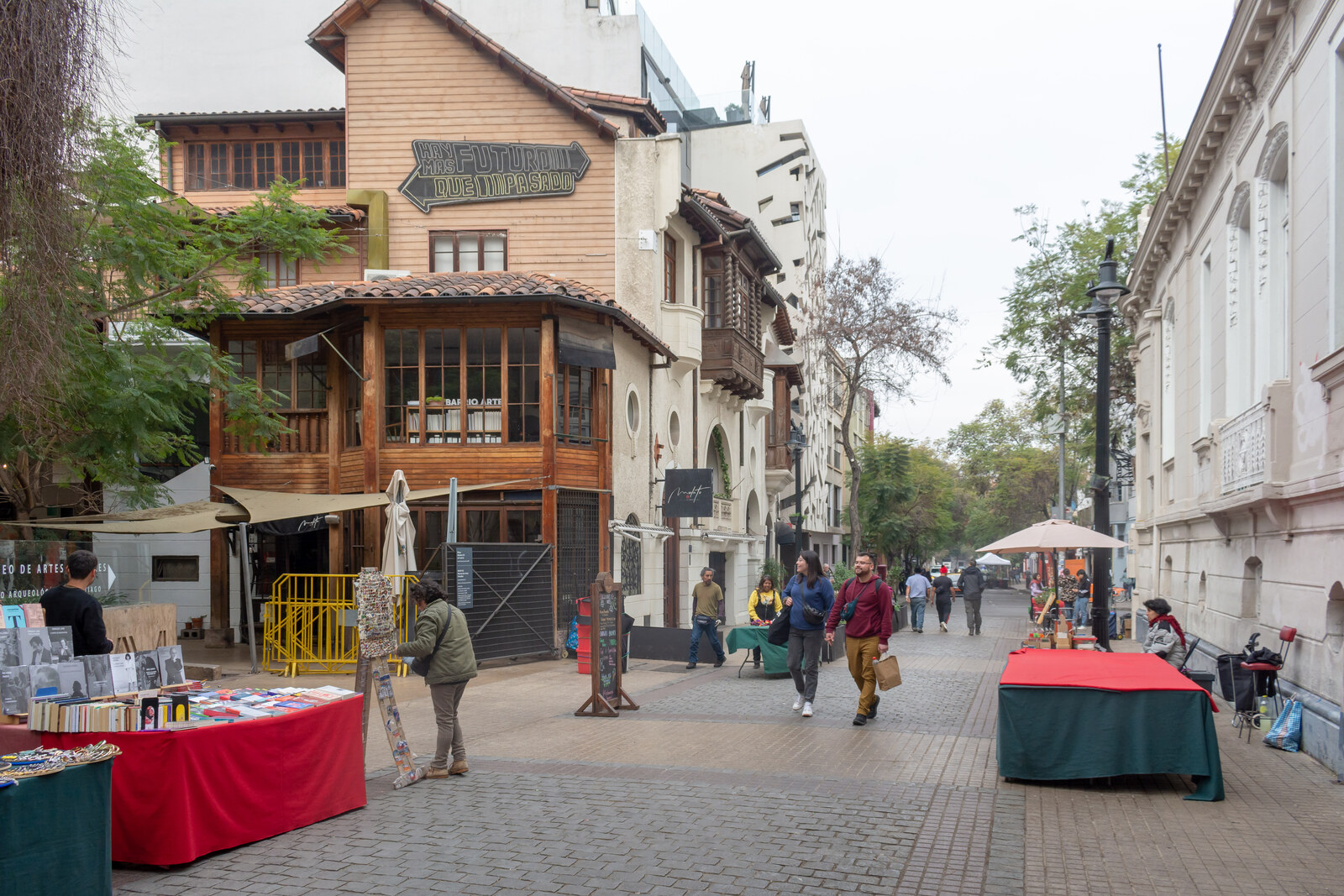
Look around first
What to notice
- Widened sidewalks
- Permanent selling places
- Tables with old books
- The edge of the roadway
The story of the place
The wide sidewalk by the edge of the roadway is lined with tables of old books and objects: the street still serves as a thoroughfare, but on market days a market appears here. A narrow road once crossed the grounds of the Villavicencio family estate, along which crops were carried out. The land was divided into lots, houses appeared along the road, and the former rural route entered the city. The street’s name preserves the memory of José Victorino Lastarria and then gave its name to the whole neighborhood.
In nineteen ninety-two, sellers of old books and objects began setting out their goods at the end of this street, between Rosal Street and Merced Street. Their livelihood lay on their tables: secondhand editions, coins, jewelry, porcelain, and silver. The vendors had no permanent premises, and each depended on permission to occupy a spot on the sidewalk.
Soon the municipality began rebuilding José Victorino Lastarria Street. The sidewalks were widened and repaved, and the final block was turned into a short semi-pedestrian stretch. Vehicle access remained: restaurant and theater owners expected people to keep arriving by car. The street vendors would have to defend their places anew, now on an improved promenade.
In two thousand two, antique dealers and secondhand booksellers formed their own association. Alone, each was responsible only for their own table; together, they could negotiate with the city and preserve the market. As a result, eleven permanent selling places were established here: six for antiques and five for old books. It was the decisions of municipal officials and the vendors’ self-organization that arranged this street as it is used today: the roadway did not disappear, but on market days its edge is occupied by the market.
José Victorino Lastarria Street itself also grew out of a passage whose purpose people changed. When the Villavicencio family estate stood here, crops were carried out along a narrow road. At the beginning of the nineteenth century, the owner divided the land into lots, more houses appeared along the passage, and the rural road became an urban one. It was called Mesiás Lane—an altered form of the surname of Diego Mesía de Torres, owner of the neighboring estate.
José Victorino Lastarria later lived here. He grew up in an impoverished family from Rancagua and earned a living teaching law and writing articles for newspapers. In eighteen forty-two, when he was twenty-five years old, young authors elected him leader of the Literary Society of Santiago. Lastarria urged them to stop treating Spanish literature as a ready-made model and to write about their own country. Over time, his stories were hardly read anymore, while his opening address became a programmatic text of the Chilean literary movement of eighteen forty-two.
On city maps published from nineteen ten onward, the former Mesiás Lane was already labeled with the name of its former resident. The name then passed from the street to the whole neighborhood. On market days, old Chilean books are still laid out beneath the sign reading “José Victorino Lastarria.”
Useful on site
A public street with no fixed hours. Market tables, cafés, and individual spaces operate on their own schedules.
Checked: June 29, 2026. Check the official source before visiting.Do not tie the account to whether a particular café or theater box office is open: the character of the street is clear during a short walk outside.