 Guide On Map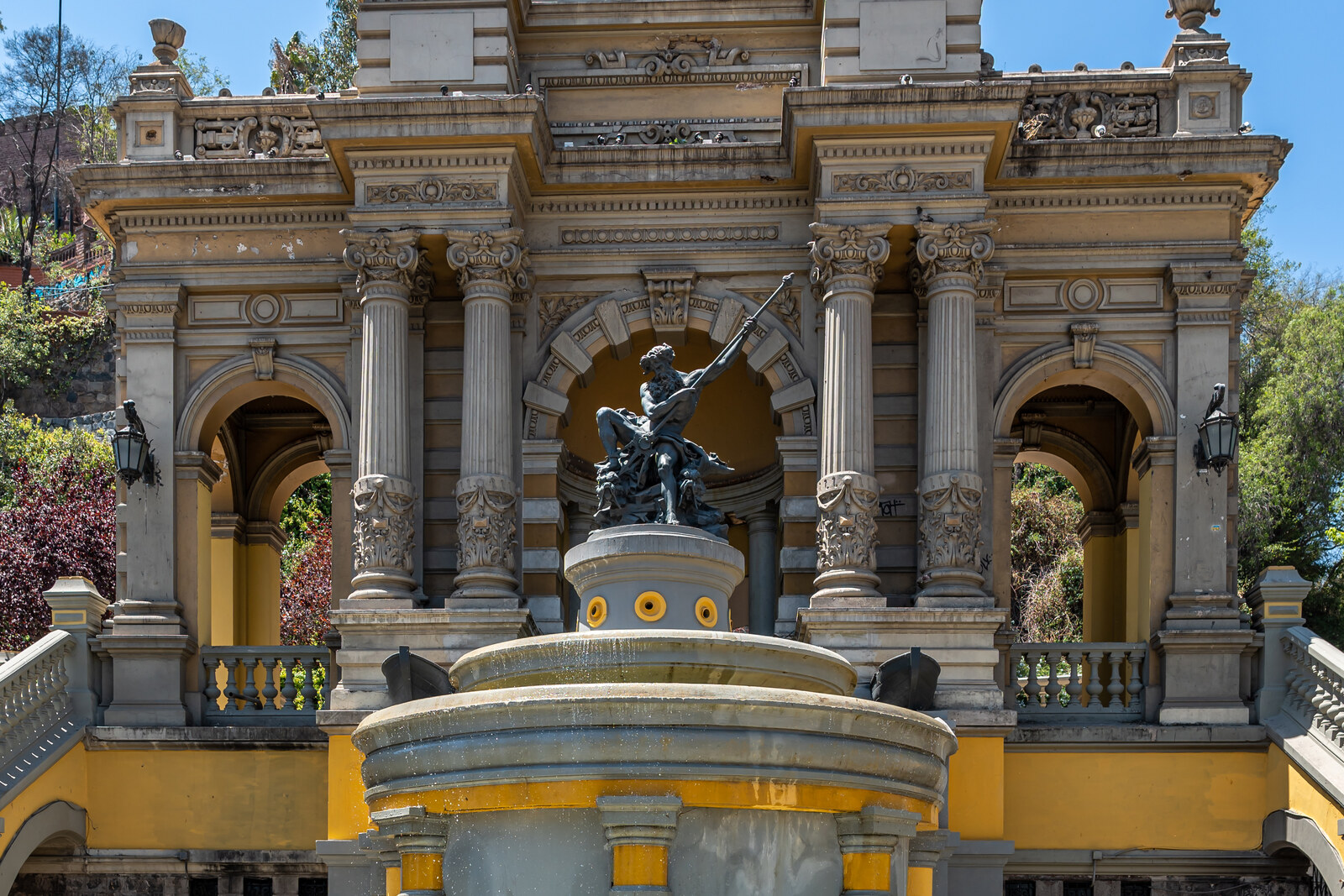
Look around first
What to notice
- The seated figure of Neptune
- Trident
- Paired stairways
- Pools and arch
The story of the place
The seated Neptune with a trident gave the entire terrace its name. The Roman god of the sea came to stand on Santiago’s dry slope as the figure for a city fountain. It was cast in France from a model by the sculptor Gabriel-Vital Dubray. Such statues were mass-produced at Val d’Osne: another Neptune from the same mold stands in Valparaíso, while other copies made their way to cities across Europe and Latin America.
The Chilean state ordered the figure in eighteen fifty-nine. At first, it was installed in the middle of Alameda de las Delicias—the name then used for what is now Bernardo O’Higgins Avenue. Neptune was soon removed. The reason is not stated in the documents. The statue was taken to the city police depot and left among the carts. By eighteen seventy-two, it had lain there for about ten years, covered over so completely that a contemporary called it buried.
At that time, Santiago’s intendant Benjamín Vicuña Mackenna was turning the rocky Santa Lucía Hill into a public park. He was criticized for the expense and because the elegant pleasure garden was intended above all for wealthy city residents. Pipes were being laid on the hill: water was needed by visitors, new plantings, cascades, and fountains.
Víctor Sacléaux, the city waterworks engineer, was responsible for this part of the work. He found Neptune in the police depot, retrieved the statue, and transported it to Santa Lucía Hill. A grotto of rough stone was made for it, with water running over it. Thus, a forgotten object from a municipal storehouse ended up at one of the entrances to the new park and once again took on the role of a fountain sculpture.
Between eighteen ninety-seven and nineteen oh three, the municipality opened a new ceremonial ascent from the Alameda side. Neptune was taken out of the old grotto and placed at the center of the present composition—between paired stairways, pools, and an arch. The grotto remained without its god, and its third city address became Neptune Terrace. The present name preserves not the site’s original purpose but the route of one statue: Alameda, the police depot, the stone grotto, and this fountain.
Useful on site
Summer schedule: Monday 12:00–20:30, Tuesday–Sunday 07:00–20:30. Winter schedule: Monday 12:00–19:30, Tuesday–Sunday 08:00–19:30. The hill is closed during rain.
Checked: June 29, 2026. Check the official source before visiting.The stone steps require attention, especially after precipitation. Do not continue climbing if the entrance is closed or the surface seems slippery.