 Guide On Map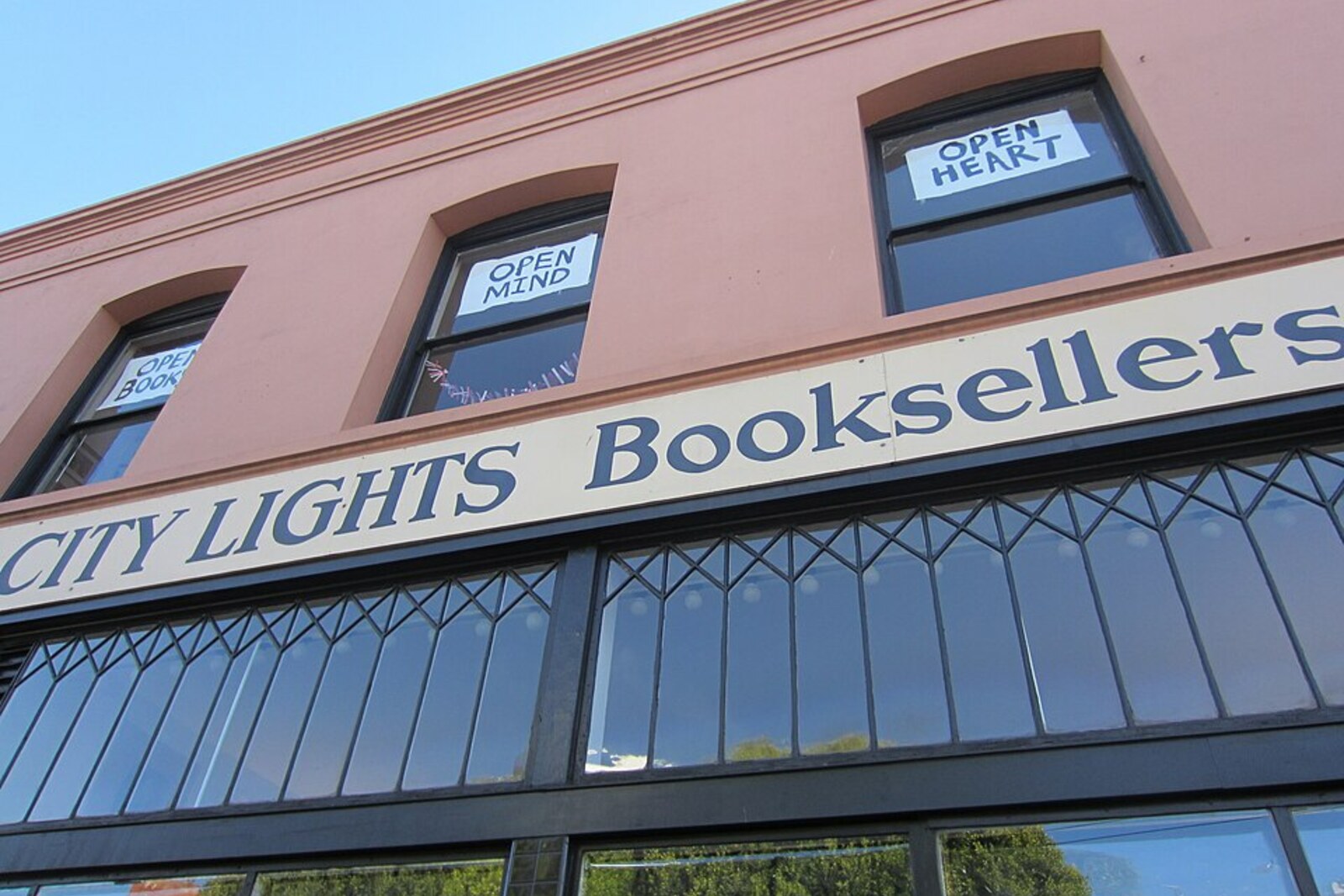
Look around first
What to notice
- The triangular building
- Granite paving blocks
- Writers' lines in the stone
- Alley lamps
The story of the place
The short alley between the bookstore and the bar was once called Adler Place and served as a roadway: trucks drove in here and left trash behind. After traffic was closed, the passage was paved with granite blocks, lamps were installed, and the bookstore wall became one of its boundaries. Writers' lines can be read in the stone beneath your feet: different voices were chosen by the exit toward North Beach, and Chinese authors closer to Grant Avenue. The alley received its present name in memory of Jack Kerouac, who walked between two neighboring doorways.
Books are sold, the bookstore’s own publications are issued, and literary readings are held in the triangular building by Columbus Avenue. The name City Lights Bookstore and Publishers came before the bookstore: sociology instructor Peter Martin published a magazine named after Charlie Chaplin's City Lights Film. In nineteen fifty-three, Martin was hanging a sign reading “Pocket Book Shop” here when the poet Lawrence Ferlinghetti passed by. They each put in five hundred dollars and opened the first bookshop in the country to sell only inexpensive paperback editions.
Two years later, Martin sold his share. Ferlinghetti remained the owner and created a small publishing house at the bookstore for authors rejected by major firms. The manager Shigeyoshi “Shig” Murao was responsible for the counter and book orders. He too invested his own five hundred dollars in the venture: the bookstore was at once his job, capital, and circle of friends.
In the fall of nineteen fifty-five, Ferlinghetti heard the young poet Allen Ginsberg read Howl—a long poem about mental breakdowns, drugs, and sex, including love between men. Ferlinghetti offered to publish the manuscript. He understood the risk in advance and, even before printing, arranged with the American Civil Liberties Union that its lawyers would take the case if prosecution began.
Howl and Other Poems came out as a small book in the Pocket Poets series. In the spring of nineteen fifty-seven, customs officers detained five hundred twenty copies of a new print run, printed in England, as an obscene publication. Ferlinghetti ordered another two thousand five hundred copies in the United States, and the book reappeared on the shelves of City Lights Bookstore and Publishers.
At the end of May, two inspectors from the police juvenile division came here out of uniform. Murao sold them one copy. On June third, police officers returned with a warrant, arrested the manager right in the bookstore, and took him to the Hall of Justice. Ferlinghetti was out of town; when he returned, he surrendered to the police himself. Each faced six months in prison and a fine of five hundred dollars—exactly the amount Murao had invested in the bookstore.
The charge against Murao was dropped: prosecutors could not prove that the seller had read the book and knowingly distributed obscene text. Ferlinghetti's trial continued. On October third, Judge Clayton Horn found the publisher not guilty: the poem had literary and social significance, so coarse words and explicit scenes did not by themselves make it a crime.
By the following year, more than twenty thousand copies of Howl had already been printed. Ginsberg gained wide recognition, Ferlinghetti kept the publishing house, and City Lights Bookstore and Publishers grew from a small shop into a well-known center of independent literature. In two thousand one, the city gave this building landmark status number two hundred twenty-eight; among the officially stated reasons was its defense of freedom of the press.
The short passage along the bookstore wall was once called Adler Place. Jack Kerouac, a Beat Generation novelist and author of On the Road, visited both City Lights Bookstore and Publishers and Vesuvio Cafe on the other side of the passage in the nineteen fifties. In nineteen eighty-eight, Ferlinghetti persuaded the city council to give the alley Kerouac's name.
One new sign was not enough: trucks still drove through here and left trash behind. Only nineteen years later did the staff of City Lights Bookstore and Publishers, together with the Chinatown Alleyway Improvement Program, succeed in closing the passage to traffic. Granite blocks were laid here, lamps were installed, and writers' lines were carved into the stone. On the North Beach side, Kerouac's words are among them, while closer to Grant Avenue there are lines by Chinese authors. The name appeared above the alley because Kerouac walked between two neighboring doorways; this route became pedestrian-only only in two thousand seven.
Useful on site
First, look at the facade and the alley from outside; plan a visit to the bookstore and any events inside separately. Do not stand as a group across the narrow passage.