 Guide On Map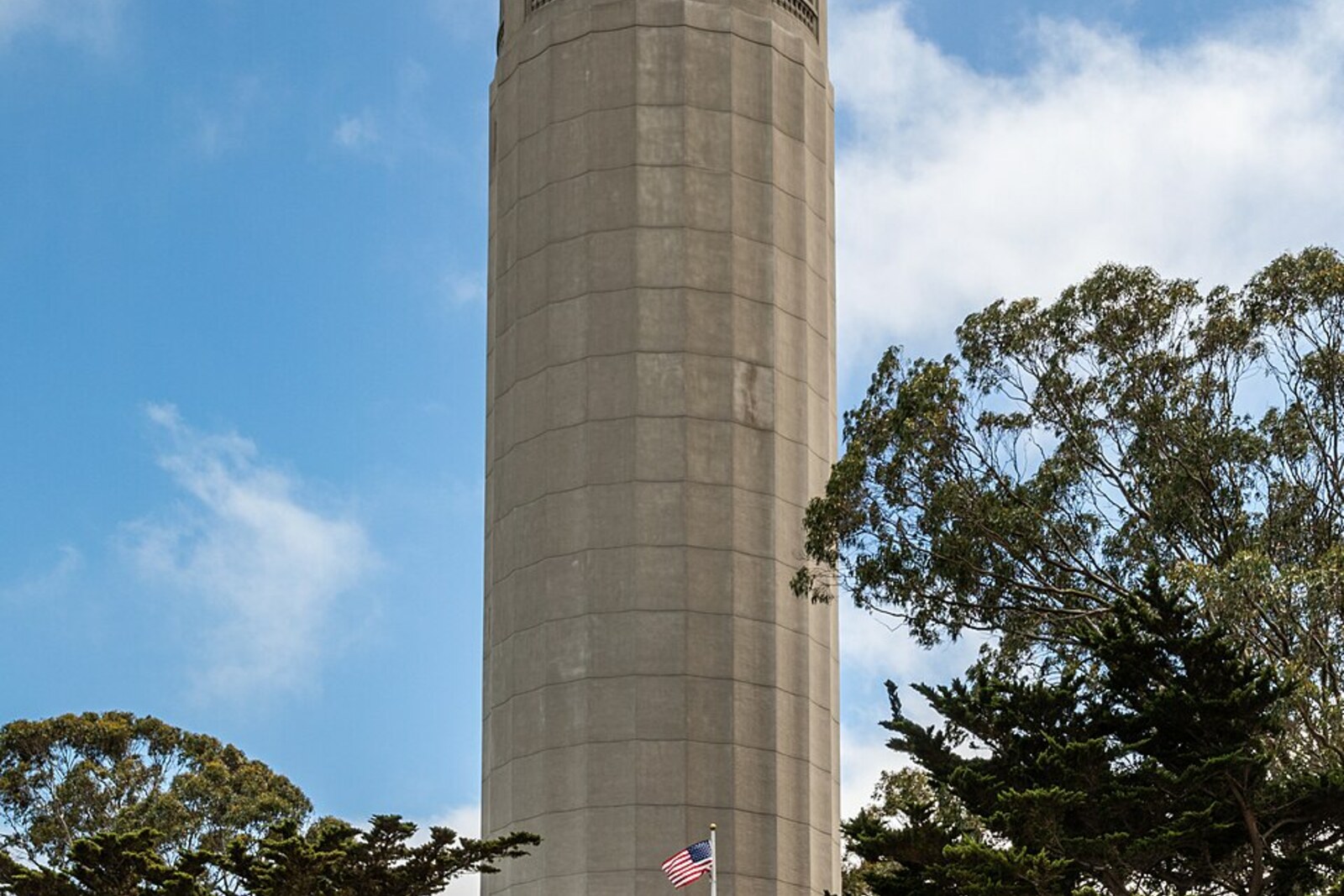
Look around first
What to notice
- The tower’s fluted shaft
- The plaque to the left of the entrance
- The sign in the lobby
- The observation gallery
The story of the place
In the middle of the nineteenth century, this summit was called Loma Alta—“High Hill.” San Francisco was expanding because of the gold rush, and mail, goods, and people arrived by sea. Marine-news reporters George Sweeney and Theodore Baugh made money by informing newspapers and merchants about incoming ships before anyone else did. In eighteen forty-nine, they set up a two-story observation station here, with a mast above it bearing two movable black arms.
Sweeney and Baugh published a table of signals. From the position of the arms, the waterfront and the business district could distinguish a sailing ship, a paddle steamer, or a vessel that needed help. When a mail steamer appeared, a boatman working for Sweeney and Baugh met it out in the bay, took the papers, rowed to the wharf, and handed the packet to a mounted messenger. Subscribers received the news several hours before the ship completed its journey to the anchorage. Newspaper people and merchants paid for this head start, and the enterprise brought its owners a profit.
In eighteen fifty-one, Sweeney and Baugh opened a distant observation post at Point Lobos. From there, the signal was relayed here, to the summit, and from here to the city. Fog sometimes broke this chain. Two years later, the entrepreneurs ran an eight-mile electric telegraph from the point to the center. Sweeney and Baugh continued selling information over the wire; the station with the black arms became unnecessary. The hill retained the name Telegraph Hill.
When the station closed, city residents bought the parcels on the summit and, in eighteen seventy-six, transferred them to San Francisco for the public Pioneer Park. Half a century later, a new vertical landmark appeared here.
Lillie Hitchcock Coit, a wealthy patron of volunteer fire companies, died in nineteen twenty-nine and left the city one-third of her estate for its beautification. She did not commission a tower or specify exactly how the money should be spent. City commissioners chose the summit of Telegraph Hill, and architects designed a concrete memorial with an observation gallery. It was completed in nineteen thirty-three and given the surname of the woman who paid for its construction after her death.
Coit’s connection with firefighters gave rise to a legend that the tower was made to resemble the nozzle of a fire hose. The architects denied this: the narrow fluted shaft was chosen for a small site and a limited budget. To the left of the entrance is a plaque about Coit’s will, and a sign in the lobby marks the site of the signal station. The two-story building itself, the mast, and the movable black arms are no longer here.
Useful on site
The outdoor part of this stop can be visited regardless of whether the tower is open. Check separately whether you can see the interior and the murals; going up is not required for the story.