 Guide On Map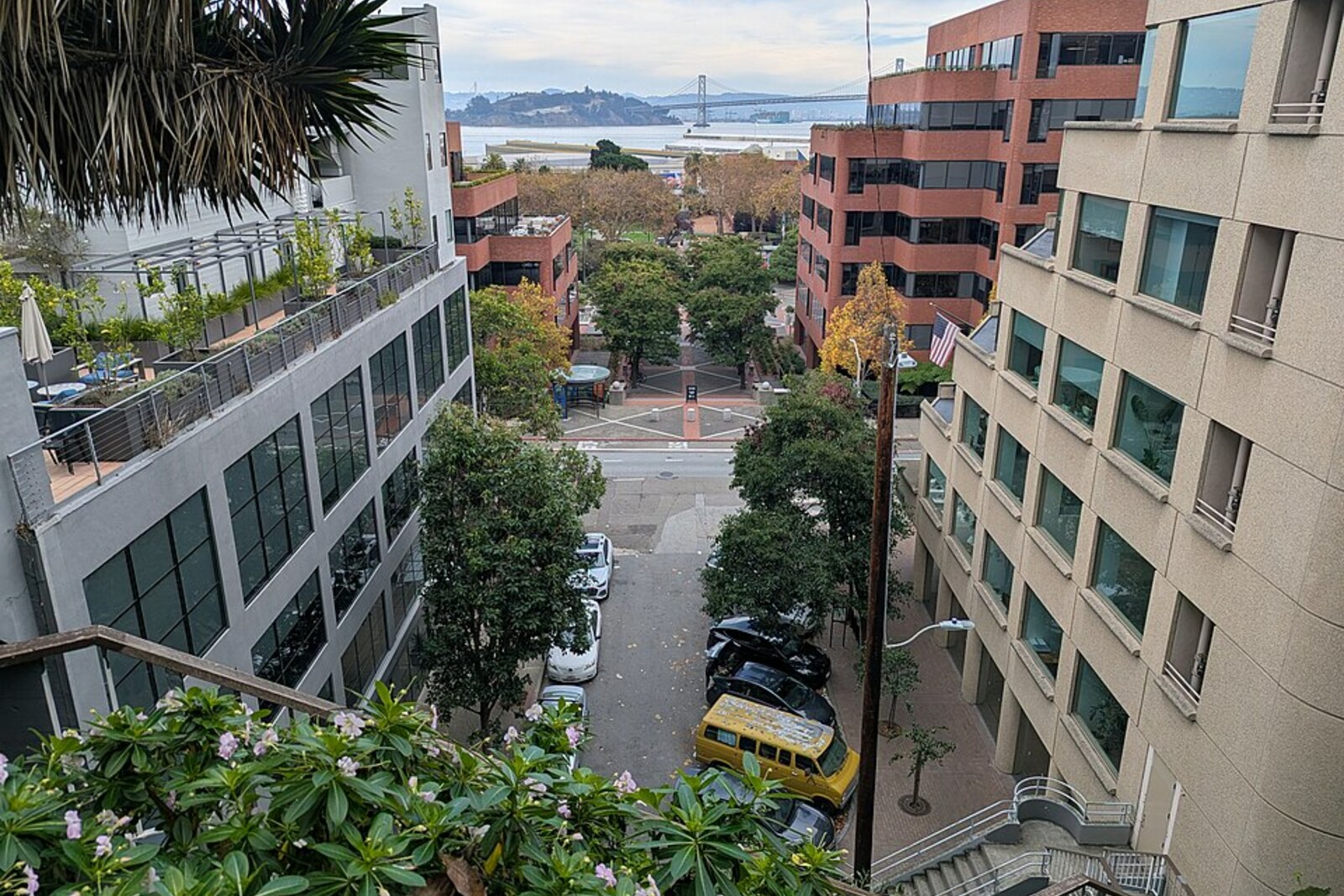
Look around first
What to notice
- Granite boulders
- Water cascades
- Winding paths
- The lower flight of the steps
The story of the place
Landscape architect Lawrence Halprin designed this part of the corporate headquarters as an open city park between low office buildings. A paved plaza gives way to granite boulders, water cascades, and winding paths among the plantings. Filbert Street passes through the park and at Sansome Street leads to the lower flight of the steps. Above begins the old slope of Telegraph Hill.
In eighteen fifty-one, Filbert Street existed here only as a line on the city map. Water lay before the lower slope of Telegraph Hill. Frederick Griffing bought two waterfront lots specifically for the deep water at the shore: he built warehouses and a wharf that could accommodate large vessels. Access from the water sustained his entire enterprise.
One of his warehouses was the three-masted ship William Gray, built in eighteen twenty-seven. The ship no longer went to sea: Griffing kept goods in it at Shaw’s Wharf, as this pier was then called. In eighteen fifty-two, he ordered its hull filled with stone and sunk. The vessel settled on the bottom and became the foundation of a new section of Griffing’s wharf. The ship stopped carrying cargo, but it allowed its owner to extend warehouse land farther into the bay.
A few years later, the enterprise acquired a dangerous neighbor. Merchants Daniel Gibb and Donald Fraser began driving piles into the water where Filbert Street and Battery Street met on the map. They intended to fill in a lot and build their own wharf. Griffing claimed that the piles altered the current, trapped silt, and made the water in front of his warehouses shallower. If large vessels stopped coming alongside, the warehouses would lose their purpose along with the money invested in them.
Through the courts, he demanded that construction be stopped permanently. The federal district court dismissed the lawsuit, but Griffing reached the United States Supreme Court. In eighteen sixty-two, the justices decided that the case had been closed in error: the described threat to the wharf gave its owner grounds to seek protection, and the dispute was sent back for consideration.
The decision did not preserve deep water for Griffing. Over the following decades, people filled in the entire area between the slope and the new shoreline. The wharves disappeared beneath dry land, and William Gray, which was meant to bring ships closer to Griffing’s warehouses, ended up far from the bay.
In nineteen seventy-nine, while preparing construction of the present complex, archaeologists found underground the starboard side of the bow section and a fragment of the deck. From documents and the construction, they identified the vessel as William Gray. They examined roughly one-twentieth of the hull: there was no need to remove it in full for the construction. The remains were documented and covered over again, preserving them for future excavations. Specialists recognized this hull as the most complete among the San Francisco Gold Rush-era vessels that have been found.
The name Levi’s Plaza appeared almost one hundred thirty years after the ship was sunk. It belongs to Levi Strauss & Co.—the company of Levi Strauss, an immigrant from Bavaria and a wholesale merchant who opened a mercantile house in San Francisco in eighteen fifty-three. The company’s headquarters moved here in nineteen eighty-one. Landscape architect Lawrence Halprin arranged a paved plaza, granite boulders, water cascades, and a park with winding paths among the low office buildings. The private site was opened to city residents, and in the spring of nineteen eighty-two, the park was dedicated to the company’s employees.
Filbert Street runs through this office park and at Sansome Street meets the lower flight of the steps. The steps climb the old slope of Telegraph Hill; in the opposite direction, the street lies on filled land. Beneath it remains William Gray, packed with stone on Frederick Griffing’s orders so that his wharf could extend a little farther into the bay.
Useful on site
Before climbing, put away your phone and check your footwear: the steps are steep, and the narrow flights must be shared with people coming the other way. The houses and some of the gardens here are private.