 Guide On Map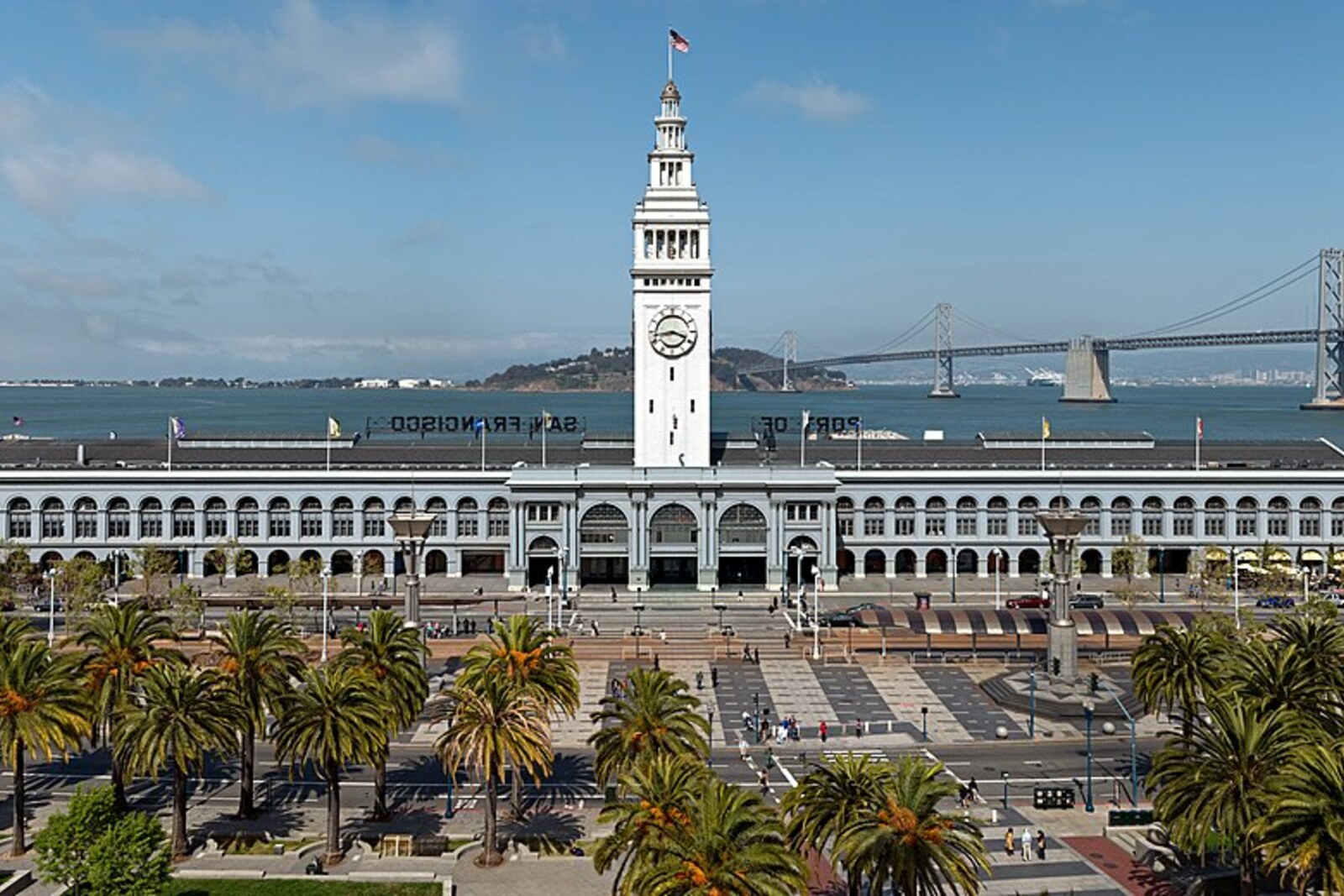
Look around first
What to notice
- Tower clock
- Former passenger hall
- Ferry piers
The story of the place
The clock tower above the waterfront stands over the former main hub for crossings of the bay. Before there were bridges, trains ended their journeys on the opposite shore, and passengers continued by ferry and disembarked here. Later, the main flow moved to the bridges, the spacious hall was divided by office floors, but they were removed during restoration: an indoor market now operates inside, while people still board ferries at the piers.
The name “Ferry Building” translates literally: ferry terminal. Shops and cafés now operate in the former passenger hall, offices occupy the floors above, and ferries still depart from the waterfront side.
The terminal opened in eighteen ninety-eight. Long-distance trains came only as far as Oakland, on the opposite shore of the bay: there were no bridges yet. Passengers transferred to ferries and disembarked here, at the beginning of Market Street, where city streetcars were waiting for them. That is why this enormous terminal was built at this very spot.
On the morning of April eighteenth, nineteen oh six, Thomas Chase, the cashier and telegraph operator on the early shift, was walking here. He earned his living by selling tickets and transmitting telegrams, and he rented a room with a shift mate named Gibbs. There were no night streetcars, so Chase usually walked to the terminal.
The earthquake caught him a few blocks from here. Bricks and glass were falling into the street, wires had snapped, and the pavement had sunk. Chase made it to the terminal nonetheless. The entire southern wall had collapsed into the bay, office counters and the floor were covered in plaster, pipes had burst, and the telephone and telegraph were silent. Chase himself did not know whether his mother and grandmother in Oakland had survived.
At the piers, boats first pulled away from shore and then began to return. One gate attendant was on hand; a captain arrived soon afterward. Together, they decided to resume service. The first ferry departed at six twenty—only twenty minutes behind schedule.
By seven o’clock, people carrying suitcases and bundles were already coming here. Many asked for tickets on long-distance trains, but Chase sold only ferry tickets: the fire was spreading, and the hall needed to be cleared more quickly. After another tremor, the crowd surged back into the street, then returned. One employee walked to work with his head bandaged: a brick from a chimney had struck his home.
When the fire surrounded the approaches to the terminal, employees locked the ticket booths and opened the gates to everyone who remained. Transportation companies stopped charging fares. According to the carrier’s report, the next day people were leaving San Francisco at an average rate of seventy people per minute; most were heading to Oakland and neighboring towns.
Gibbs arrived at the terminal blackened with grime and without any belongings. He boarded a ferry, and Chase never saw him again. Chase himself left the terminal after noon and reached Oakland. His mother and grandmother were alive; for seven hours, they had not known what had happened to him.
Firefighters and sailors directed water from vessels and held the fire at the piers. The terminal survived and continued the evacuation. Later, the San Francisco–Oakland Bay Bridge, and then the Golden Gate Bridge, took most passengers away from the ferries. In nineteen fifty-five, engineers divided the old hall with office floors. They were removed during restoration, and the present indoor market opened here in two thousand three.
The earthquake stopped the tower clock at five sixteen. It is running again now, and ferries still take passengers from the other side of the building.
Useful on site
To hear the story, it is enough to remain outside, where both the tower and the bay are visible at once; near the roadway, listen only in a safe place.