 Guide On Map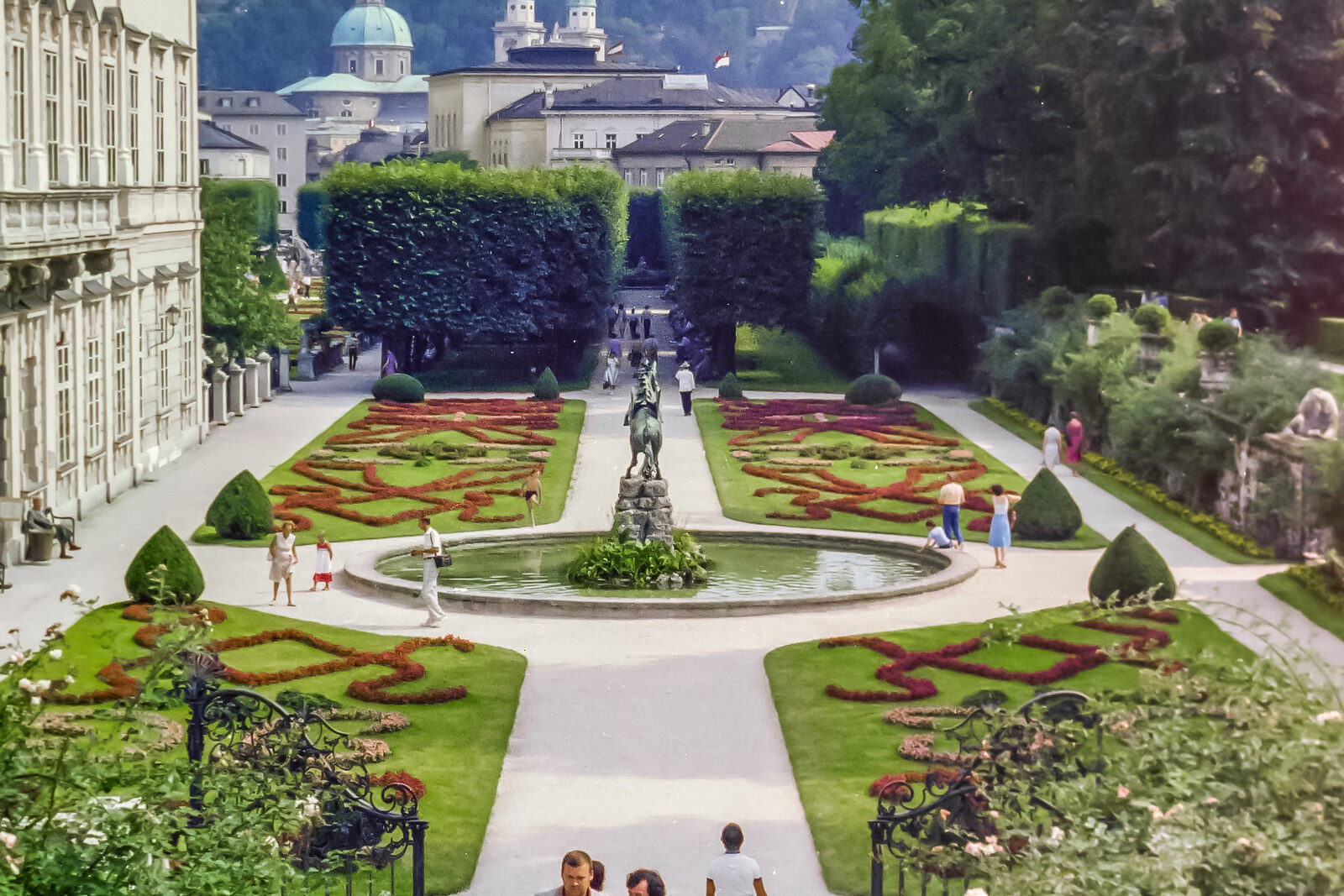
Look around first
What to notice
- Copper Pegasus
- Round stone basin
- Rock of local conglomerate
- Silhouette of the Cathedral behind the fountain
The story of the place
The round stone basin in the garden's small parterre supports the copper figure, which was connected to it only at the beginning of the twentieth century. Beneath it lies a small bridge made of local conglomerate, and the silhouette of the Cathedral is visible behind the fountain. Newlyweds now take photographs by the water, although the garden was not the old sculpture's first home: before returning here, it spent a long time in museum storage.
The winged horse is called Pegasus. According to Greek legend, with a strike of his hoof he opened the spring of Hippocrene on Mount Helicon, dedicated to the Muses. That is why a stone rock lies beneath his raised hooves, with water gathered around it. Yet this Pegasus appeared for the sake of very earthly horses.
In sixteen sixty-one, Prince-Archbishop Guidobald von Thun commissioned it for a horse bathing pool on Kapitelplatz, the square behind Salzburg Cathedral. In such basins, horses were watered and washed. The commission went to Caspar Gras, an Innsbruck court master who earned his living by working for princely courts. An entry in the state ledger preserved both his name and the fact that payment was made for the delivered metal horse. Gras hammered the huge figure out of sheet copper: Pegasus rears up and spreads his wings above the water from which real horses drink.
At the beginning of the eighteenth century, court officials moved the figure across the river, to the horse bathing pool on Mirabellplatz, on the other side of the palace. Pegasus stood there until the great city fire of eighteen eighteen. After the fire, the bathing pool was dismantled, and the copper horse was taken to the Salzburg Residence.
After that, Pegasus's fate was decided not by mythology, but by appraisers. In eighteen thirty-two, Pegasus was to be sold at auction. The sale was canceled: its artistic value was deemed too low even for an auction. Ten years later, city officials nevertheless returned the figure to the street and placed it on Hannibalplatz—the name then used for what is now Makartplatz. Pegasus lasted there for seventeen years. Then employees of the city museum, the Carolino Augusteum, now the Salzburg Museum, sent it back into storage. This time, for more than half a century.
Pegasus was pulled out of museum oblivion by members of the Salzburg Beautification Society, an association of city residents preparing to celebrate its fiftieth anniversary. They sought to return the old figure to the urban space. Even a sympathetic commission gave Pegasus a restrained assessment: artistically undistinguished, but still interesting. Its location was also debated; the Mirabell courtyard was among the proposals.
The society secured the installation in the spring of nineteen thirteen. The copper figure was raised above the old round basin in the garden's small parterre, and a small bridge made of local conglomerate served as its support. The basin, the rock, and the present location all date specifically from that installation; Pegasus itself is two and a half centuries older than they are.
Now the fountain serves as one of the most recognizable spots for wedding photographs. Pegasus faces the Cathedral, and behind the Cathedral lies Kapitelplatz—the first stop of this copper horse.
Useful on site
Open section of the Mirabell Gardens; access depends on the garden's hours, and the water and individual areas are seasonal.
Checked: June 26, 2026. Check the official source before visiting.Do not lean on the edge of the basin for a photo; when the water is turned off, the sculpture itself remains fully visible.