 Guide On Map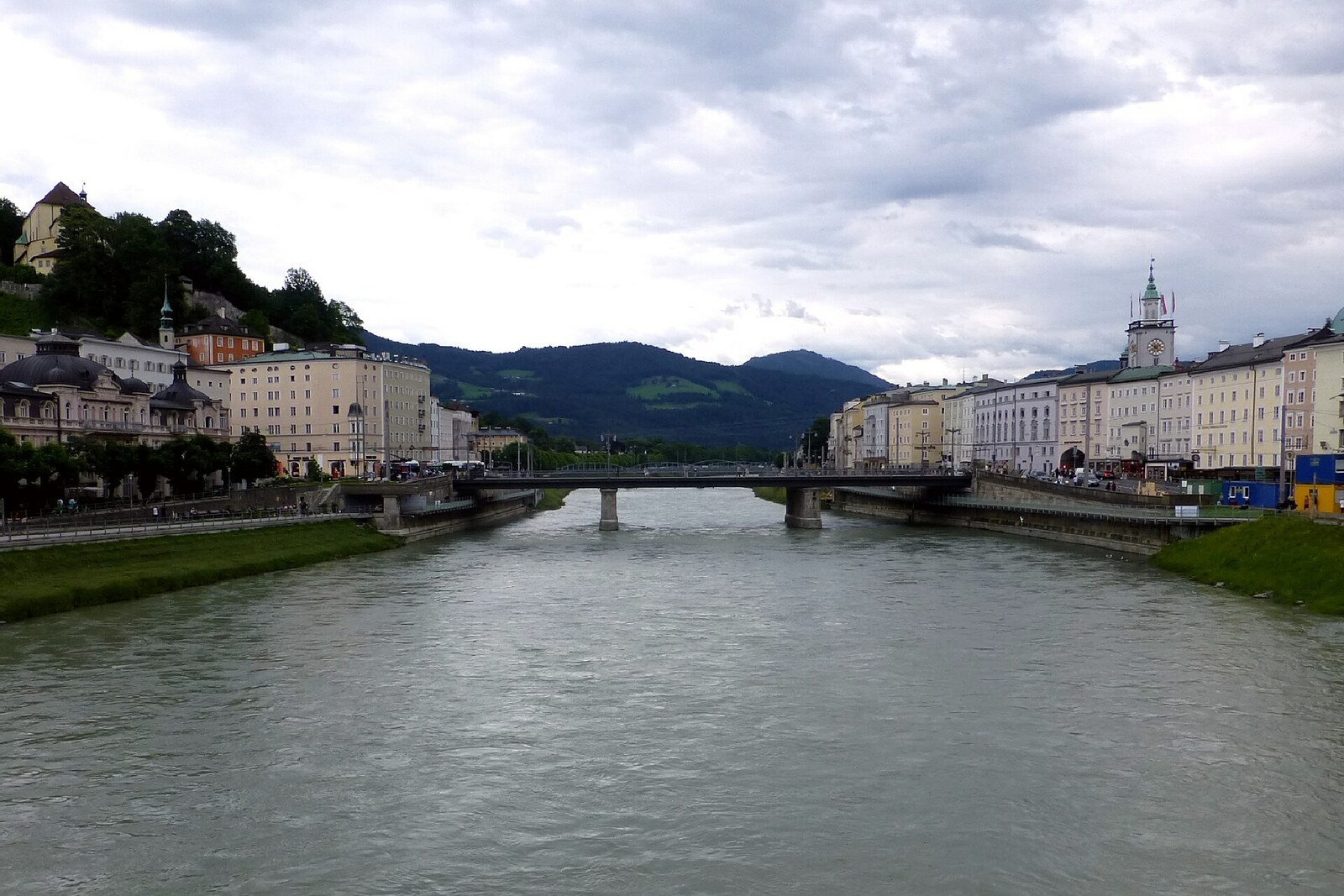
Look around first
What to notice
- Curved deck
- Bridge railings
- Commemorative plaques at the entrances
The story of the place
The curved deck over the Salzach preserves a short crossing between Makartplatz and the old town: pedestrians and cyclists use it. The current crossing became the third on this line; the earlier iron spans and the watchman’s booth have disappeared, along with the crossing fee. Commemorative plaques are embedded at both entrances, and on a certain day an exhibition about the Jewish history of Salzburg appears on the railings.
The first crossing here was paid for not by the city budget, but by a specially created association of citizens—the Makart Bridge Association. Its members wanted to take pedestrians directly from Makartplatz on the right bank to the quay and the city museum on the left. The association commissioned an iron bridge on two piers and opened it for passage on June eighteenth, nineteen oh five.
Along with the bridge, a watchman’s booth appeared on Franz-Josef-Kai—square, with sides of about three meters. To cross, each person bought a small blue card costing two hellers. The private association gained its own toll crossing, while residents gained a short route between two parts of the center. By nineteen twenty-one, the fee had risen to ten hellers. Another year later, the bridge passed into city ownership: the association had completed its task and lost the crossing for which it had been created.
The iron bridge, the booth, and the blue cards are gone. The first structure was dismantled in nineteen sixty-seven, the next one in the autumn of two thousand. The current curved deck opened in July two thousand one. What remains of the private enterprise is the crossing line itself: pedestrians and cyclists still travel here from Makartplatz to the old town.
Until two thousand twenty-one, the crossing was called Makart Bridge, after the Salzburg artist Hans Makart. Now the signs bear the name of Marco Feingold, who survived Auschwitz, Neuengamme, Dachau, and Buchenwald and, after liberation, helped other Jewish prisoners leave the postwar camps.
Feingold came to Salzburg by chance. On May twentieth, nineteen forty-five, a transport carrying one hundred twenty-eight former prisoners was not allowed across the demarcation line on its way to Vienna. On the return journey, Feingold got off during a stop in Salzburg. Here he began supplying a kitchen that fed about five hundred fifty liberated prisoners, and then started helping Bricha, which took Jewish refugees to Italy and onward to ships bound for Palestine.
He obtained trucks from the provincial government, transported people from Salzburg to a camp near Saalfelden, and accompanied individual columns across the border. Feingold had learned Italian before the war, when he earned money selling liquid soap and floor polish. Now he persuaded border guards that he was taking Italians home; the organizers used forged documents, cigarettes, and alcohol so that the guards would look away. In nineteen forty-seven, several thousand refugees passed from this area through Krimmler Tauern into South Tyrol. After the camps closed, Feingold opened a fashion store in Salzburg, then led the Jewish community for decades and told schoolchildren about the camps.
The city’s authors of the name explained their choice of bridge by his work as a mediator between religions and generations. Commemorative plaques are embedded at both entrances to the deck, and every year, on Feingold’s birthday, an exhibition about him and the Jewish history of Salzburg is displayed on the railings.
Useful on site
Open continuously as an urban pedestrian crossing; temporary narrowing of the passage is possible during maintenance.
Checked: June 29, 2026. Check the official source before visiting.There is no separate exhibition on the bridge; listen at the edge, leaving the way clear for pedestrians.