 Guide On Map
Salzburg Between Mozart's Two Homes
From Rathausplatz through Getreidegasse and Alter Markt—across the Salzach to Makartplatz
Guide On Map on your phone
Open the walk like a regular app
It takes about 10 seconds to install. No app store needed.
The whole path
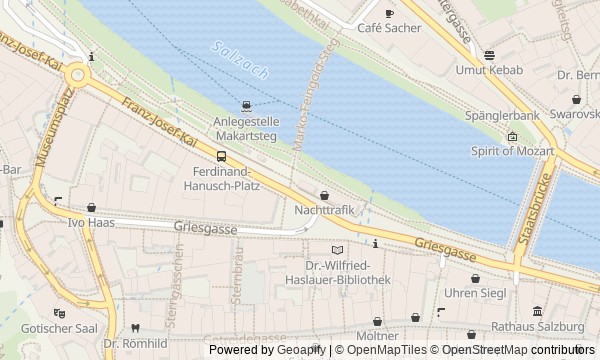
Route map
About the walk
You will begin at the Old Town Hall, enter Getreidegasse, and emerge through passage courtyards at two markets. Then you will return to the Salzach, cross the bridge, and finish at Makartplatz—at the Mozart family's second home.
The grand facades will prove to be only the foreground. Behind them lie storerooms, a cramped family apartment, a bread arch, and a fountain where craft once changed a person's social standing. You will find out why a hurried merchant had to stop, why a father asked his landlord to add rooms, and what a small blue card by the river might have meant. The answers will remain inside the stories.
The story will be calm and concrete: city decisions, letters, and everyday details instead of a roll call of great names. By the end, you will recognize Salzburg by its passages, signs, and squares—as a city where someone was always setting the rules for choosing, selling, working, and crossing the river.
Why this order
Rathausplatz will pose the route's central question: who set the rules of city life? Right after it, Getreidegasse will show how the council's authority worked not in a hall, but on a trading street. Mozart's Birthplace continues the same thread inside a merchant's house: here, family work became a profession that would soon outgrow its old rooms. A passage leads to Universitätsplatz, where a private lack of space gives way to a city task—making room for a market and directing carts of goods. Ritzerbogen brings you to Alter Markt, allowing the new trading place to be compared with the old one, and market rules with admission into a craft at the shared fountain. From there, the route reaches the river: after the right to trade and belong to a fellowship comes the right to cross the Salzach for a fee. The bridge carries the walk to Makartplatz and literally echoes the family's move from their cramped Getreidegasse home to a spacious apartment, where the Mozart story reaches its grim final chapter.
Those interested in Mozart as part of a family story rather than a monumental one Those who enjoy city history told through rules, crafts, and everyday details Those happy to look into passages, courtyards, and old markets
Those expecting a detailed discussion of Mozart's works Those looking for a route through the fortress and the city's heights Those who prefer one large museum to a city walk
Before you go
Decide in advance whether you want to enter both Mozart museums: they are two separate visits, while the outdoor part of the route requires no admission tickets. Check visiting conditions just before your walk if you plan to see the interiors. In passage houses, stay in publicly accessible arches and courtyards; do not enter private staircases or block shop entrances. At the market squares, let sellers and shoppers get on with their business—the story is easier to hear a little away from the stalls.
When to go
The first half of the day best conveys the route's trading character and lets you see the squares in their working rhythm. Later on, it is easier to study the facades, signs, and fountain, but the central streets may grow busier. Without the museums, the walk remains compact; visiting both exhibitions will require noticeably more time.
Backup plan
In the rain, use the arches and passage courtyards of Getreidegasse as brief shelters without disturbing residents or trade. The outdoor stories at the Old Town Hall, the two markets, and the bridge can be shortened to their main visible details, leaving more time for the museums if they are open that day. If you do not want to go inside, the route still makes sense: Mozart's two homes can be read from the outside as two different family addresses, and the final theme of destruction and restoration can be completed at Makartplatz.
Route conditions
Surface. Paved — 1.1 km
Facilities. Toilets — 3; drinking water — 4
Elevation. Ascent — 24 m; descent — 18 m
OpenStreetMap extract of June 18, 2026: database data, not a check on the ground. Data © OpenStreetMap contributors, ODbL licence
Walk plan
Open in maps ↗- 1
Rathausplatz
Here you will understand how the townspeople gained the right to choose their rulers and why they could not hold on to it. - 2
Getreidegasse
This commercial street will show how the city held onto goods in transit and controlled merchants’ time. - 3
Mozart's Birthplace
The apartment shows how home lessons for two children became a family profession and required more space. - 4
Universitätsplatz
The square will show how officials moved the main market and divided the space among sellers and carts. - 5
Alter Markt
The fountain will link the market square to an apprentice's public transition into the fellowship of adult craftspeople. - 6
Marco Feingold Bridge
The crossing connects a private toll bridge with the memory of a man who helped others cross borders. - 7
Mozart Residence
The finale will show the cost of the family’s attempt to find another position for the young musician.
Route features
Everything you need stays in the browser
Progress, saves and your trip plan are stored on this device.
Add Guide On Map to your home screen so the walk opens outside the browser.
How we handle sources, maps and corrections: our editorial standards