 Guide On Map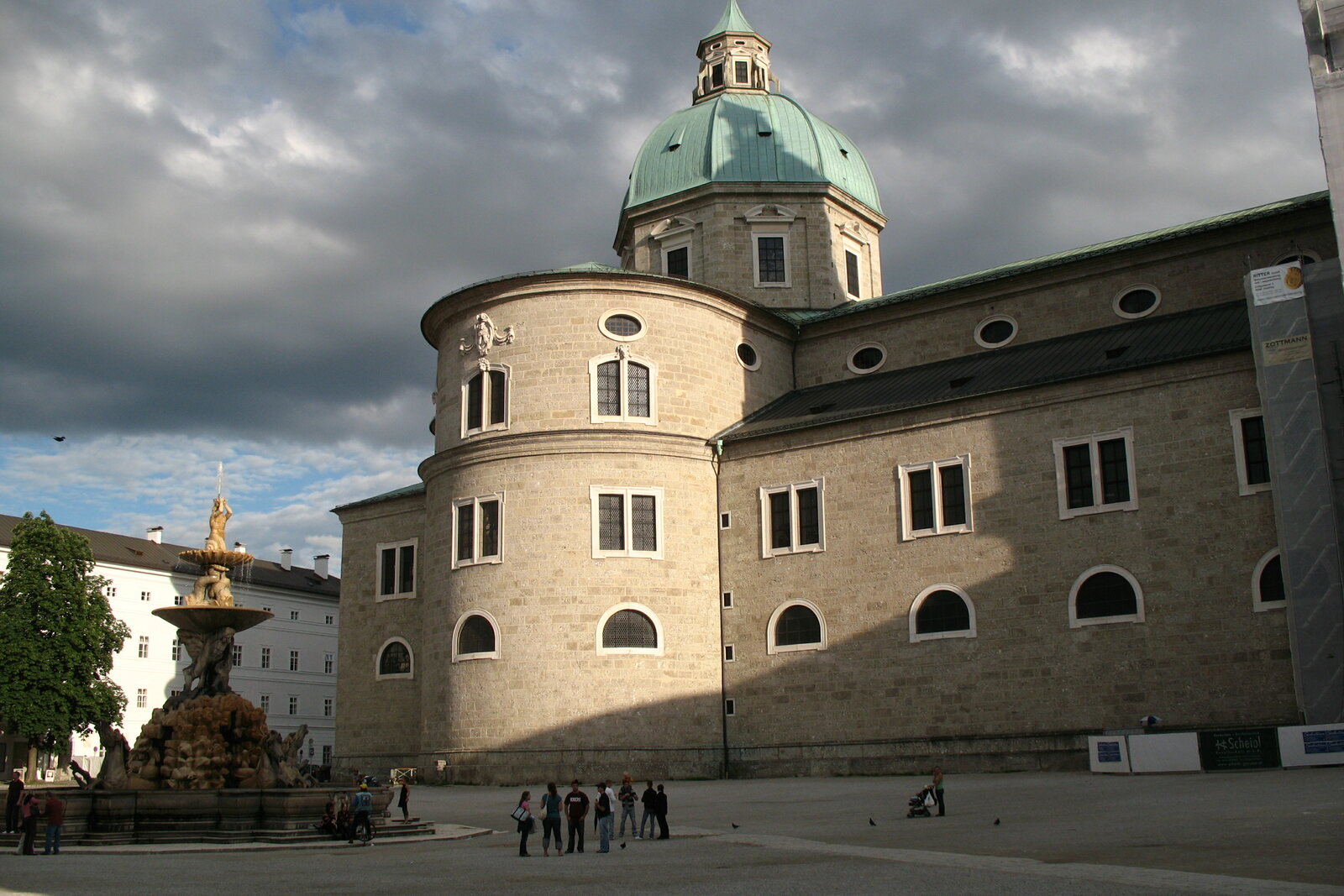
Look around first
What to notice
- The cathedral façade
- Side passages
- Figures of Saint Peter and Saint Paul
- The salt barrel held by Rupert's figure
The story of the place
On August twenty-second, nineteen twenty, the theater director Max Reinhardt brought a troupe onto Domplatz. He was working to open the new Salzburg Festival, although after the First World War the city was living in hardship, money was scarce, and many considered the idea itself untimely. What was commissioned for the opening was not ready, either. There was not even enough timber for the audience stands at the Felsenreitschule—the former court riding school where they planned to perform.
Reinhardt asked Archbishop Ignaz Rieder, head of the Archdiocese of Salzburg, to allow a performance in front of the cathedral. To save the program, the director chose Everyman by Hugo von Hofmannsthal. This poet took part in creating the festival and reworked a medieval play about the death of a rich man. The rich man feasts until God sends Death for him. His friends, beloved, and money refuse to go with him to judgment; faith and good deeds remain at his side. Reinhardt had already staged this play in Berlin in nineteen eleven, but in Salzburg it was to open a new institution without its own theater.
The director used the entire layout of Domplatz. It is an enclosed cathedral courtyard between the Residence and St Peter's Abbey. The side passages near the façade served as actors' entrances and exits, while the flat roofs above the arches were used by trumpeters and people shouting Everyman's name. Reinhardt positioned other participants on the bell towers of the Old Town and on the tower of the Franciscan Church opposite. They called the rich man to death from different sides, while above him, on the cathedral pediment, stood a figure of Jesus Christ with a globe.
Four performances were scheduled for the first days. Their success was such that two more had to be added—especially for Salzburg residents. These performances are considered the birth of the Salzburg Festival. Hofmannsthal and Reinhardt achieved what they had set out to do: concerts appeared in the program a year later, and opera another year after that. After several breaks, Everyman continues to return to Domplatz almost every festival summer.
The façade that Reinhardt turned into scenery belongs to Salzburg Cathedral—the main church of the archdiocese. In the lower tier stand the apostles Saint Peter with a key and Saint Paul with a sword, with two local bishops beside them. Rupert holds a salt barrel, and Virgil a model of a church.
Rupert arrived here at the end of the seventh century as a missionary invited by the Bavarian duke Theodo. On the ruins of Roman Juvavum, he founded St Peter's Abbey and established a church center. To support it, the duke granted Rupert the salt springs of Bad Reichenhall. Income from salt sustained the community and helped the mission; hence the barrel in the saint's hands and Salzburg's very name—the “salt city.”
Several decades later, the Irish abbot and bishop Virgil ordered the first cathedral to be built on this site. At its consecration in seven hundred seventy-four, he transferred Rupert's remains here from St Peter's Abbey. After Virgil's own death, he was buried in the cathedral; later, he too was recognized as a saint. That is why one bishop stands on the façade with the source of funding for early Salzburg, and the other with the church he built here.
During Everyman, the actor playing the rich man kneels before the cathedral entrance. Above him remain Jesus Christ with a globe, Rupert with a salt barrel, and Virgil with a model of the first cathedral.
Useful on site
Domplatz is accessible as an urban space; from March to July, the cathedral is open Mon–Sat 08:00–18:00 and Sun/holidays 13:00–18:00, but services, midday music, and festival rehearsals/performances may affect access.
Checked: June 27, 2026. Check the official source before visiting.For the best exterior view of the statue of the Virgin Mary, look from the Franziskanergasse arcade. Entry to the cathedral may depend on services; do not linger at the doors or disturb worshippers.