 Guide On Map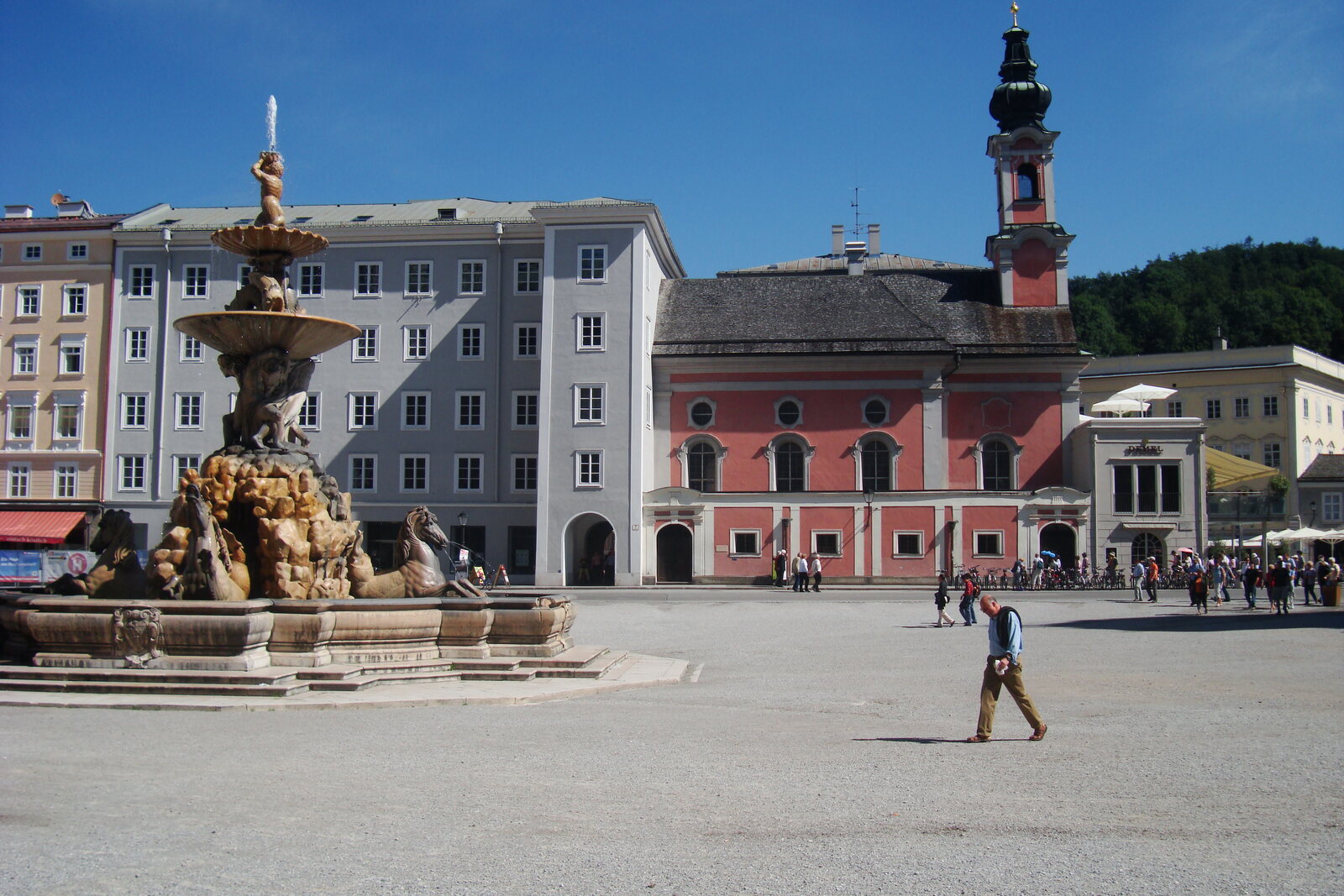
Look around first
What to notice
- Glass set into the paving
- Black metal framework of an open book
- Western wall of the New Residence
- Fountain
The story of the place
A sheet of glass is set into the paving by the western wall of the New Residence. Beneath it lies the black metal framework of an open book—a memorial to the book burning held on Residenzplatz on April thirtieth, nineteen thirty-eight.
The square's name refers to the buildings along its sides. The Prince-Archbishops lived in the Old Residence—rulers of Salzburg (state), who also headed the local church. The New Residence stands opposite. At the end of the sixteenth century, Prince-Archbishop Wolf Dietrich von Raitenau decided to create a broad ceremonial courtyard between his palaces and the cathedral, modeled on Italian examples. On his orders, fifty-five medieval buildings were demolished, the old cathedral cemetery was closed, and the site in front of the residences was cleared. This created a square designed for large public ceremonies. It still serves that role: fairs, concerts, and major city celebrations are held here.
A few weeks after the annexation of Austria by Nazi Germany, Karl Springenschmid, head of Salzburg's school authority and the National Socialist Teachers League, chose Residenzplatz for a public action against books. He sought to remove from schools, libraries, and the book trade authors whom the new regime had declared hostile. The central square beside the cathedral made it possible to turn the removal of literature into a spectacle for the whole city.
An appeal to residents was printed in the newspaper: books by Jewish authors were to be selected and handed in. The list contained fifty names. Members of the Hitler Youth collected about one thousand two hundred volumes from libraries, bookshops, and private homes. The bonfire was built north of the fountain, near St Michael's Church.
Springenschmid gave a speech, after which the books began to be thrown into the fire. Participants were selected by role: two schoolchildren, two members of the Hitler Youth, a worker, a peasant, a musician, a soldier, and representatives of the Storm Detachments and the SS. Each accompanied their throw with a prepared phrase. The organizers wanted to present a party action as a decision of every stratum of urban society.
Stefan Zweig was named separately—a writer from a Jewish family who had lived in Salzburg for fifteen years and earned his living through literary work. By then, he had already left Austria and was trying to continue publishing abroad. On Residenzplatz, his book was hurled into the bonfire with a special formula of condemnation. That same day, one of his volumes was removed from the general collection at the Austrian National Library, and a cardboard card stamped “closed” was put in its place. The copy was retained for the regime's official purposes and was no longer issued to readers. The ban deprived Zweig of the German-language market, and he made new contracts with foreign publishers.
After the fall of the Nazi regime, Springenschmid spent several years in hiding. In nineteen forty-six, his own writings were placed on Austria's list of banned Nazi literature. The judicial investigation was discontinued, and from nineteen fifty-three onward he was able to publish again.
The bonfire stood near St Michael's Church; no separate marker remains at its site. The memorial was moved to the western wall of the New Residence: beneath the glass is a metal book binding without pages.
Useful on site
The city square is always accessible, but may be occupied by fairs, concerts, a Christmas market, and other events.
Checked: June 27, 2026. Check the official source before visiting.The entire visit takes place outside. If the center is occupied by a stage or installation work, stay at the edge of the square: the fountain and the relationship between the façades can be seen from there as well.