 Guide On Map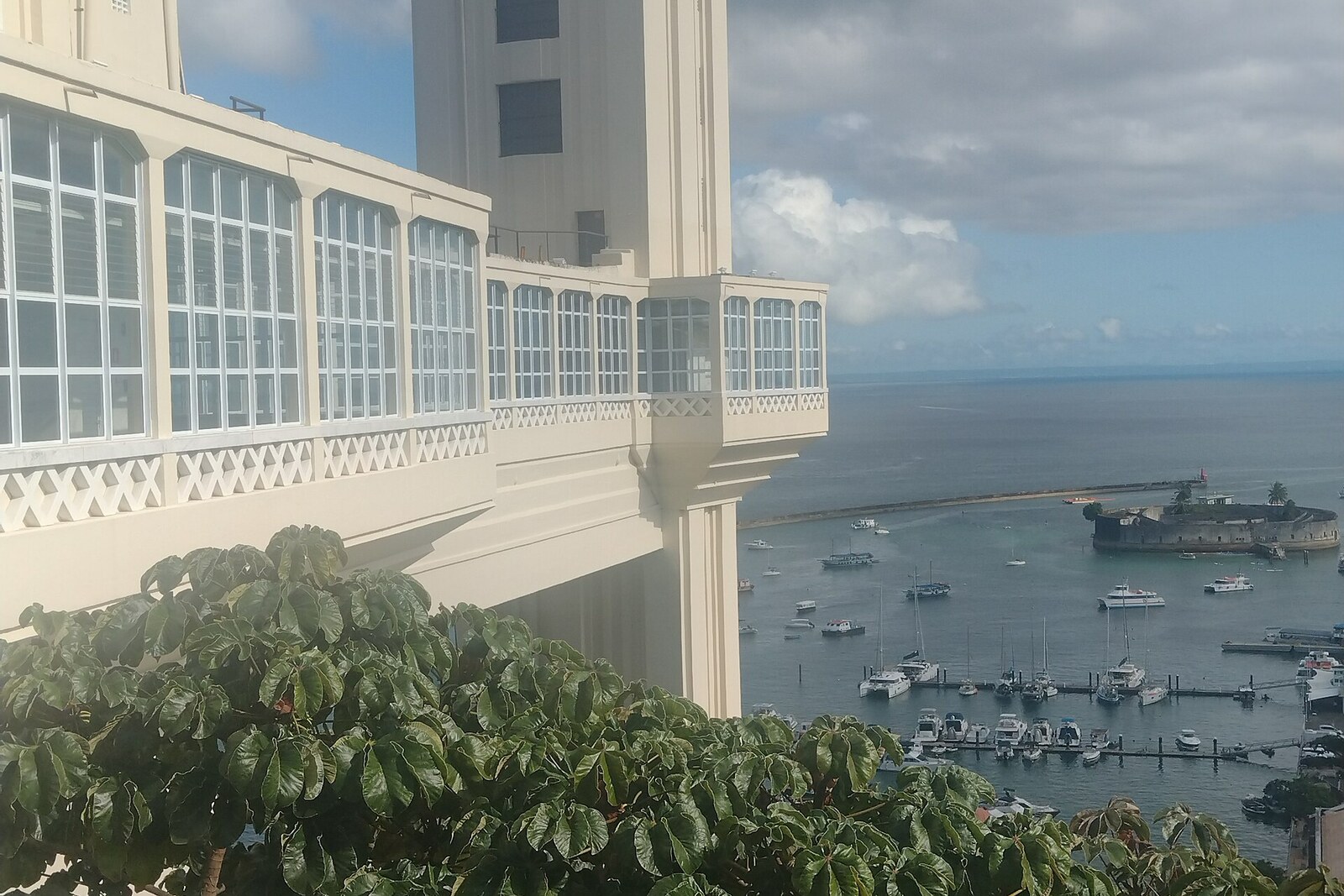
Look around first
What to notice
- Freestanding tower
- Walkway to the tower
- Slope of Cidade Alta
- View of Comércio
The story of the place
The shaft of the first Lacerda elevator survives inside the slope: one tunnel was cut vertically for the cars, while the other was driven to the lower entrance. The separate tower above Comércio, with its walkway, appeared later, and from outside only part of the system descending into the stone is visible. The upper exit led to Praça do Palácio, where passengers transferred to a tram.
Comércio below got its name from trade. Here, at the quays, ships were unloaded and warehouses were kept; above were institutions, churches, and residential quarters. This division was established as early as Salvador’s founding. People climbed the steep streets and stairways, while goods were hauled up with winches. By the nineteenth century, thousands of passengers were already traveling between the port and Cidade Alta, but they had no convenient direct route.
Antônio de Lacerda ran the family transport company and worked to give its horse-drawn trams above a connection to the port. He studied engineering in the United States, did not complete the course, and returned to run the family businesses. He developed the technical side of the plan with his younger brother Augusto Frederico de Lacerda, a qualified engineer.
The city did not commission an elevator from them. Lacerda raised the money himself: he brought in about twenty entrepreneurs, and his father, the merchant Antônio Francisco de Lacerda, gave his son part of his inheritance in advance. The family fortune arose, among other things, from trading in enslaved people: Lacerda’s father acted as an intermediary in their sale and took part in a transatlantic expedition in eighteen thirty-nine, when it was already prohibited. The same family company became the main source of funding for the construction.
Workers began cutting through the slope in eighteen sixty-nine. One tunnel went vertically through the rock for the cars, and another ran horizontally to the lower entrance. Four years later, the Conceição Hydraulic Elevator opened, named after a church in the Lower City. A passenger could enter near the port, rise to Praça do Palácio, and transfer to a Lacerda tram. The elevator was installed here, above Comércio, precisely for that connection.
There were many passengers, but the expensive construction did not pay for itself. Four years after opening, revenues still did not cover the investment, and the group of Lacerda family businesses went bankrupt. Antônio died in eighteen eighty-five. He never saw his own name on the elevator: the Geographic and Historical Institute of Bahia proposed naming the structure after him only in eighteen ninety-six.
The freestanding tower above Comércio and the walkway to it were added in nineteen thirty. The shaft of the first Lacerda elevator remained in the rock; his surname is on the structure that bankrupted the family company and outlived its creator.
Useful on site
Free. Monday–Friday 06:30–21:30; Saturday, Sunday, and holidays 07:00–21:30.
Checked: June 24, 2026. Check the official source before visiting.The elevator serves as urban transport, not just as an attraction; do not hold up passengers, and view the panorama from a safe viewing point.