 Guide On Map
Pelourinho: African Brotherhoods and Baroque Salvador
From the Rosary of the Black People through Terreiro de Jesus to Elevador Lacerda
Guide On Map on your phone
Open the walk like a regular app
It takes about 10 seconds to install. No app store needed.
The whole path
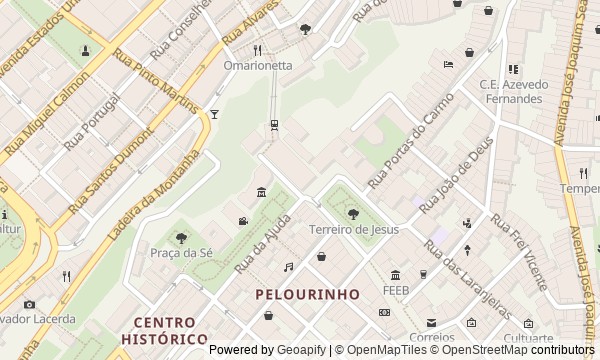
Route map
About the walk
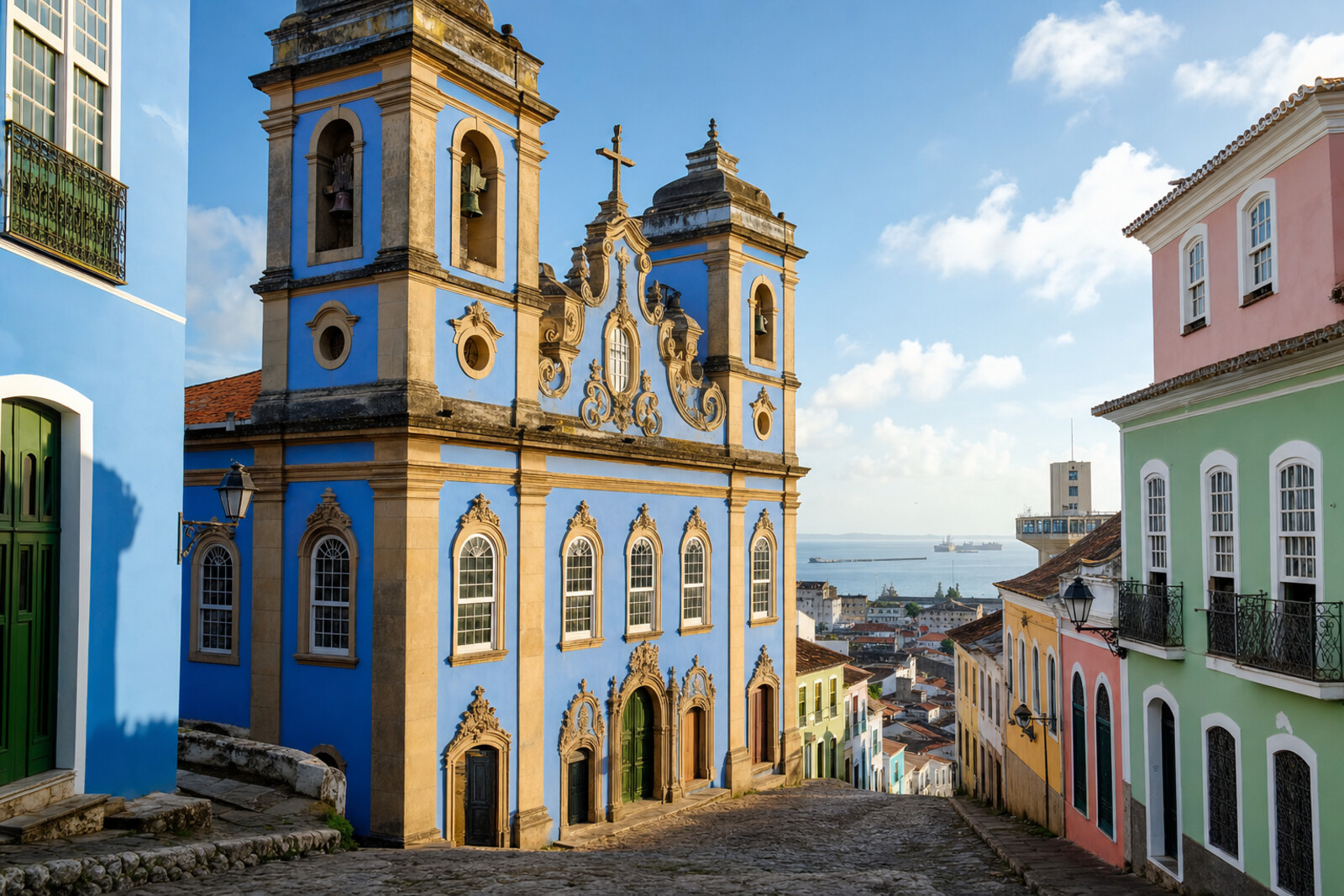
You will walk through Pelourinho from the church of a brotherhood of Africans and their descendants to the edge of Cidade Alta above the port of Comércio. You will climb a steep square, turn toward the Convent of São Francisco, cross Terreiro de Jesus, and reach Elevador Lacerda by way of Praça da Sé.
Along the way come baroque altars, the former Jesuit College, a carnival museum, and a cross standing where a vanished cathedral once stood. From the outside, everything will look splendid. The stories are more complicated. You will ask why the owners of their own church had to ask a queen for permission to make music. Why the Franciscans had to choose between poverty and gold. How a museum judged impossible to finish on time opened after all.
The story will be calm and specific. It will separate documents from oral versions, and the city's splendor from labor, coercion, and failed calculations. By the end, you will know the difference between a church of a Black brotherhood, a former site of public punishment, and a square created after a cathedral was demolished.
Why this order
The Church of Our Lady of the Rosary of the Black People stands by Largo do Pelourinho, so the first stop immediately sets the brotherhood's own space against a square of public punishment. The climb from Largo do Pelourinho to Church of São Francisco shifts the conversation from a community that built for itself to a convent saved by brothers brought in from elsewhere. From Church of São Francisco, a short return along Cruzeiro de São Francisco leads to Terreiro de Jesus: after the convent, the former Jesuit College shows how a religious institution became a hospital and a school. The Cathedral Basilica of Salvador on the same square continues the Jesuit thread through a civic vow. After it, Casa do Carnaval da Bahia replaces the language of altars and lecture halls with music and movement. From the museum, the route reaches Praça da Sé, where the leaning Fallen Cross explains the open space. The final walk along the edge of Cidade Alta toward Elevador Lacerda shows why streets and transport were rebuilt here: to connect with Comércio.
Those who want to understand Pelourinho's Afro-Brazilian layer Those interested in baroque art, urban history, and religious brotherhoods Those who want to link Cidade Alta and the port through one clear thread
Those looking only for an easy postcard walk Those who do not want to hear about slavery and public punishment Those more interested in a list of sights than in human decisions
Before you go
Wear shoes that stay secure on uneven stone: the route follows old paved streets and ends at a sharp change in elevation. The churches remain religious spaces, so check access at the entrance, silence your device during services, and do not treat worship as a performance for visitors. Check separately, just before your walk, whether the cloister, ceiling details, and museum exhibition can be visited. Bring headphones, but keep one ear free in busy squares and do not stop in the middle of a passage.
When to go
Choose daylight hours and begin with enough time not to rush through church interiors or the museum exhibition. Service times and access to Casa do Carnaval da Bahia can alter the route's pace, so check them on the day of your walk.
Backup plan
If a church is closed or a service is underway, listen to the relevant story outside and focus on the facade, the building's position, and the surrounding square; do not try to insert yourself into a religious ceremony. If the Casa do Carnaval da Bahia exhibition is unavailable, keep the stop at the facade: its history works as a story about the street, not only museum objects. In rain, wait out the heaviest downpour in an accessible public interior, do not hurry over wet cobblestones, and save open squares and the view by the elevator for a clearer spell.
Route conditions
Surface. Paved — 504 m (data covers 43% of the route)
Elevation. Ascent — 18 m; descent — 10 m
OpenStreetMap extract of July 4, 2026: database data, not a check on the ground. Data © OpenStreetMap contributors, ODbL licence
Walk plan
Open in maps ↗- 1
Church of Our Lady of the Rosary of the Black People
It shows how the brotherhood turned a shared fund and parishioners’ free hours into a space of its own. - 2
Largo do Pelourinho
Connects the district's name with public punishment and an attempt to free an imprisoned teacher. - 3
Church and Convent of São Francisco
It will place Franciscan poverty alongside donors' money and the threat facing an emptied convent. - 4
Terreiro de Jesus
It will explain why medical education began in the premises of the former college and military hospital. - 5
Cathedral Basilica of Salvador
It will explain the city’s vow, which survived both the epidemic and the church’s change of purpose. - 6
Casa do Carnaval da Bahia
It will show how a building almost ready for one exhibition had to be adapted for another in just a few months. - 7
Praça da Sé and the Fallen Cross
It will explain why the open square bears the cathedral's name and is marked by a slanting cross. - 8
Elevador Lacerda and the View of Comércio
It will connect the view of Salvador’s two levels with the cost of a private transport project.
Route features
Everything you need stays in the browser
Progress, saves and your trip plan are stored on this device.
Add Guide On Map to your home screen so the walk opens outside the browser.
How we handle sources, maps and corrections: our editorial standards