 Guide On Map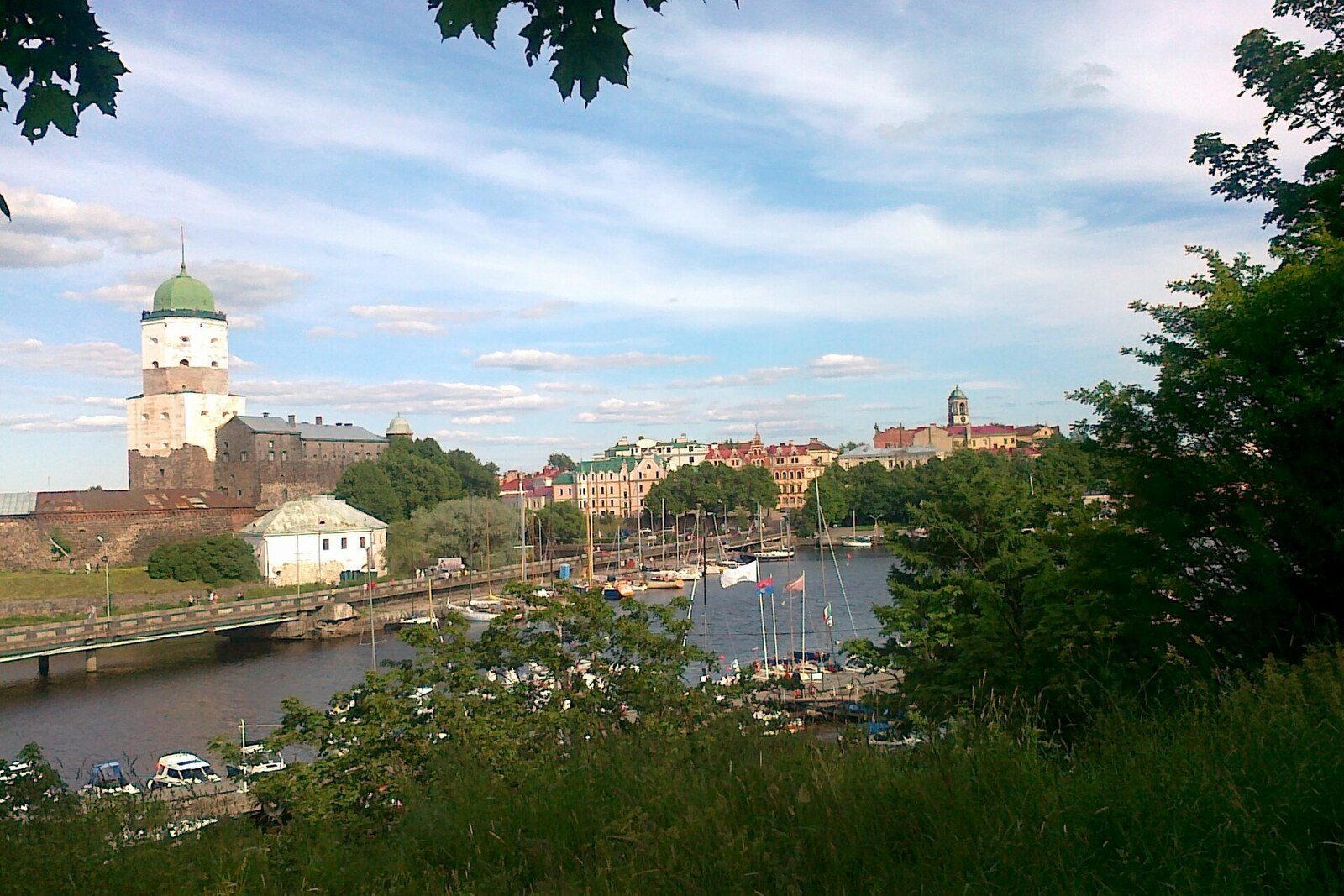
Look around first
What to notice
- The square granite base of the tower
- St. Olaf's Tower
- The storage buildings of the Lower Courtyard of Vyborg Castle
- Granite masonry of the lower tier
The story of the place
The Lower Courtyard of Vyborg Castle once served as its administrative and military section: the long buildings held supplies of weapons, gunpowder, and ammunition. One tall tower was no longer enough for defense: cannons stood on the town fortifications, while rows of pilings in the water blocked the approaches to the island. The storehouses around the courtyard were repaired and rebuilt more than once, so their former appearance has not survived. Above them, the rough granite masonry of the tower's lower tier is still visible—an old foundation that survived the castle's later alterations.
The square granite base of St. Olaf's Tower dates almost entirely from twelve ninety-three. The Swedes built a donjon here—the castle's main fortified tower, capable of serving as the last line of defense. It was named after Olaf II Haraldsson, the Norwegian king who established Christianity in his country and was canonized after his death. For participants in the Swedish Crusade, the saintly king was an understandable patron of a fortress built on the conquered eastern frontier.
Four centuries later, Vyborg's defenses no longer consisted of a single tower. Artillery stood on the town's bastions, rows of pilings had been driven around the island, and gunpowder, weapons, and grenades were stored in the Lower Courtyard of Vyborg Castle. It was here, in February seventeen ten, that the Swedish Colonel Magnus Stiernstråle assumed command. He arrived only a few weeks before the Russian siege corps appeared.
Stiernstråle had served in garrisons since his youth and had already surrendered a fortress once. In seventeen four, he commanded Ivangorod, which had been left without food or aid. The colonel then arranged a capitulation, and his soldiers were released. He knew what a commandant who waited too long risked: after a breach in the wall, the victor could refuse negotiations, and during an assault, residents died alongside the military.
Vyborg was meant to hold up the troops of the Russian tsar Peter I, who sought to push the Swedish fortress farther from newly founded Saint Petersburg. But the Swedish field army had left this place before the siege began. Fyodor Apraksin's Russian corps crossed the ice of the Gulf of Finland and surrounded the town. At first Apraksin had no heavy siege guns, so the garrison had time to prepare its defense, but it never received help from outside.
Stiernstråle ordered weapons and ammunition transferred from the Castle Armoury—a military storehouse—to the town. The next day, a Russian bomb struck the storehouse building. The remaining gunpowder caught fire, and grenades and loaded bombs began to explode. Buildings in the Lower Courtyard of Vyborg Castle and the northern defensive wall were damaged. Moving part of the supplies limited the destruction, but it could not save the fortress from further bombardment.
When the Russian fleet arrived by water with guns and provisions, the situation changed. For several days, heavy artillery battered the town fortifications. A large breach appeared in the wall, and the soldiers were sick and hungry. Stiernstråle assembled the officers and proposed surrendering Vyborg under the terms of an accord—a written agreement under which the garrison had the right to leave with its weapons, families, and property. Both sides signed the agreement.
After the Russian troops entered, Peter I refused to release the entire garrison. The tsar declared that he would hold the Swedish soldiers until Russian officers, diplomats, and Vyborg residents who were in Sweden returned. The wounded, the sick, and some of the families were released, while three thousand eight hundred eighty people were taken prisoner. The officers were sent to Novgorod, and the rank-and-file soldiers were used to build the fortifications of Saint Petersburg and Kotlin Island. Stiernstråle and his family ended up in Pinsk and returned to Sweden only after the peace of seventeen twenty-one. He was not convicted for the two surrendered fortresses: the colonel was promoted to major general.
The storage buildings along the Lower Courtyard of Vyborg Castle, beside which Stiernstråle began issuing his order to transfer the ammunition, had to be restored after the siege. They acquired their present appearance in the eighteenth and nineteenth centuries; the armoury struck by the Russian bomb is no longer here in its former form. Above the rebuilt stores remains the granite base of the tower bearing the name of the Norwegian King Olaf—the first sixteen meters of fortification from which the castle began.
Useful on site
Castle Island is usually open daily 9:00–20:00; museum exhibitions 10:00–18:00, Mon–Tue closed; St. Olaf's Tower 9:30–19:45 with a limited number of tickets and exit until 20:15.
Checked: June 24, 2026. Check the official source before visiting.Access to the tower is arranged separately and may be limited; allow for the climb up the stairs. If you cannot get inside, look closely at the change in materials from outside.