 Guide On Map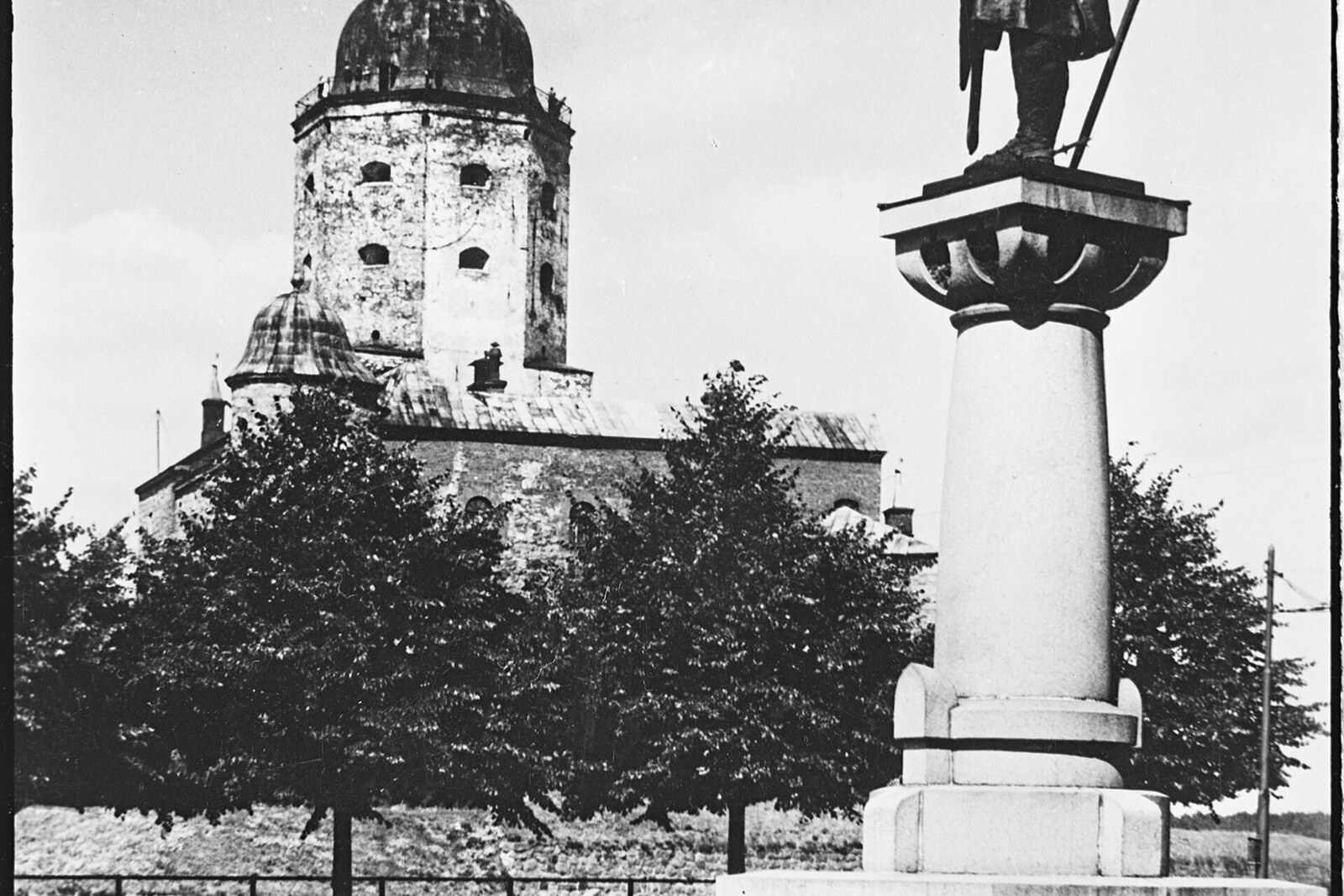
Look around first
What to notice
- The bronze figure of a knight
- Sword and shield
- Granite pedestal
- Facade of the Old Town Hall
The story of the place
The square took its name from the town hall at its edge: in the Middle Ages, people who decided Vyborg's city affairs gathered here. The facade of the Old Town Hall remains a sign of that time. Later, the administration moved to Cathedral Square, and the former building was adapted for other uses. Thus the former civic center found itself at the start of the road to the castle.
The bronze knight stands between two buildings that explain why he appeared here. Behind him is the Old Town Hall, the home of the city council. In front of him, across the strait, is Vyborg Castle. Sculptor Ville Vallgren turned the figure to face the fortress whose foundation is attributed to Torkel Knutsson.
Knutsson was a Swedish marshal and the de facto ruler of the kingdom under an underage king. In twelve ninety-three, he organized a military expedition to the Karelian Isthmus to push the Swedish border eastward. A naval militia ravaged a Karelian settlement and a guard post on the island, then the Swedes built a stone castle there. A town gradually grew on the opposite shore.
Knutsson himself most likely never came to Vyborg. The medieval chronicle closest in time does not name the leader of the expedition at all, and documents show that the marshal was in Sweden at the time. He became known as the initiator of the expedition. Later tradition turned the expedition's organizer into the founder of the castle and the town—it is this tradition that was cast in bronze.
Vyborg architect and antiquarian Jacob Arenberg decided to place the statue here. In eighteen eighty-four, he received a letter from the young Vallgren: the sculptor was looking for work. Arenberg commissioned a Knutsson from him and demanded accurate armor and a coat of arms. They began collecting money at a literary evening; ticket sales brought in three hundred marks. Arenberg himself agreed to redesign the square in front of the Old Town Hall free of charge.
The first clay model dried out and cracked. Vallgren made a new one, but the military commandant of Vyborg did not permit it to be installed: a monument to a Swedish conqueror seemed impermissible to him in a city of the Russian Empire. The plaster figure was displayed in the Vyborg museum under the neutral names “Knight” and “Courage.” The dispute reached Emperor Alexander III; in eighteen ninety, he ordered that no monuments be erected in public places in the future without the Emperor's permission.
Arenberg did not abandon the idea. Vyborg pharmacist Johann Casimir von Zweigberg bequeathed the city a large sum for its beautification, and the municipal administration allocated thirty thousand marks from that money to cast the statue. The council then appealed to Nicholas II. In April nineteen oh seven, the Emperor approved the project, Vallgren sent the model to Paris, and Knutsson was finally cast in bronze there. On October fourth, nineteen oh eight, twenty-four years after the first fundraising effort, Vyborg's first public monument was unveiled in the square.
By then, the square had long been called Old Town Hall Square. It had been the main square as early as the Middle Ages, and the city council met in the building behind the monument. In the nineteenth century, the administrative center moved to Cathedral Square, the former town hall was given over to other uses, and the word “Old” appeared in the name. Arenberg placed Knutsson in the former civic center, at the start of the road to the castle.
The bronze figure stood here for exactly forty years. In nineteen forty-eight, the city leadership suggested that the communications personnel stationed in the castle remove it. According to the recollections of a Vyborg historian, soldiers tied ropes around the statue at night and pulled it off the pedestal with jerks. The feet remained on the granite, while the shield, scabbard, and part of the sword hilt flew off. The damaged Knutsson was dragged to the castle, then sent to a warehouse.
Staff of the Vyborg Museum of Local History found the bronze figure in a shed of the municipal-improvement combine only in nineteen seventy-five. It was moved to the castle and kept in the basement beneath St. Olaf's Tower. Sixteen years later, sculptor Viktor Dymov and restorers restored the missing parts, and granite workers recreated the pedestal from the old design. In nineteen ninety-three, that very Vallgren statue returned to the square: damaged bronze with restored feet, shield, and sword, once again facing the castle.
Useful on site
The square is always open; viewing the monument and facades is unrestricted.
Checked: June 24, 2026. Check the official source before visiting.Stand to the side of the figure to see the monument and the castle at the same time: their visual connection matters here more than the inscriptions on the pedestal.