 Guide On Map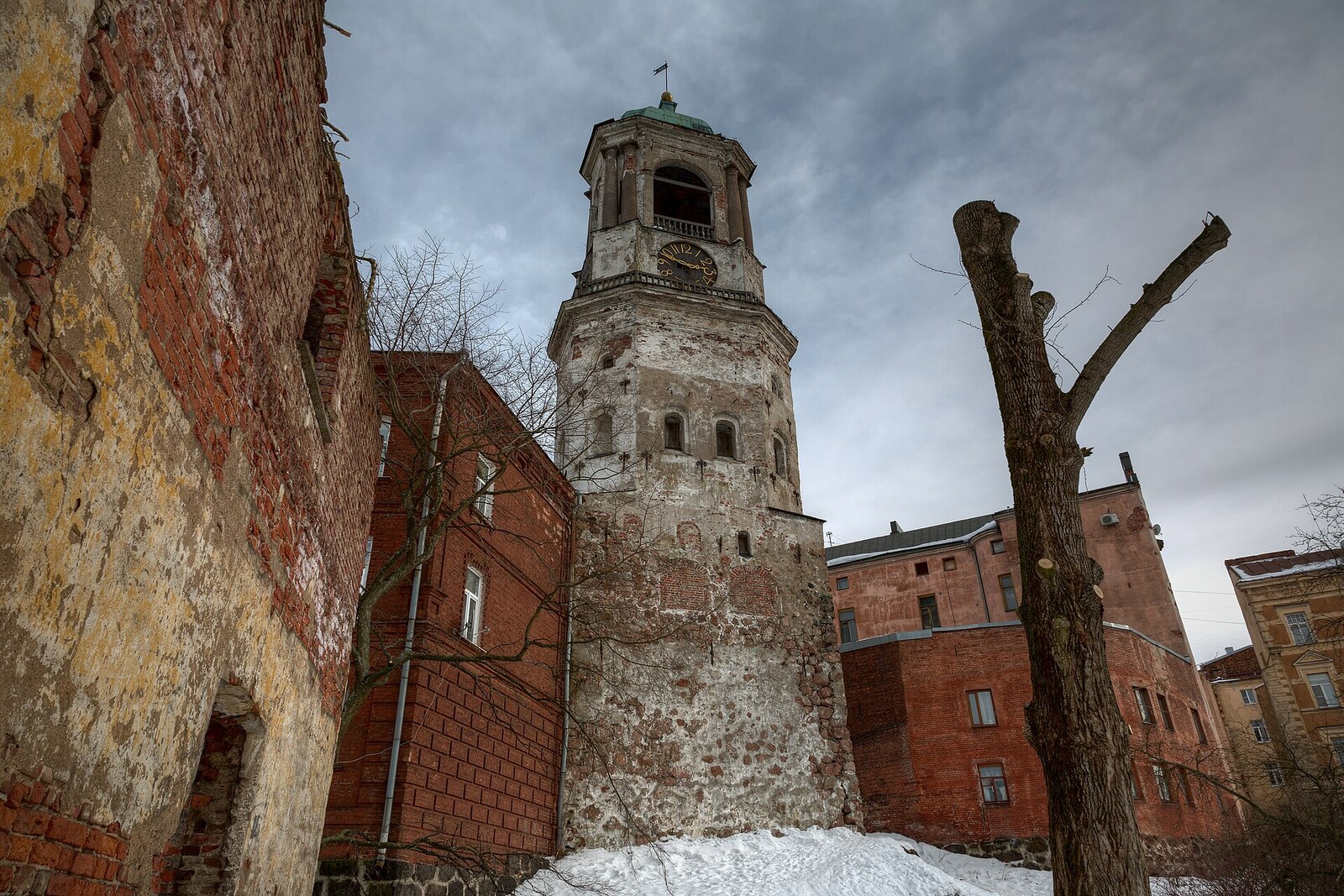
Look around first
What to notice
- The tower clock faces
- The alarm bell
- The wooden shaft for the weights
- The walls of the Old Cathedral
The story of the place
Above the ruins of the old city church rises a tower with clock faces and an alarm bell. Its lower stone tier was built at the end of the fifteenth century for the cathedral, of which only the outer walls survive around it. Inside, the weights of the clock mechanism descend through a wooden shaft between the staircases, and the bell marks every hour. Later, a fire watch was set up at the top, and from here the watchman looked out for smoke above Vyborg's tightly packed quarters.
In the autumn of two thousand sixteen, the tower clock had already been out of operation for more than a year. The room containing the mechanism was left unattended: unauthorized people climbed in, and individual parts could have been taken apart for souvenirs. Ivan Pershin, an eleventh-grade student fascinated by the history of Vyborg and by how clocks work, entered the tower uninvited. First, he secured the mechanism behind a locked door; then, using video recordings, he learned how to regulate and lubricate it. On October sixth, the hands began moving again.
The clock gained about two minutes a day. Once a week, Ivan came up here after classes, wound the weights, and corrected the timekeeping. The museum did not punish him for entering without authorization: the schoolboy was hired as a part-time caretaker, with a salary. Later, he continued to look after the mechanism and lead tours of the tower.
The mechanism Ivan started is not medieval. It was installed in eighteen forty-eight. Heavy weights descend inside a wooden shaft between the flights of stairs, and every hour the clock sets the alarm bell in motion. The bell itself is even older than the mechanism.
To understand why it is here, we need to return to the tower's original purpose. Its lower stone tier was built at the end of the fifteenth century as the bell tower of the city's main church. The walls beside it are the remains of that very cathedral.
In seventeen ninety-three, a major fire damaged both the church and the bell tower. By then, services were no longer held in the cathedral, and a new one had been built in the city. They did not return the old building to its former life: the military stored provisions, weapons, and grain within its walls. The bell tower, by contrast, was restored for the city.
The provincial architect Johann Brockman added a third tier and created a fire-watch platform there. From the height, a watchman kept an eye out for smoke above Vyborg's tightly packed quarters. Catherine II gave Vyborg an alarm bell weighing sixty-one poods. It was cast in Moscow at the factory of Pyotr Strugovshchikov. The inscription on the bronze says that the fire turned Vyborg to ashes and that the bell tower was restored in seventeen ninety-six.
The cathedral was later adapted for worship again, but it was destroyed in nineteen forty. Only the outer walls remain of the main church. Above them, the clock once started by a Vyborg schoolboy still runs, and the bell cast more than two centuries ago after the fire still hangs.
Useful on site
Freely accessible outside; ascent of the Clock Tower usually Wed–Sun 10:30–17:30, Mon–Tue closed, age 12+.
Checked: June 24, 2026. Check the official source before visiting.View the ruins only from permitted areas, and do not go beyond the barriers. Check separately whether ascent of the tower is possible; the stop remains meaningful from outside as well.