 Guide On Map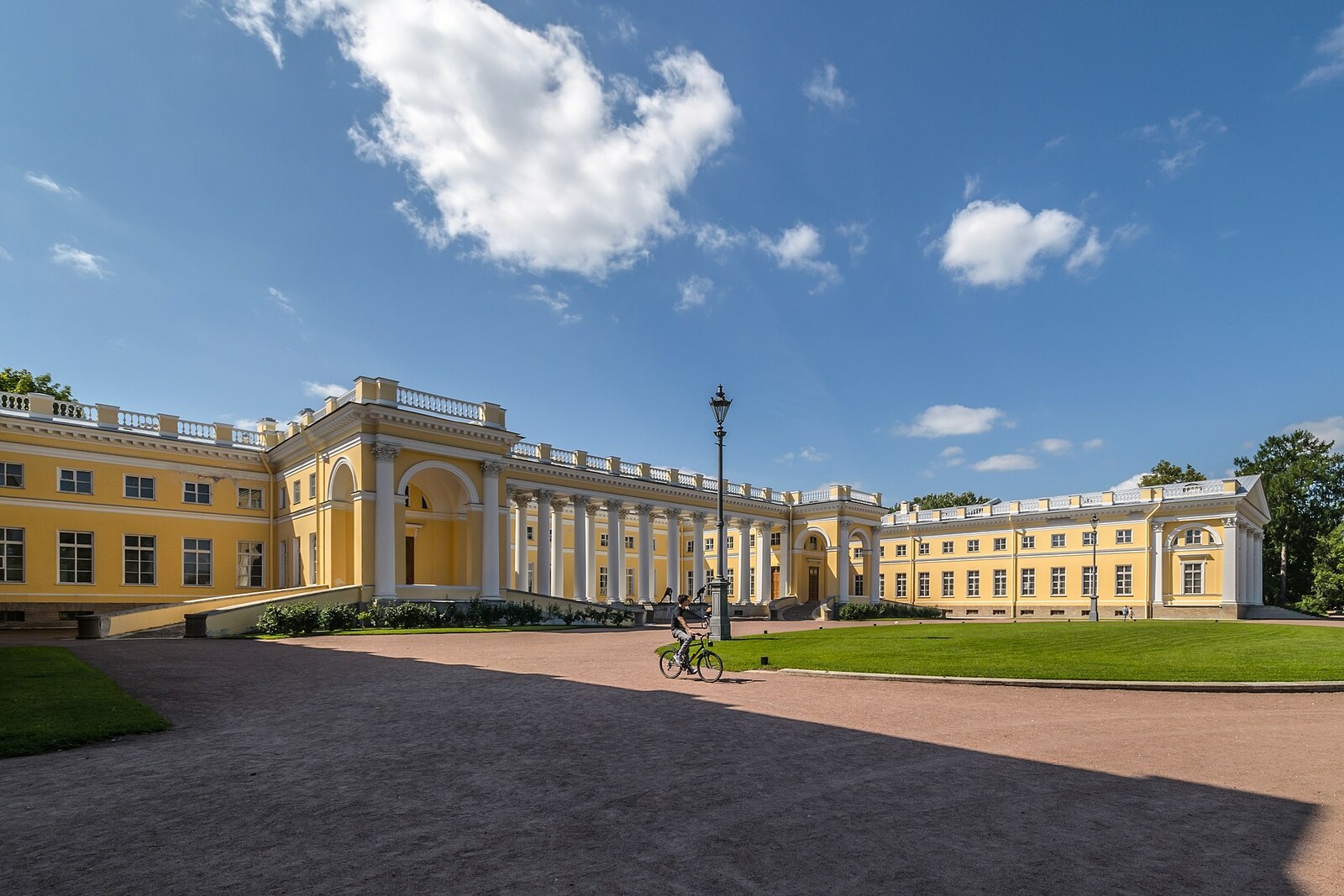
Look around first
What to notice
- Central colonnade
- Rounded projection of the Semi-Circular Hall
- Dome
- Doors to the park terrace
The story of the place
Behind the central colonnade, the palace continues with residential wings: the owners' rooms were once in the right wing, and the children's quarters were a floor above. Catherine II commissioned it as a wedding gift for her grandson Alexander Pavlovich, and the first owner's name remained in its title. Later, the family of his descendant settled here again; the house served at once as a private residence and a place for state receptions. At the center of the park-facing facade is a rounded projection beneath a dome: beyond the doors of the Semi-Circular Hall begins the terrace.
In March nineteen seventeen, at the gates of Alexander Palace, a guard officer gave the order: “Open the gates for the former tsar.” Nicholas II had left here as emperor and returned after the abdication had been signed—to his wife and five children. All the children fell ill with measles one after another; Maria had the disease especially severely. While the monarchy was collapsing in Petrograd, the palace's second floor became a family infirmary.
For Nicholas, this was his own home. He was born here, spent his childhood here, and from nineteen oh five lived here permanently with his family. The rooms of Nicholas and his wife Alexandra Feodorovna were in the right wing, with the children's quarters above them. From here the emperor left for military headquarters, received ministers here, and here armed guards now awaited him.
The palace's name belongs to another owner. Catherine II commissioned it as a wedding gift for her beloved grandson Alexander Pavlovich, the future Emperor Alexander I. The present name was established after its first owner's name. A century later, the palace again served as a family residence for the heirs of that Alexander, but after the decision of the Provisional Government, the palace doors were locked from the outside, with Nicholas and Alexandra within.
Under arrest, they retained their rooms, furniture, and servants, but the guards set the schedule. The family was allowed out for walks only in an allotted part of the park. Nicholas dug garden beds, sawed fallen trees, and studied history and geography with his son Alexei. In his diary, he noted that he now spent far more time with his family than during his years of reign. Beyond the fence, people discussed a trial, exile, and the possible sending of the Romanovs abroad; inside, a father checked the lessons of a boy who until recently had been considered heir to the throne.
In the summer, Alexander Kerensky, chairman of the Provisional Government, decided to take the family far from troubled Petrograd—to Tobolsk. The destination was not disclosed even to those who were leaving. On the final night, no one went to bed. The staff packed belongings, while officers opened and checked suitcases; eighteen crates were inspected and nailed shut under the guard's supervision. The train was late, and the family waited for several hours, not knowing when they would be taken out.
At dawn, Nicholas, Alexandra, and the five children passed through the Semi-Circular Hall to the cars. Nicholas asked Kerensky whether he would ever be able to return to his native Tsarskoye Selo. He received no answer that promised anything. The family was taken from the palace to Alexandrovskaya Station, then to Tobolsk. In the spring of the following year, they were transferred to Yekaterinburg, and in the summer Nicholas, Alexandra, and all five children were killed in Ipatiev House.
The Semi-Circular Hall has survived at the very center of the palace. On the park side, it is marked by a rounded projection beneath a dome; the hall's doors still lead to the terrace from which the family of the last emperor began their final journey from this home.
Useful on site
10:00–18:00, ticket office until 16:45, admission until 17:00; closed Wednesday. From 15 June to 15 December 2026, a modified visitor entrance is in effect.
Checked: June 24, 2026. Check the official source before visiting.The interiors are especially important to the family part of the story, but they require separate museum time. Outside, linger by the facade and imagine how a familiar home became a guarded territory.