 Guide On Map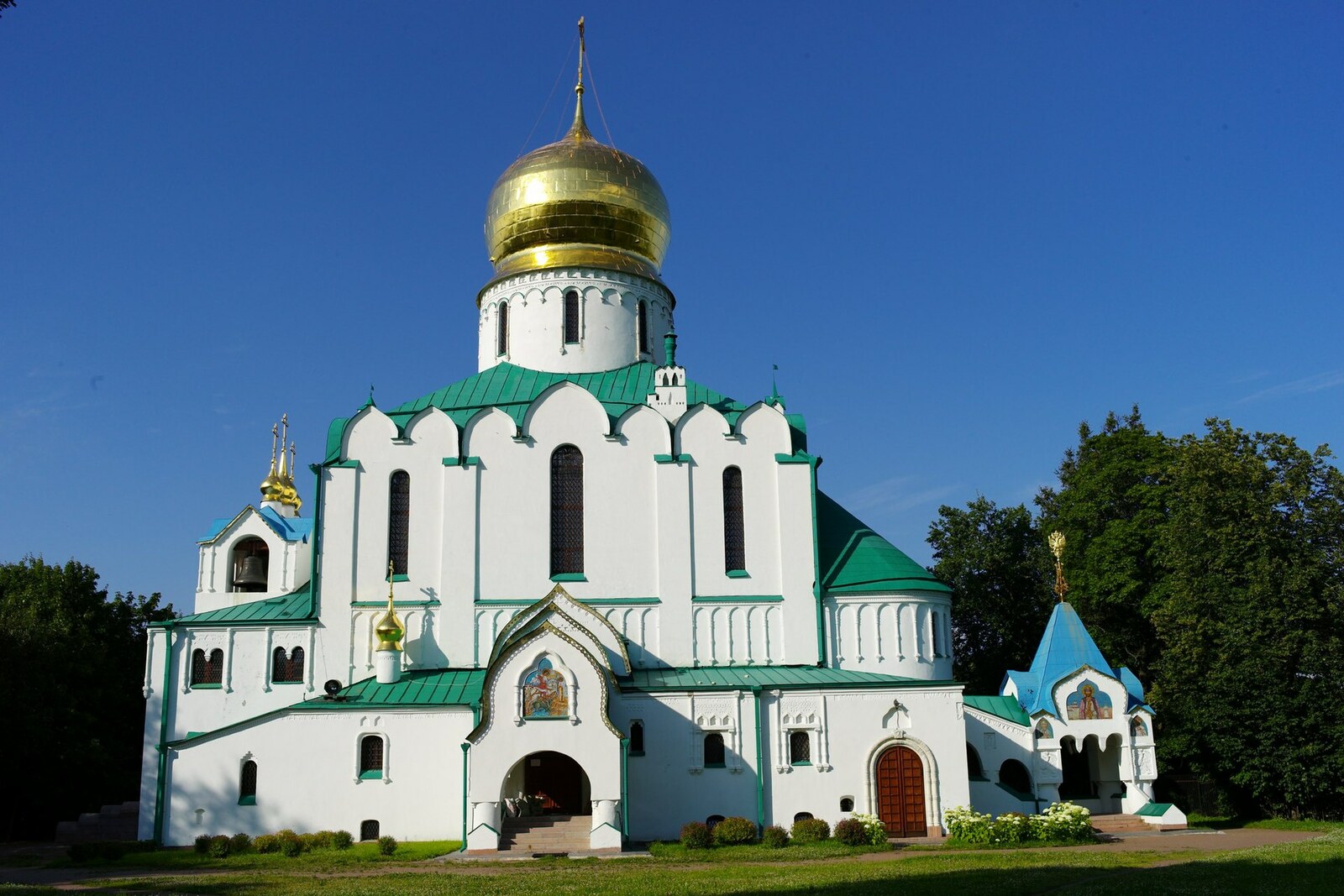
Look around first
What to notice
- Mosaic of St. George the Victorious
- Tsar's porch
- Blue tented roof
- Gilded eagle
The story of the place
Feodorovsky Sovereign Cathedral is often considered a monument to the three-hundredth anniversary of the House of Romanov. A surviving statement from the construction committee directly refutes that version. The church was created for the people who lived and served nearby: the imperial family and two units of its personal guard.
The Composite Infantry Regiment was recruited from selected soldiers of Guards and army units. His Imperial Majesty's Own Convoy consisted of Cossacks who accompanied and guarded the emperor. Both units were quartered near the Alexander Palace, but they had no regimental church of their own. The military pressed for one to be established, while Nicholas II and Alexandra Feodorovna needed a church near their home where the imperial family's presence would not turn a service into a spectacle for an incidental crowd.
At the empress's wish, Officer Dmitry Loman first adapted the premises of a training detachment for use as a church. The first service was held there in February nineteen hundred nine. It was a temporary solution: a field iconostasis stood inside a government building, and soldiers were expected to return there after guard duty and training.
In March of that same year, Emperor Nicholas II chose the site for a permanent church. Loman, who soon became the ktitor—the manager of the cathedral's affairs—recalled how the emperor came out of the palace and, in deep snow, pointed out a plot between the roads and the officers' assembly hall. The cathedral stood between the Alexander Palace and the barracks precisely because it was to serve both ends of this short road: those who were guarded and those who stood guard.
It was called Feodorovsky after the Feodorovskaya Icon of the Mother of God, not after a person connected with its construction. The origin of the icon's own name is explained in different ways: it is associated either with the church of the holy warrior St. Theodore Stratelates, to which the image was once transferred, or with the baptismal name of Prince Yaroslav Vsevolodovich—Theodore. For the Romanovs, another connection mattered more. According to church tradition, in sixteen thirteen, before this icon, the mother of sixteen-year-old Mikhail Romanov blessed her son to accept the tsar's throne. A venerated copy of the ancient image was commissioned in Kostroma for the new cathedral; its depiction still stands above the western entrance.
In nineteen fourteen, the church officially received the word “Sovereign.” It described a quite literal order: the cathedral belonged to the emperor and empress, the schedule of services was submitted to Nicholas II for approval, and the palace commandant decided whom to admit. When the imperial family was present, outsiders were issued named or single-use tickets. After the emperor arrived, the doors were closed until his departure.
Even inside, people did not mix. Soldiers of the Composite Infantry Regiment stood on the left, the Cossacks of the Convoy on the right, the retinue occupied a separate place, and Nicholas and his family entered through their own porch to the right choir loft. Lower ranks were instructed to kneel when the emperor knelt. After the service, the Cossacks did not approach the cross with the others: they were to leave more quickly and form up to guard the departure.
This arrangement can still be seen from outside. On the south, the entrance for officers and the Convoy survives, with a mosaic of St. George the Victorious. At the southeast corner stands the tsar's porch beneath a blue tented roof and a gilded eagle. The northern entrance, used in summer by parishioners and lower ranks, has now become the main one. The cathedral is once again active as a parish church, and a ticket from the palace commandant is no longer required for this entrance.
Useful on site
Active church; a daily liturgy at 10:00 has been confirmed, with an additional one at 07:00 on Sundays and holidays. The full opening schedule and access to the lower church have not been fully published in advance.
Checked: June 24, 2026. Check the official source before visiting.This is an active church: keep quiet, do not disturb the service, and check on site whether visiting is possible. Outside, compare the entrances intended for different ranks.