 Guide On Map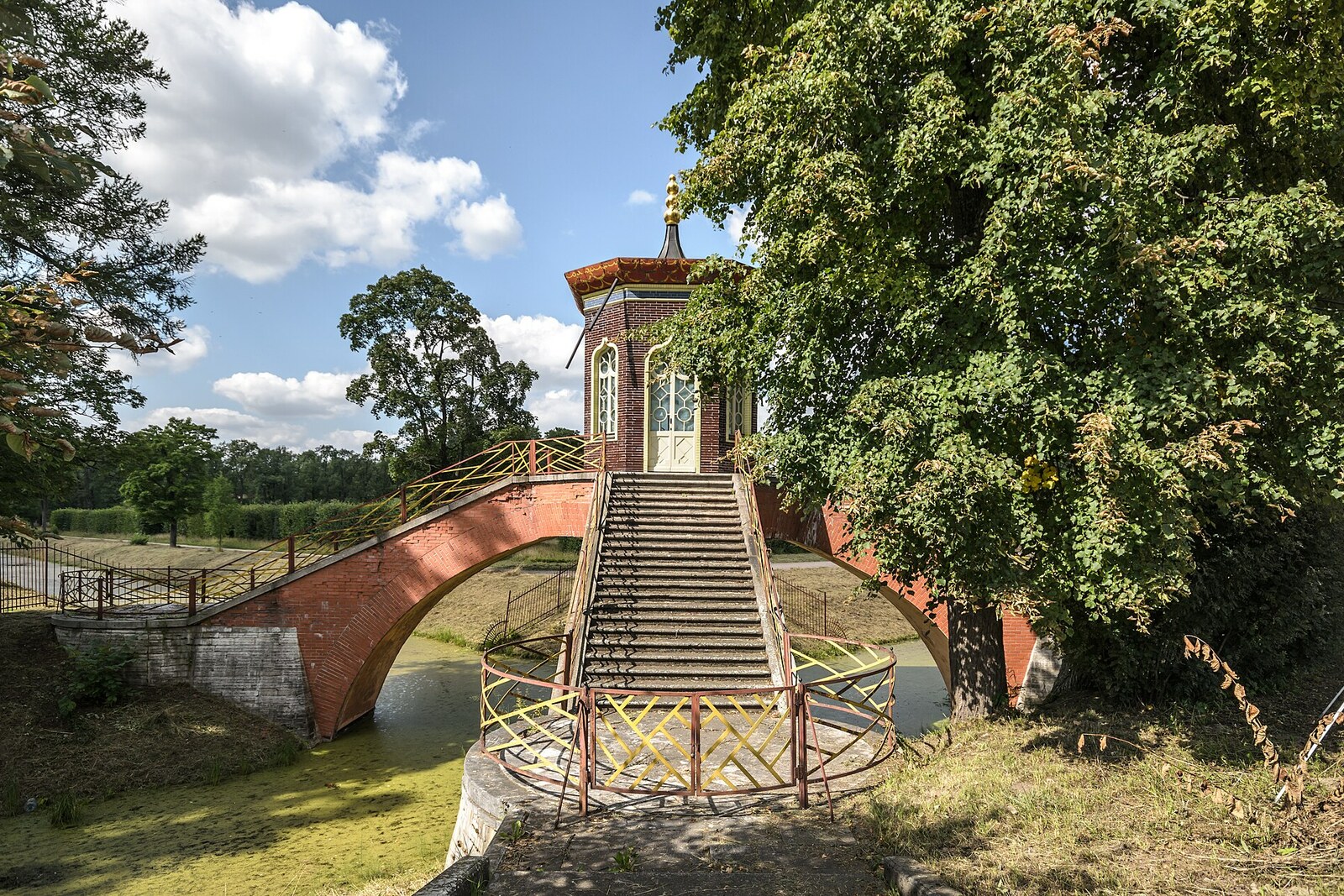
Look around first
What to notice
- Four granite staircases
- Octagonal pavilion
- Crossed arches
- Joined blocks of the Chinese Village
The story of the place
Cross Bridge consists of two tall bridges thrown across one another. Four granite staircases converge on an octagonal pavilion, forming a cross in plan—hence the name. In seventeen seventy-six, Catherine II ordered the architect Vasily Neelov to build here “a Chinese pavilion on arches, with four approaches.” Neelov used a model from an English album of European fantasies about Chinese architecture. Actual Chinese craftsmen had nothing to do with this work.
Beyond the bridge, the Empress intended to create an entire Chinese Village: houses, gates, and a tiered tower. She did not manage to complete the project. Ten of the planned houses were built in full, while the tower remained unfinished. Under Alexander I, the architect Vasily Stasov joined the houses in pairs and turned them into state apartments for courtiers and imperial guests. Thus, the decorative village acquired a purpose Catherine had not intended for it.
In the spring of eighteen twenty-two, Alexander I assigned houses number five and six to Nikolay Karamzin, the state historiographer, who wanted to bring his multivolume History of the Russian State to completion. Back in eighteen oh three, the Emperor had granted him an annual pension of two thousand rubles. This money allowed Karamzin to leave journals and literary prose behind for one vast work. Now his patron also gave him a home beside his own residence.
The family occupied both houses from spring until late autumn. Karamzin’s friend Ivan Dmitriev found a strict routine here. After a morning walk, the historian drank coffee with his household, went to his study, and returned only at around four o’clock, straight to dinner. The study contained a state writing desk covered in black leather; the remaining items were recorded in an inventory hanging by the door. Even a court stoker was assigned to the residents on the official staff: the dampness in the houses could not be overcome despite constant repairs.
Karamzin worked here on volumes about the end of the sixteenth and beginning of the seventeenth century. He had to compare manuscripts, rewrite chapters, and at the same time preserve the independence of a man whose support and housing were paid for by the sovereign. In eighteen twenty-four, the tenth and eleventh volumes came off the press. Karamzin then began the twelfth. In the autumn of eighteen twenty-five, he was still working in the Chinese Village and wrote to a friend that the work was bringing him joy again. In November, the family left for St Petersburg. Half a year later, Karamzin died, leaving the final volume unfinished; his friends prepared his drafts for posthumous publication.
Later, the houses of the Chinese Village were rebuilt again and joined into long blocks. The separate houses numbered five and six can no longer be distinguished. The cross formed by the four staircases has survived, and beyond it stand the walls within which Karamzin completed the final finished volumes of his History.
Useful on site
Alexander Park is open daily, with free admission. Cross Bridge is viewed from the outside; the Chinese Village is used as a guest and residential complex.
Checked: June 24, 2026. Check the official source before visiting.The village does not require entering the houses: view the ensemble as a residential space and respect the access restrictions for the buildings in use.