 Guide On Map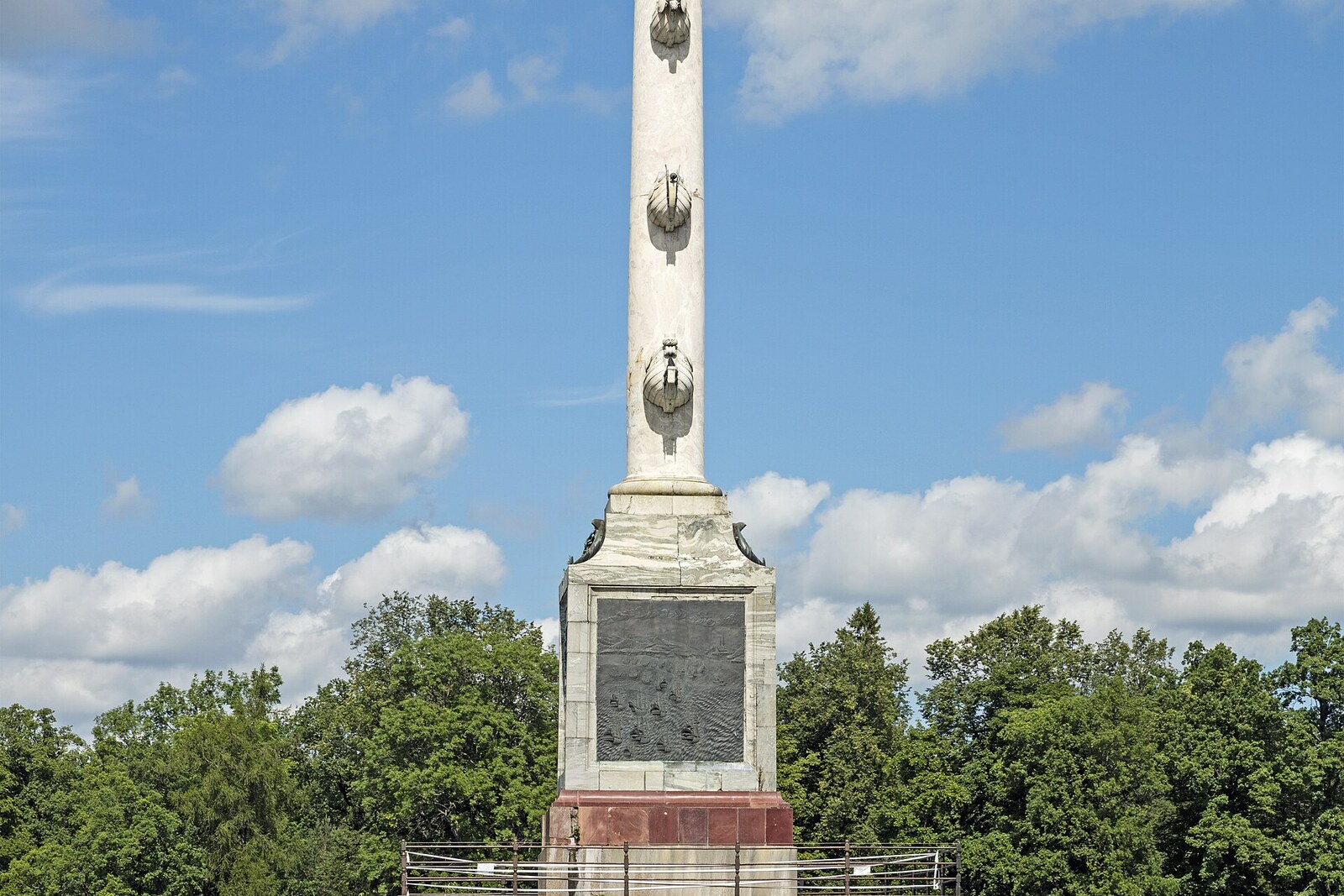
Look around first
What to notice
- Six ships’ prows
- Bronze eagle
- Ottoman crescent
- Relief of the nighttime fire
The story of the place
When Great Pond was being deepened and its banks reshaped, a point directly in the water was chosen for the column. Antonio Rinaldi placed it on a granite base: six prows of ancient ships spread out to the sides, while a bronze bird at the top holds a crescent. The relief on the north face of the pedestal was restored after the Great Patriotic War, when the earlier bronze disappeared. One of the fragments found later lies on the opposite bank.
A marble column rises from the water, with six ships’ prows—rostra. Victors in antiquity displayed such prows as trophies. Here they tell us that this is a monument to a naval war. The column is called the Chesme Column, after the Turkish Chesme Bay in the Aegean Sea, and the Orlov Column, after the surname of the man who commanded the Russian expedition.
In the summer of seventeen seventy, Count Alexei Orlov had to save a campaign that had begun with a failure. Catherine II sent the Baltic Fleet around Europe to the Mediterranean, hoping to divert the Ottoman Empire from the main fighting. Orlov wanted to raise an uprising on the peninsula of Morea, as the Peloponnese was then called, but there were too few Russian soldiers, and the local detachments could not replace an army. The occupied port of Navarino had to be abandoned. Orlov brought together the scattered squadrons and went in search of the Ottoman fleet: without a victory at sea, the whole distant expedition lost its purpose.
The opponents were found in the Chios Strait. The Ottoman ships outnumbered the Russian ones and had more guns. Admiral Grigory Spiridov led his line in at close range. His flagship, Saint Eustathius, came almost alongside the Ottoman flagship. A burning mast from the enemy ship fell onto the Russian deck, the flames reached the powder magazine, and Eustathius exploded. Spiridov and the captain managed to escape in a boat, but most of the crew died. Soon the Ottoman flagship exploded as well, while the other ships cut their anchor cables and took shelter in neighboring Chesme Bay.
The cramped harbor chosen for protection became a trap. The ships stood so close together that fire could pass from one side to another. Spiridov proposed a nighttime attack, and Rear Admiral Samuel Greig led a detachment to the entrance of the bay. After an artillery bombardment, four fire ships went forward—old vessels loaded with combustible materials. The crew of such a ship had to grapple with an enemy vessel, set fire to its own deck, and escape in a small boat.
Lieutenant Dmitry Ilyin brought his fire ship alongside an Ottoman vessel that was not yet burning, secured it beside the ship, lit the fuse, and withdrew with the sailors. The flames engulfed the grappled hulls, then the neighboring vessels. Explosions in the powder magazines scattered burning wreckage around the bay. By morning, most of the Ottoman squadron had been destroyed. The Russian fleet gained an advantage in the Aegean Sea and began a blockade of the Dardanelles. Ilyin was promoted to captain-lieutenant and awarded the Order of St. George. Orlov received the highest class of the same order and an honorary addition to his surname—Chesmensky. This is where the column’s second name comes from: the Orlov Column.
Catherine approved Antonio Rinaldi’s design only a year after the battle and chose the site herself. At that time, builders were deepening Great Pond and reshaping its banks. Rinaldi placed the naval monument directly in the water: its granite base rises from the pond, the rostra face in different directions, and a bronze eagle at the top holds an Ottoman crescent.
A nighttime fire in Chesme Bay is cast on the north side of the pedestal. This is a restored relief: the original disappeared during the Great Patriotic War, and part of the bronze fragments was later found on the bottom of Great Pond. One of the recovered fragments lies on the bank opposite the column.
Useful on site
Catherine Park is open from 20 April to 31 August, 07:00–22:00; paid admission applies 09:00–19:00.
Checked: June 24, 2026. Check the official source before visiting.View the monument from the bank and, if possible, from several points: you cannot approach it by path, and the distance is part of the design.