 Guide On Map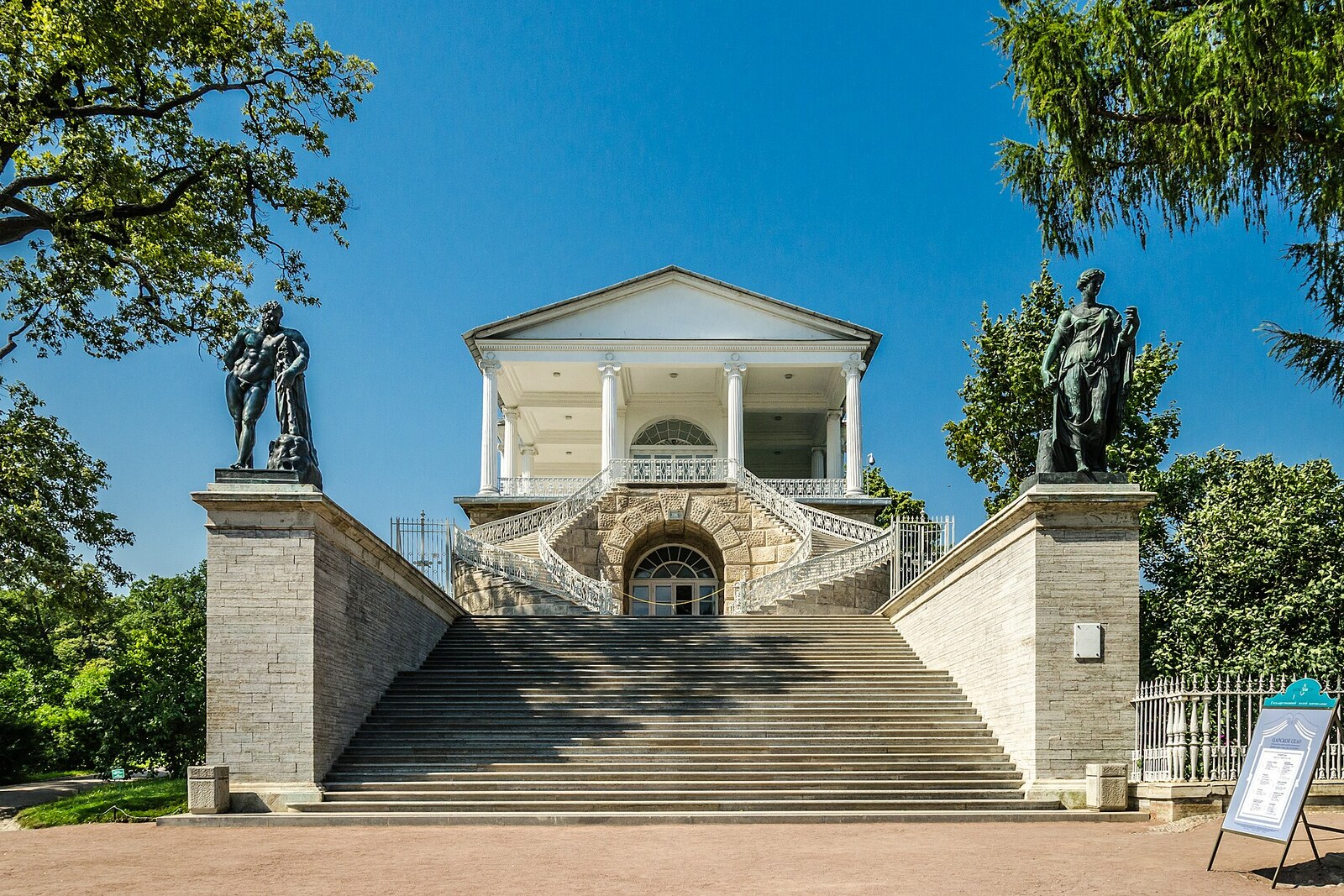
Look around first
What to notice
- Long colonnade
- Bronze busts
- Granite pedestals
- Broad staircase
The story of the place
The colonnade stretches along the slope between the palace quarters and the park: its upper tier is level with the palace, while the lower floor grows ever higher on the park side. Below is a bathing hall with a tin pool, a bathroom, a massage room, and a Russian steam room; for steam, two hundred fifty cannonballs were heated red-hot and doused with water. Above the bath are the Agate Rooms, with studies, a library, and a hall finished with marble and multicolored jasper; the palace’s mistress worked here with letters and state papers. The broad staircase leads to bronze busts between the columns, set on granite pedestals.
In seventeen seventy-nine, Empress Catherine II invited Charles Cameron to Russia. She knew him not from buildings: he had not yet completed any independent structures. Cameron earned his living through architectural drawings and engravings, and gained renown through the lavish treatise The Baths of the Romans, published seven years earlier. Catherine wanted a building modeled on antiquity beside her private quarters and decided to entrust its construction to a man who could so far explain Roman architecture only on paper. Cameron received an apartment, a salary of one thousand eight hundred rubles, and his first major commission.
He recreated the arrangement of Roman baths at Tsarskoye Selo almost literally. On the lower floor, he placed a bathing hall with a tin pool, a bathroom, a massage room, and a Russian steam room. For steam, servants heated two hundred fifty cannonballs red-hot and poured water over them. The name Cold Bath refers specifically to this bathing floor; here, the cold pool stood alongside hot treatments.
Upstairs, Cameron created the Agate Rooms: studies, a library, and a hall finished with marble and multicolored jasper. Catherine worked there on state papers and letters. From the palace’s private quarters, she passed through the Hanging Garden to the Agate Rooms, then reached the long colonnade and descended into the park. Cameron placed the gallery on a slope: its upper tier was level with the palace quarters, while the massive lower floor gradually rose higher on the park side.
The completed bathhouse did not withstand its main test. Catherine’s cabinet secretary, Alexander Khrapovitsky, recorded her assessment: it was strange that everything had been built for the sake of a bath, yet the bath turned out poor—it was impossible to bathe in it. The Empress more often used two other Tsarskoye Selo baths by the Square Ponds. The first completed project of the celebrated scholar of baths did not become her usual place for bathing.
Catherine did not abandon the rest of the complex. She worked in the Agate Rooms and walked along the colonnade. Originally, the staircase from the park reached only the lower floor; at the Empress’s instruction, Cameron added two upper flights leading directly to the gallery. Catherine herself selected bronze busts of ancient philosophers, poets, military commanders, and rulers for it. They were cast in the workshop of the Imperial Academy of Arts and placed between the columns on granite pedestals. In her letters, Catherine described walking among the already installed busts and drawing up new lists right there.
The Tsarskoye Selo commission turned the author of a book with no construction experience into a court architect. Today, the gallery bears his surname, and its upper tier and collection of bronze busts are preserved on the historic site chosen by Catherine. Beside it still stands the Cold Bath—Cameron’s first structure and the part of his Roman design in which the patron never wished to bathe.
Useful on site
Exterior viewing follows the Catherine Park schedule. Catherine Park is open 07:00–22:00 from April 20 to August 31; paid admission applies 09:00–19:00. Access to individual interiors depends on the seasonal museum program.
Checked: June 24, 2026. Check the official source before visiting.First compare the heavy base with the light upper level. The Agate Rooms are part of the museum visit; even without entering, the ensemble’s main contrast is still visible.