 Guide On Map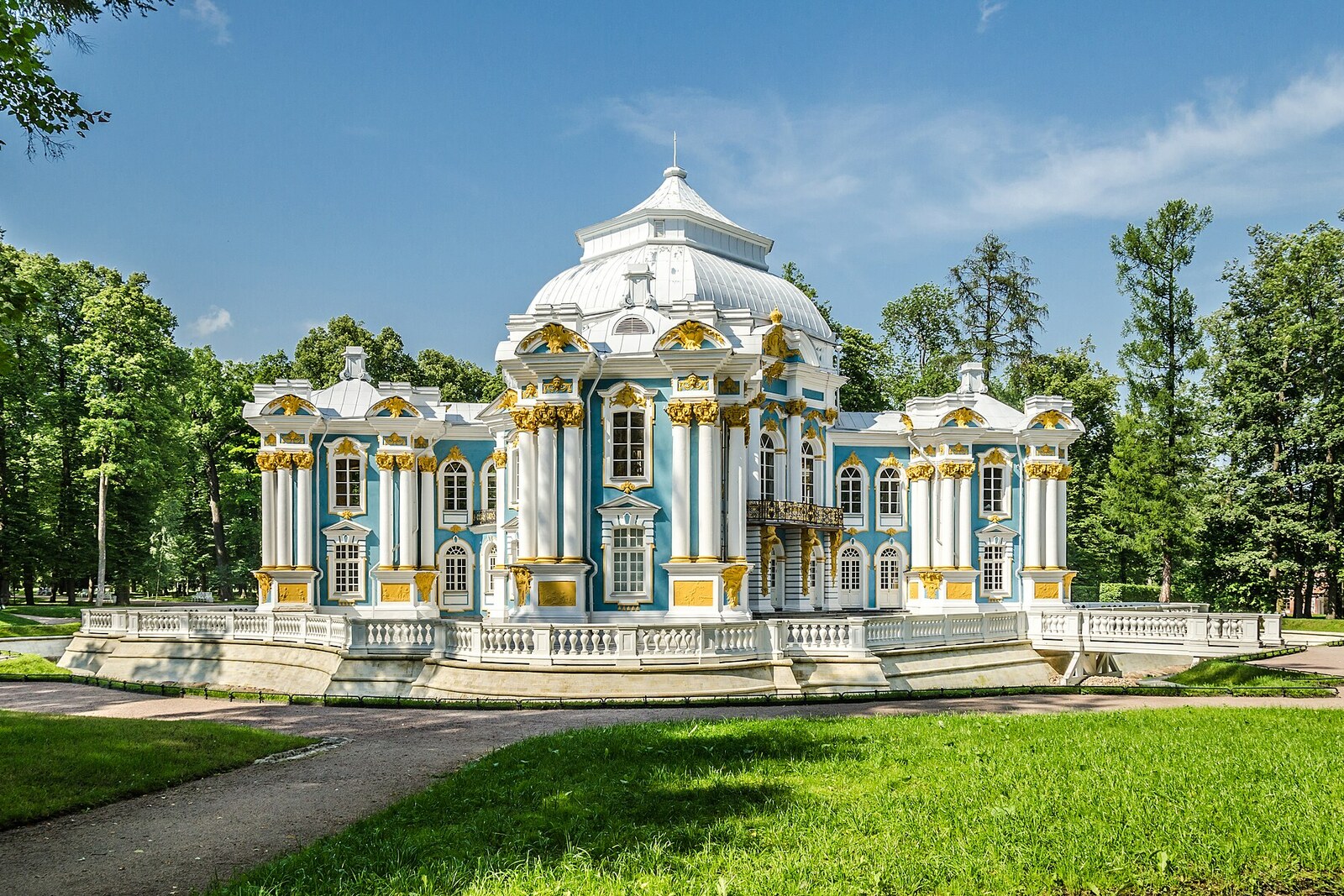
Look around first
What to notice
- Domed hall
- Five lifting tables
- Parquet panels
- Stone staircase
The story of the place
At court in the eighteenth century, the word hermitage referred to rooms for dining in a close, preselected circle. At Tsarskoye Selo, a separate Hermitage Pavilion with a domed hall was built for such receptions; two drawbridges led to it, and the present stone staircase appeared later. Here, guests were separated from those who prepared and served the meal. Later, the name of these closed palace rooms passed to galleries in St Petersburg and remained with the State Hermitage Museum.
In May seventeen forty-five, Empress Elizabeth of Russia ordered changes to the pavilion then under construction. Instead of an ordinary staircase, she required a lifting seat, and in the hall, tables that could be lowered whole to the floor below. Elizabeth wanted to receive selected courtiers and foreign ambassadors without servants behind their backs, while also astonishing guests with a device they had never seen before.
The pavilion's name is explained by this purpose. In the court language of the eighteenth century, a “hermitage” meant secluded rooms for dining in a closed circle. This did not mean solitude: Elizabeth expected to seat up to thirty-five people here. Seclusion began with the guest list—all others remained beyond the bridges or a floor below.
A craftsman made the first large table with twenty-two places, but it proved too long. Elizabeth ordered two places removed from each end, so that guests could pass between it and the four smaller tables. As a result, the central table seated eighteen people, while the others were arranged around it. The Empress herself determined the size of the party and made the machinery conform to court protocol.
On July thirty-first, seventeen fifty-six, Elizabeth was documented dining here for the first time with gentlemen and ladies. At that time, two wooden drawbridges led to the Hermitage Pavilion. There were no present-day staircases inside: guests sat in pairs on small canapé sofas upholstered in green velvet with gold braid, and rose to the hall on platforms.
When the invitees were upstairs, sections of the parquet floor were drawn apart, and five already laid tables appeared from the floor below. An individual plate could also be sent down: a guest wrote on a slate tablet which dish was wanted and pulled a cord. Below, the note was read, the plate was changed, and it was returned by the same route.
People moved all of this. A team of twelve soldiers was needed to operate the heavy platforms. While ambassadors and courtiers saw tables rising from the floor, soldiers one floor below pulled ropes, turned winches, and held the platforms at the required height. Whether the precious tableware rose evenly, and whether a delay gave away the entire prepared effect, depended on their coordinated actions.
After dinner, the team lowered the tables and covered the openings with parquet panels. The furniture disappeared, and the same hall was cleared for dancing. Elizabeth got exactly what she had sought: the invitees were raised above the service floor, ordered dishes without a footman entering, and then saw the dining room disappear beneath their feet.
Catherine II, who succeeded Elizabeth on the throne, transferred this idea to St Petersburg. In seventeen sixty-eight, she ordered lifting tables made in a new pavilion at the Winter Palace exactly on the Tsarskoye Selo model. There, Catherine held gatherings of a select circle and housed the paintings she had acquired. The name passed from closed dining rooms in the palace to palace galleries, and then to the State Hermitage Museum.
There are no longer lifting sofas in the Tsarskoye Selo pavilion. One was replaced with a stone staircase in eighteen twelve, and the other was dismantled in nineteen eleven. The five tables remained in the hall; the mechanisms beneath them were renewed in the middle of the nineteenth century and later restored. During a museum demonstration, a plate still goes beneath the floor and returns upward—to the place where Elizabeth assigned seats for thirty-five invitees.
Useful on site
In season: 11:00–19:00, ticket office and entry until 18:00; closed Monday. Interior viewing takes place during scheduled sessions.
Checked: June 24, 2026. Check the official source before visiting.If the pavilion is closed, view it from every accessible side: its exterior explains the idea of a secluded palace, while the lifting tables remain part of the story of the interior.