 Guide On Map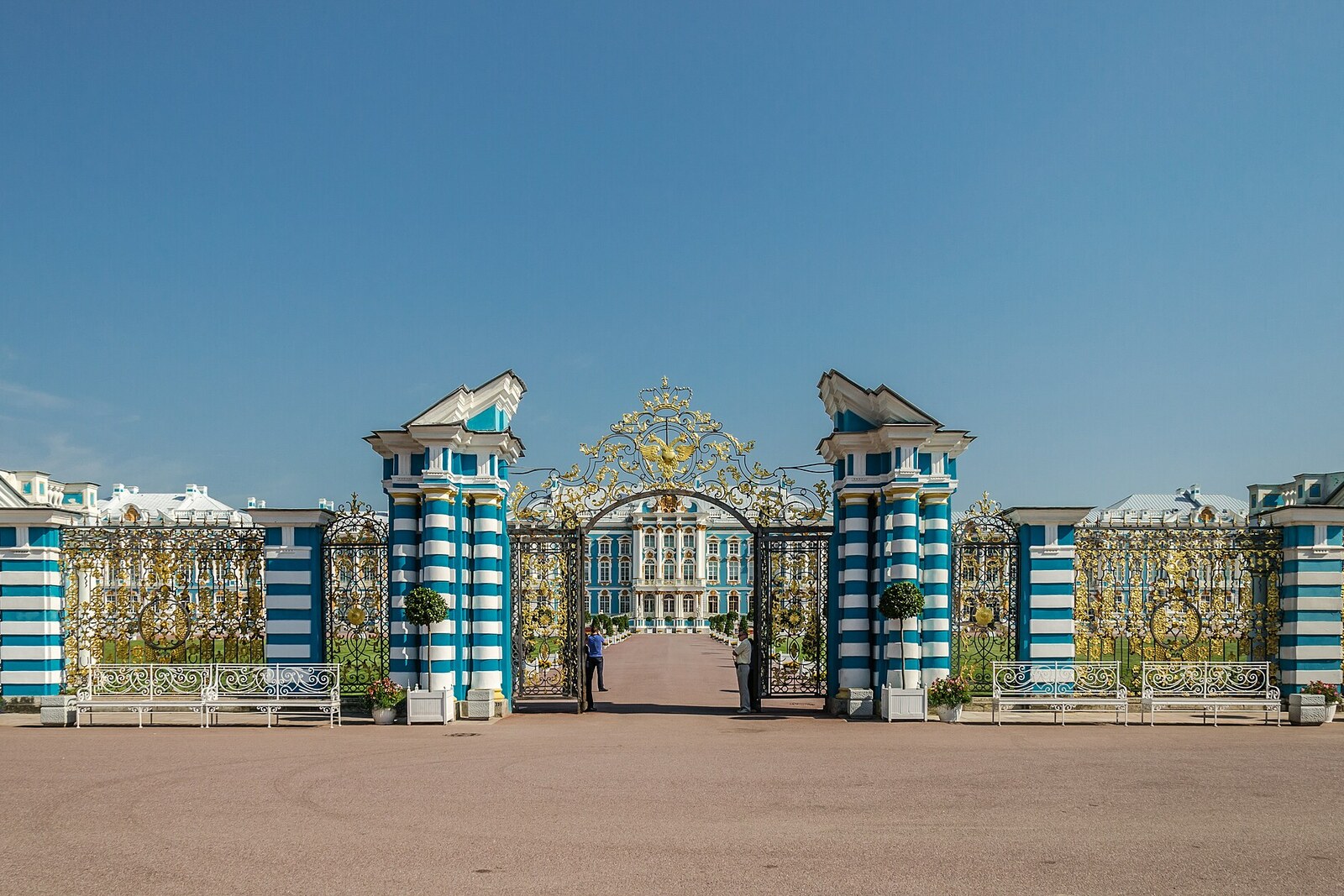
Look around first
What to notice
- The three-hundred-meter azure façade
- The gilded grille of the gate
- The semicircular service buildings
- Old and newly forged details
The story of the place
Catherine Palace is named after Catherine I, the wife of Peter I. A small stone summer house was built here for her. Its dimensions still determine the central section of the current building, although the first palace can no longer be made out behind the three-hundred-meter façade.
The residence acquired its present scale under their daughter, Empress Elizabeth of Russia. She wanted to receive the court and foreign ambassadors here, hold celebrations, and appear before guests in surroundings comparable to the residences of European monarchs. In May seventeen fifty-two, Elizabeth ordered everything built earlier to be rebuilt. The architect Francesco Bartolomeo Rastrelli joined the old buildings with a single façade, ran a sequence of ceremonial halls through the palace, and completed the work by the summer of seventeen fifty-six.
The Golden Gate stands on the central axis of this design. It leads to the ceremonial courtyard between two semicircular service buildings. The name is literal: the wrought-iron grille was decorated with gilded details. Through this entrance, a guest immediately entered the order of court life—first an enclosed parade ground, then the palace, the grand staircase, and the halls where the residents of the palace decided whom to receive and how long to keep them waiting.
After twenty-eight months of occupation, only charred walls remained of this sequence. The ceilings and roofs had collapsed, the interior decoration of most halls had perished, and the gate was deformed and lost part of its wrought-iron decoration. The palace was adapted for temporary use for several years, and full-scale restoration did not begin until nineteen fifty-seven.
The project was led by the architect Alexander Kedrinsky. His task was to restore the palace as a museum, although entire interiors had to be reconstructed from prewar photographs, inventories, drawings, and recovered fragments. Kedrinsky worked in a tiny room with two staff members. Funding was insufficient and materials arrived irregularly, so one hall could be finished while the neighboring one remained empty for years.
In nineteen sixty-three, Yakov Kazakov arrived here—an artist who headed the team restoring the lost ceiling paintings. According to staffing records, masters of monumental painting were then listed as painters of the fourth or fifth grade. They received ordinary workers' wages, but had to relearn the techniques of eighteenth-century painters and restore vast compositions for the Great Hall and the Golden Enfilade from the few surviving records.
Kazakov spent more than twenty-five years on this work. He died at the entrance to the palace. His colleagues remembered his last words as an instruction: “New canvases need to be ordered.” By then, the Great Hall and the restored section of the Golden Enfilade had already been open to visitors for eight years; his team continued the work without him.
The Golden Gate was also reassembled after the war: some eighteenth-century details were preserved, while the lost ones were forged anew. In twenty nineteen, restorers again covered about three thousand five hundred elements of the grille with gold leaf. Behind them stands the palace with Kazakov's ceiling paintings; within the gate itself, old iron and postwar work are joined under a single layer of gold.
Useful on site
Palace: 10:00–18:00, ticket office until 16:45, entry until 17:00; closed Tuesday. Catherine Park is open 07:00–22:00 from 20 April to 31 August; paid admission applies 09:00–19:00.
Checked: June 24, 2026. Check the official source before visiting.It is not necessary to enter the palace: from outside, its scale, the theatricality of the façade, and its proximity to the Lyceum are clearly visible. The interiors require a separate decision.