 Guide On Map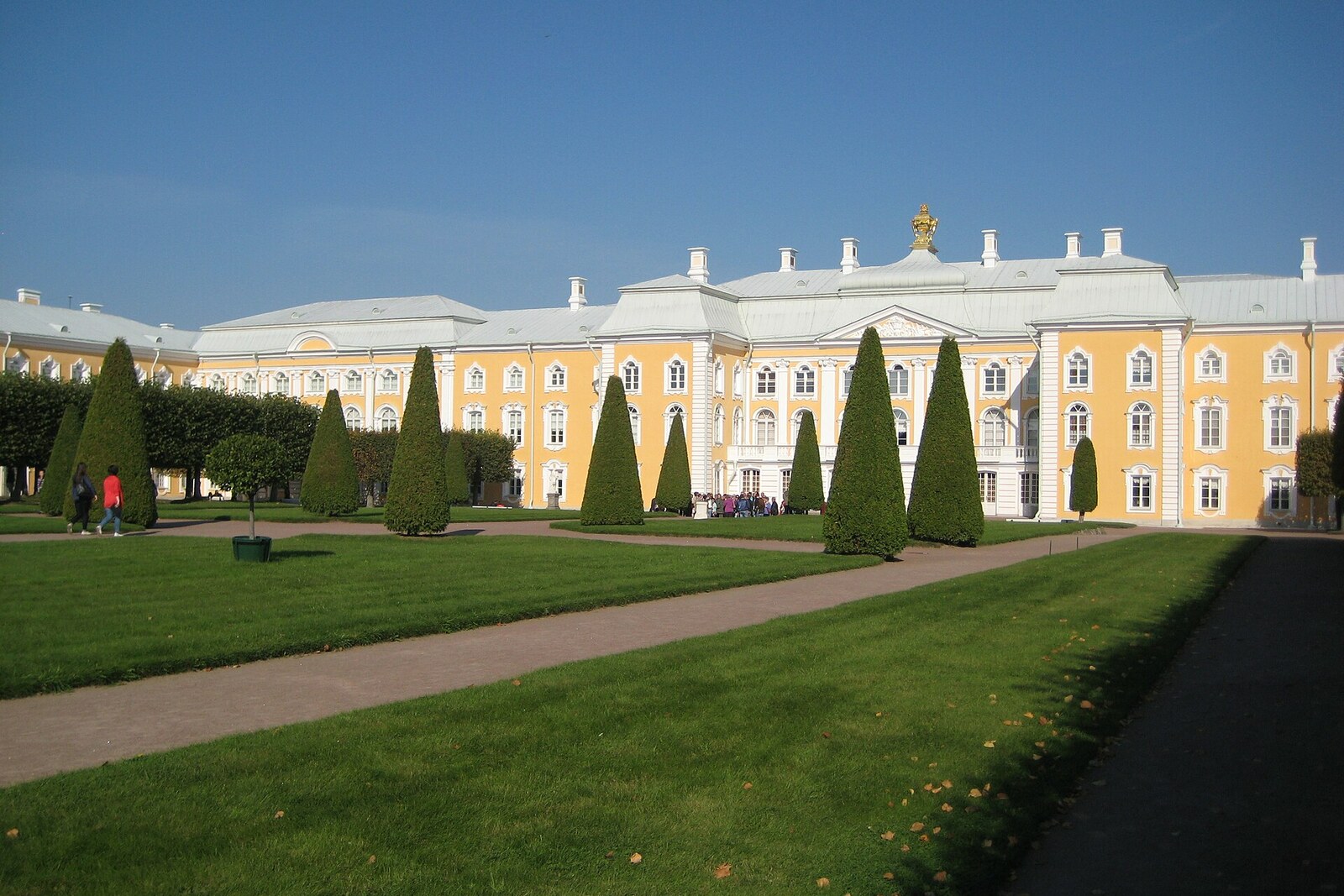
Look around first
What to notice
- The long Upper Garden facade
- Two domes above the side wings
- The vase above the central pediment
- The facade relief
The story of the place
Grand Peterhof Palace stands at the edge of the terrace between the Upper Garden and the Lower Park. On the landward side, the Upper Garden served as the ceremonial approach to the main building of the imperial residence. It is now a museum. The decision to restore this role to the palace was made when all that remained were burnt-out walls.
In January nineteen forty-four, civil engineer Nikolai Belekhov arrived to inspect the newly liberated Peterhof. He received a state salary as head of the Leningrad monument-protection inspectorate; saving damaged buildings was his profession. Belekhov was thirty-nine years old. During the years of the siege, he had grown used to assessing destruction, but here, even stepping off a cleared road meant entering mined territory.
Grand Peterhof Palace had burned down as early as September nineteen forty-one. During their retreat, German troops blew up its central section. The roofs, domes, windows, and floor slabs were gone; the side wings stood as empty shells. On March twenty-first, nineteen forty-four, Belekhov chaired a conference on the fate of the suburban palaces. He said: “We will restore the palace facades for the most part—there can be no other opinion on that.”
Behind this phrase lay a dispute over what would be inside. The country lay in ruins, and Leningrad’s leadership agreed to spend funds on the exterior shell while adapting the rooms for recreation. One proposal gave the Throne Hall over to a restaurant and the neighboring Chesme Hall to a serving line. A new staircase was to be run through the Picture Hall, with a billiard room installed on the floor above. The historic enfilades would have had to be cut through with corridors, restrooms, and service rooms.
Belekhov rejected three such proposals. He insisted on preserving the old layout and restoring at least some of the ceremonial halls. On September fourteenth, nineteen forty-eight, his position was formalized by a government decree on restoring Grand Peterhof Palace as a historical and architectural monument. A new project was prepared by the architects Vasily Savkov and Yevgenia Kazanskaya.
From nineteen fifty-one to nineteen fifty-eight, restorers cleared rubble, reinforced the foundation, raised the walls and roof, and recreated the domes, high-reliefs, and the vase above the central pediment. For the relief on the Upper Garden facade, they used plaster fragments that had survived the fire and prewar photographs. Belekhov died on February seventh, nineteen fifty-six, while the work was still under way. He was fifty-one years old. The museum opened its first restored halls in May nineteen sixty-four.
The facade facing the Upper Garden was recreated according to the postwar project; behind it, the historical sequence of rooms has been preserved. The restaurant in the Throne Hall and the billiard room above the Picture Hall remained on paper.
Useful on site
The facade is accessible during Upper Garden hours, 09:00–21:00; the interiors admit individual visitors in separate time slots.
Checked: June 24, 2026. Check the official source before visiting.An exterior inspection is enough for this stop. Do not try to combine the account with a visit to the halls: the interior requires separate time and its own entry procedure.