 Guide On Map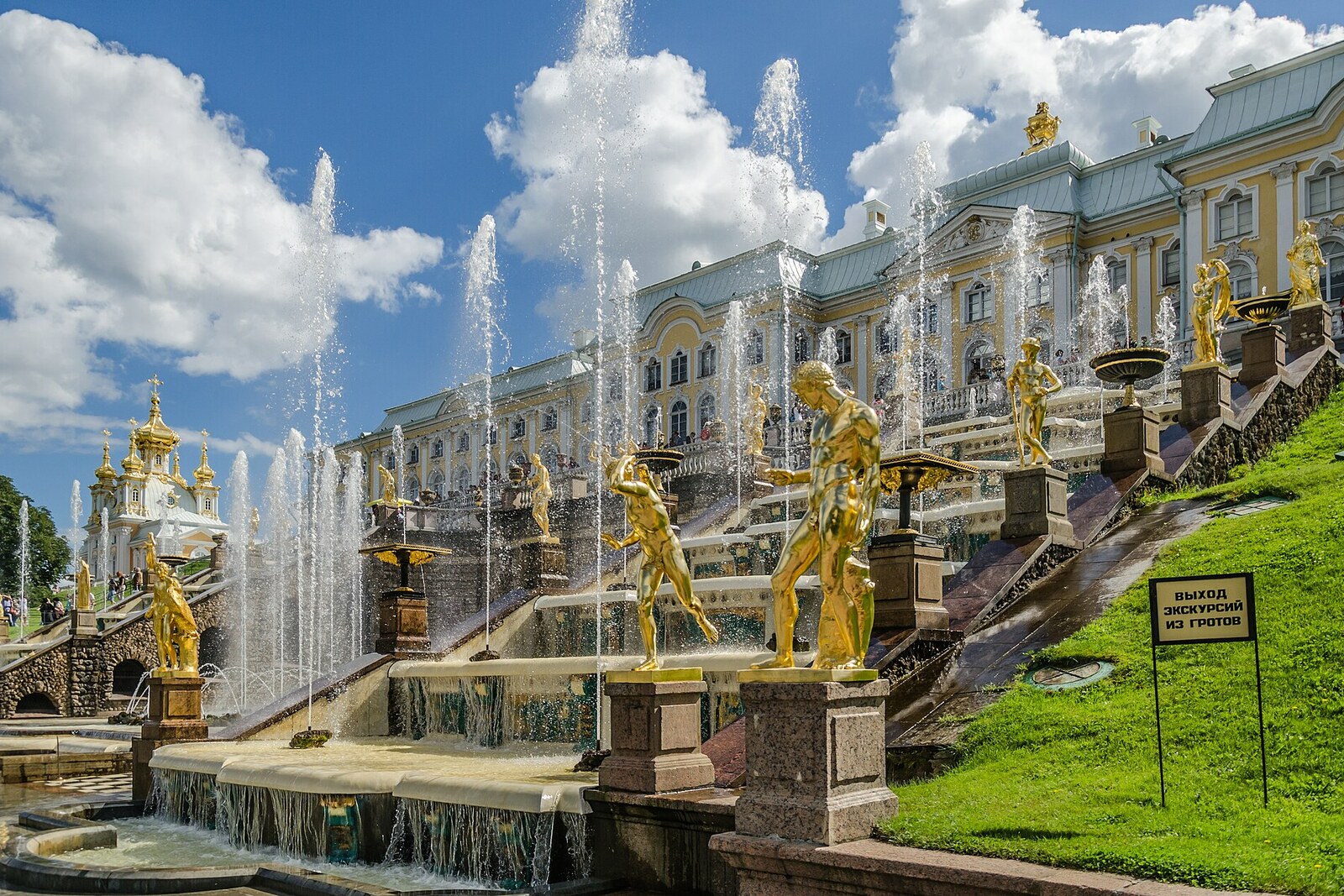
Look around first
What to notice
- Two seven-step waterfall staircases
- The grotto beneath the palace terrace
- Gilded sculptures
- Nozzles on the fountain pipes
The story of the place
At the beginning of the war, museum staff removed the nozzles from the Grand Cascade's fountain pipes—small fittings that determine the height, direction, and shape of every jet. They hid them here, in the grottoes inside the cascade. German occupying troops found the hiding place and took the nozzles away. Water could be sent through the pipes again, but without these parts the former pattern of the fountains could not be restored.
After the liberation, Pavel Vasilyevich Lavrentyev, an experienced Peterhof fountain specialist, took on the fittings. It was his craft: he knew how the slightest scratch on a nozzle head could make a jet veer off or break apart. Lavrentyev made new nozzles together with his son Pavel and passed his techniques on to him right as they worked. Father and son made hundreds of fittings. In the summer of nineteen forty-six, the Grand Cascade was put back into operation—eighteen years before the first restored palace halls opened.
A nozzle gives the water its pattern, but the pressure comes from far away. This problem had to be solved while Peterhof was still being built. The architect Jean-Baptiste Le Blond proposed lifting the water with mills. Pyotr I looked for sources higher than Peterhof in order to use the natural difference in elevation.
Vasily Tuvolkov, a young hydraulic engineer who had just returned after five years of state-funded study in Holland and France, was entrusted with bringing in the water. Such students were called Peter's pensioners. Tuvolkov served in the Admiralty Collegium as a “machinist,” the term then used for an engineer of waterworks. He laid out the route from the Ropsha Heights to reduce earthworks, designed dredgers and dewatering machines, and supervised the soldiers, who numbered up to two thousand on the canal each day.
In August seventeen twenty-one, Pyotr personally knocked out the sluice gate at the beginning of the canal with a spade. By six o'clock the following morning, the water had reached Peterhof, and it was sent through the Grand Cascade. After that, Pyotr entrusted Tuvolkov with the design of an even longer canal along the shore to St. Petersburg. The engineer did not live to finish it: he died in seventeen twenty-seven.
Even now, the water begins its journey about twenty-five kilometers to the south, in the Ropsha Heights. The difference in elevation there exceeds one hundred meters, so the cascade needs no pumps. It is called Grand because it is Peterhof's largest fountain structure: two seven-step waterfall staircases curve around the grotto and descend from the palace terrace into the Lower Park. Pyotr chose this point as the end of the ceremonial route from the gulf as well: water falls into the basin from which the Sea Canal begins.
Even with gravity flow, the jets have to be adjusted all day. The fountain team of the Peterhof State Museum-Reserve has thirty-two members. Every day, they turn about three hundred sluice gates; sixty percent of these parts were made in the eighteenth and nineteenth centuries. Over the course of a day, the water jets are adjusted ten to fifteen times because the pressure in the pipes changes. If a jet goes off course, a fountain specialist takes a wooden mallet and adjusts the lead nozzle head—the very small part that Pavel Lavrentyev and his son made anew after the war.
Useful on site
Lower Park April 25–October 18, 2026: 09:00–20:00, admission until 19:45; fountains 10:00–19:45.
Checked: June 24, 2026. Check the official source before visiting.Compare the views from above and below: from above, the space looks subordinated to a single line; from below, the palace looms over the water. At the edge of the jets, allow for spray and wind.