 Guide On Map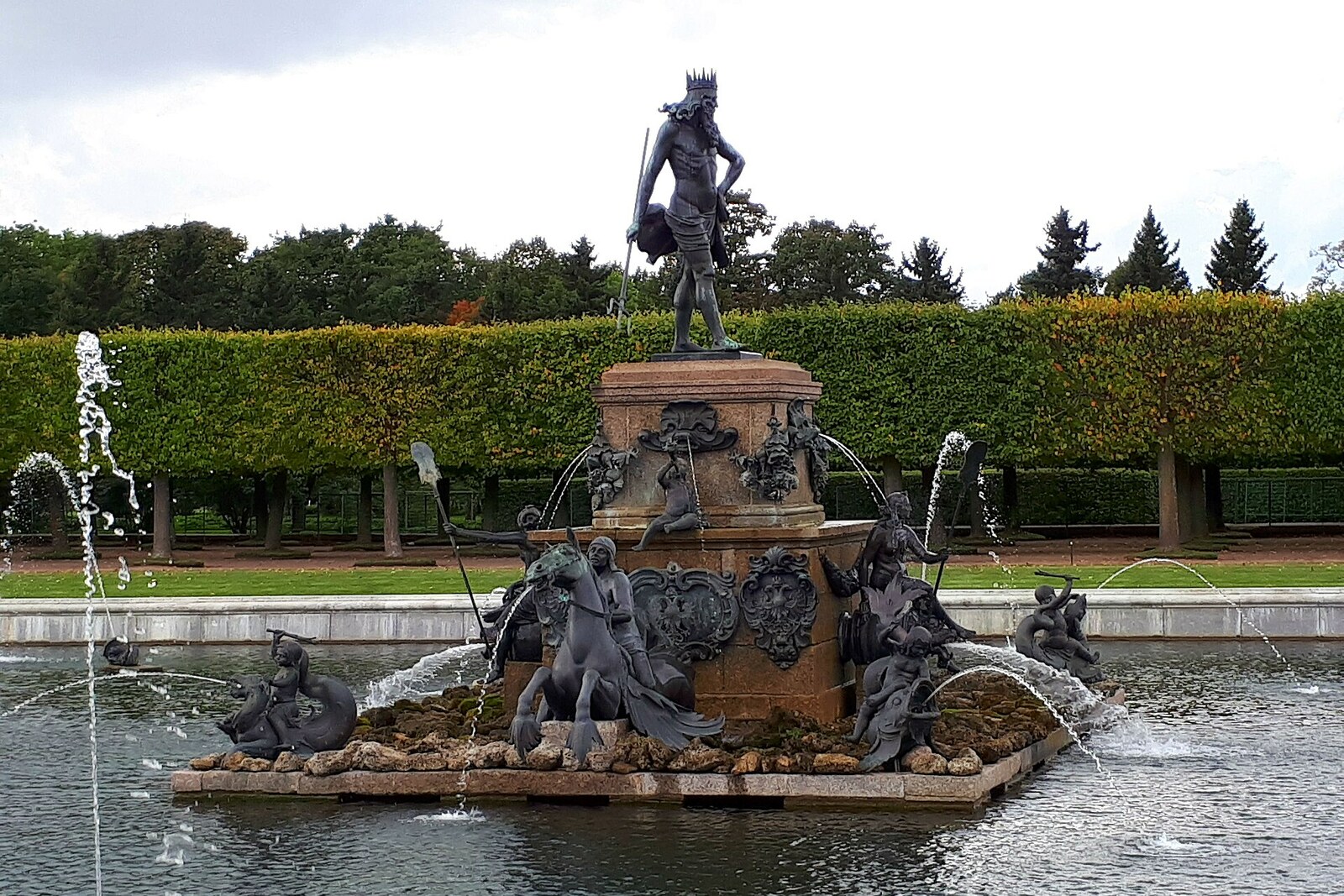
Look around first
What to notice
- The figure of Neptune with a crown and trident
- Riders on sea horses
- Relief coats of arms of Nuremberg
- Lead dolphins
The story of the place
In the main pool of the Upper Garden, a bronze retinue of the sea is assembled: Neptune, with a crown and trident, rises above a granite base; nearby, riders gallop on sea horses, while nymphs, tritons, and dolphins crowd together. This basin was previously occupied by Neptune's Cart, a gilded lead chariot; the soft metal was warped by Peterhof's frosts and heat. The new figures were arranged around the pedestal, while several lead dolphins from the former decoration were left among the bronze.
In December nineteen forty-one, German art historians were deciding what to remove from occupied Peterhof. They worked for the Einsatzstab Reichsleiter Rosenberg, a Nazi organization that selected cultural valuables for shipment to Germany. Among the fountain bronzes, the experts singled out this very Neptune. The decisive argument was the shields bearing the coats of arms of Nuremberg on its pedestal.
The coats of arms explain the origin of the entire group. After the Thirty Years' War, the Nuremberg City Council commissioned a fountain to commemorate the peace that had been concluded. The sculptor Georg Schweigger and the goldsmith Christoph Ritter created Neptune with a crown and trident, riders on sea horses, nymphs, tritons, and dolphins. The commission was intended for the city's main square: the Roman god of the seas was to stand above a large public fountain, while the coats of arms at his feet identified the commissioning city.
When the casting was complete, it became clear that installation, the water supply, and the necessary pressure would be too expensive for war-ravaged Nuremberg. The bronze figures were moved to a construction yard. Schweigger and Ritter died without ever seeing their work operate as a fountain.
For more than a century, the city council looked for a buyer. In seventeen ninety-seven, debt-ridden Nuremberg sold the composition to the Russian Emperor Paul the First for thirty thousand silver rubles. A place for it was already ready in Peterhof. In the central basin of the Upper Garden stood Neptune's Cart, a gilded lead work by Bartolomeo Carlo Rastrelli, but temperature fluctuations bent and destroyed the soft metal. Paul ordered it replaced with the Nuremberg bronze. The architect Franz Brauer rearranged the figures around a granite pedestal, retaining several lead dolphins from the former decoration. In seventeen ninety-nine, the composition conceived as Nuremberg's Peace Fountain received a permanent basin in Peterhof for the first time.
A century and a half later, its German origin was turned into grounds for its theft. In nineteen forty-two, fountain workers dismantled the group, packed its parts into twelve crates, and sent them to Nuremberg. The crates were hidden in a bunker beneath the old town.
After the war, Lieutenant Colonel Georgy Gulyayev, head of the Soviet restitution department, searched for museum valuables that had been taken away. When he learned that Neptune remained somewhere in Germany, he ordered storehouses and hiding places to be checked. The search continued for a year and a half, until word came from the American occupation zone about massive crates in one of Stuttgart's basements. In nineteen forty-seven, the twelve crates returned to Peterhof. Fountain workers reassembled the group in its former place, and in nineteen fifty-six they turned the water on again.
The bronze original stands before you. Nuremberg has a copy, cast from molds taken from the Peterhof figures as early as the end of the nineteenth century. The relief coats of arms of Nuremberg, once used to justify the fountain's removal, were restored on its Peterhof pedestal after they had been lost.
Useful on site
Upper Garden: daily 09:00–21:00, entry until 20:45, free; fountains in season 10:00–19:45.
Checked: June 24, 2026. Check the official source before visiting.Walk around the basin and be sure to view the composition from the palace side: from there, its tall central figure and the movement radiating around it are easier to make out.