 Guide On Map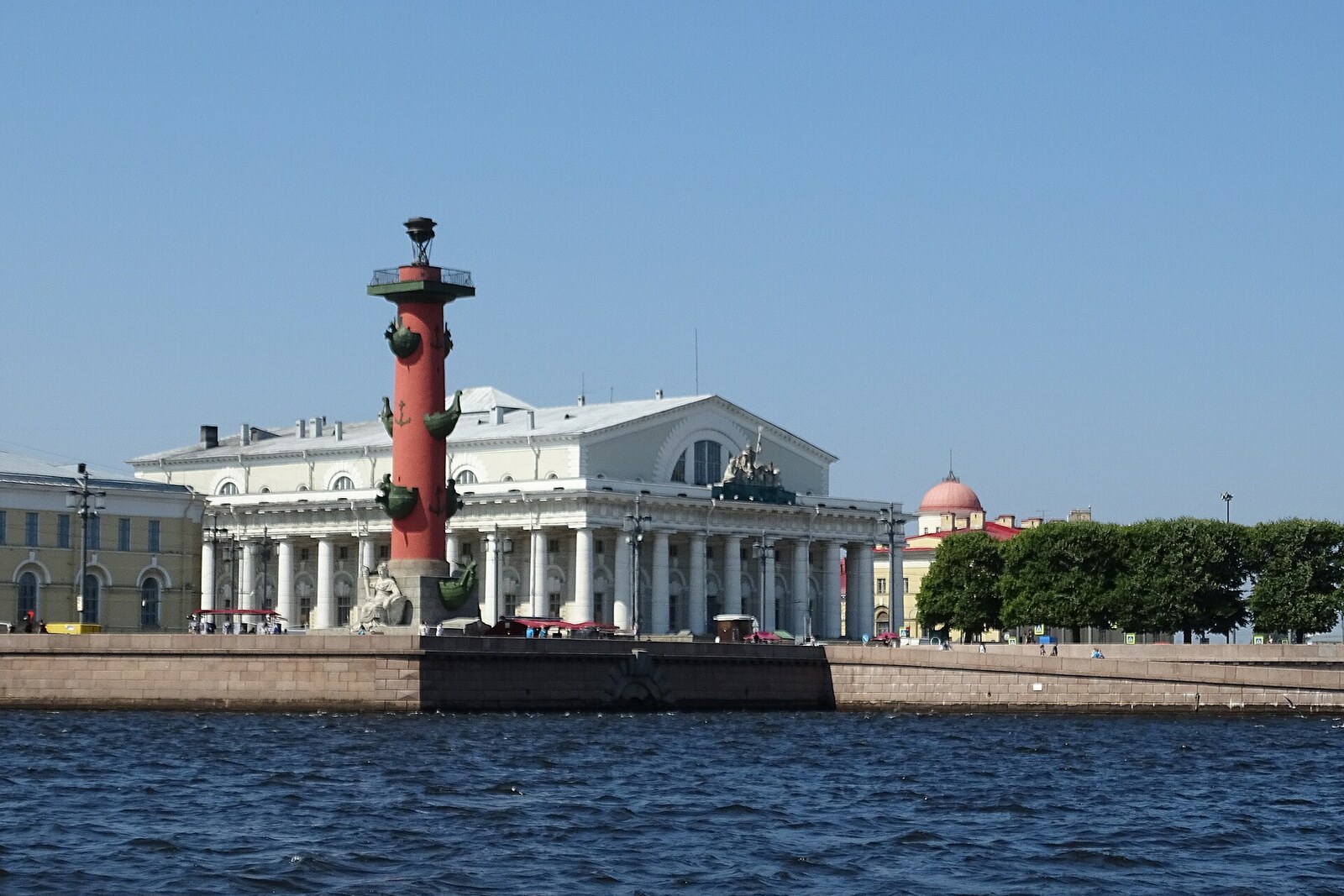
Look around first
What to notice
- The Stock Exchange
- Rostral Columns
- The semicircular granite edge
- Granite stairways
The story of the place
The Spit is the eastern end of Vasilevsky Island, where the Neva divides into the Bolshaya Neva and the Malaya Neva. The island's name has no reliably established namesake. According to a well-known legend, Pyotr I addressed orders to the artillery officer Vasily Korchmin with the words, “To Vasily on the island.” Korchmin did exist, but the island was already called Vasilevsky in a scribe book of fifteen hundred. Which Vasily the name preserves is unknown.
In seventeen thirty-three, the Commercial Port and the customs office were moved here from Trinity Square on what is now the Petrograd Side. Ships arriving from abroad unloaded along the Malaya Neva, goods went to warehouses, and merchants made wholesale deals and insured ships. At the beginning of the nineteenth century, about half of Russia's imports and exports passed through the Saint Petersburg port and the Stock Exchange. So the huge building between the river's two branches was intended for a thoroughly practical purpose: here people agreed on the price of grain, flax, hemp, sugar, metal, and entire shiploads.
Giacomo Quarenghi, the court architect commissioned to replace the wooden commercial building, began building the first stone Stock Exchange. By seventeen eighty-seven, workers had driven ten thousand piles into the ground and erected the walls. Then construction stopped. The merchants contributing to the costs and expecting to trade inside did not accept the design. Quarenghi was asked to redesign the building, but he refused to yield to their tastes. For almost twenty years, an unfinished shell stood above the port.
Jean-François Thomas de Thomon, who had recently arrived in Saint Petersburg, saw it. Known chiefly as a draftsman, he taught perspective and architecture at the Academy of Arts and sought the opportunity to build an entire ensemble here. The Academy Council wanted to cut costs and required Quarenghi's walls to be kept. Thomas de Thomon complied: in his first two designs, he tried to incorporate the foreign shell into his project. But then the Stock Exchange could not be placed exactly in the middle of the point, and the port's two sides remained disconnected.
Alexander Stroganov, president of the Academy of Arts, tried to reconcile the architects while also saving the money already spent. The unfinished Stock Exchange was put up for auction: the buyer could dismantle it or adapt it for another purpose. No one came forward. After that, permission was given to demolish the old walls. Quarenghi never forgave Thomas de Thomon for destroying his work; contemporaries remembered their hostility for many years.
With a clear site at his disposal, Thomas de Thomon oriented the new Stock Exchange along the island's central line. The shore in front of it was extended into the Neva by about one hundred twenty-three meters, raised with fill, and faced with granite. This gave the sharp natural point its present semicircular edge. On either side, the architect placed two columns bearing rostra—depictions of ships' prows. In ancient Rome, such prows decorated monuments to naval victories; here the columns also marked the two river passages of the Commercial Port.
The main work was completed in eighteen ten, but the Stock Exchange opened only six years later. Thomas de Thomon did not live to see it. In eighteen eleven, he fell from a fire-damaged wall of the Bolshoi Theatre, was ill for a long time, and died in eighteen thirteen. The ceremonial opening took place on July fifteenth, eighteen sixteen.
The area by the granite stairways, where people now stand, was water in Quarenghi's time. Quarenghi's Stock Exchange is no longer here, but during its demolition about two million bricks were saved and laid into Thomas de Thomon's building.
Useful on site
The outdoor area is usually accessible around the clock; the Stock Exchange building is not a public stop on this route, and restoration areas may alter access routes and the view of the facade.
Checked: June 24, 2026. Check the official source before visiting.The best overall view requires stepping back a little from the individual objects. If part of the Stock Exchange is hidden by restoration work, focus on the columns and the outline of the ensemble.